

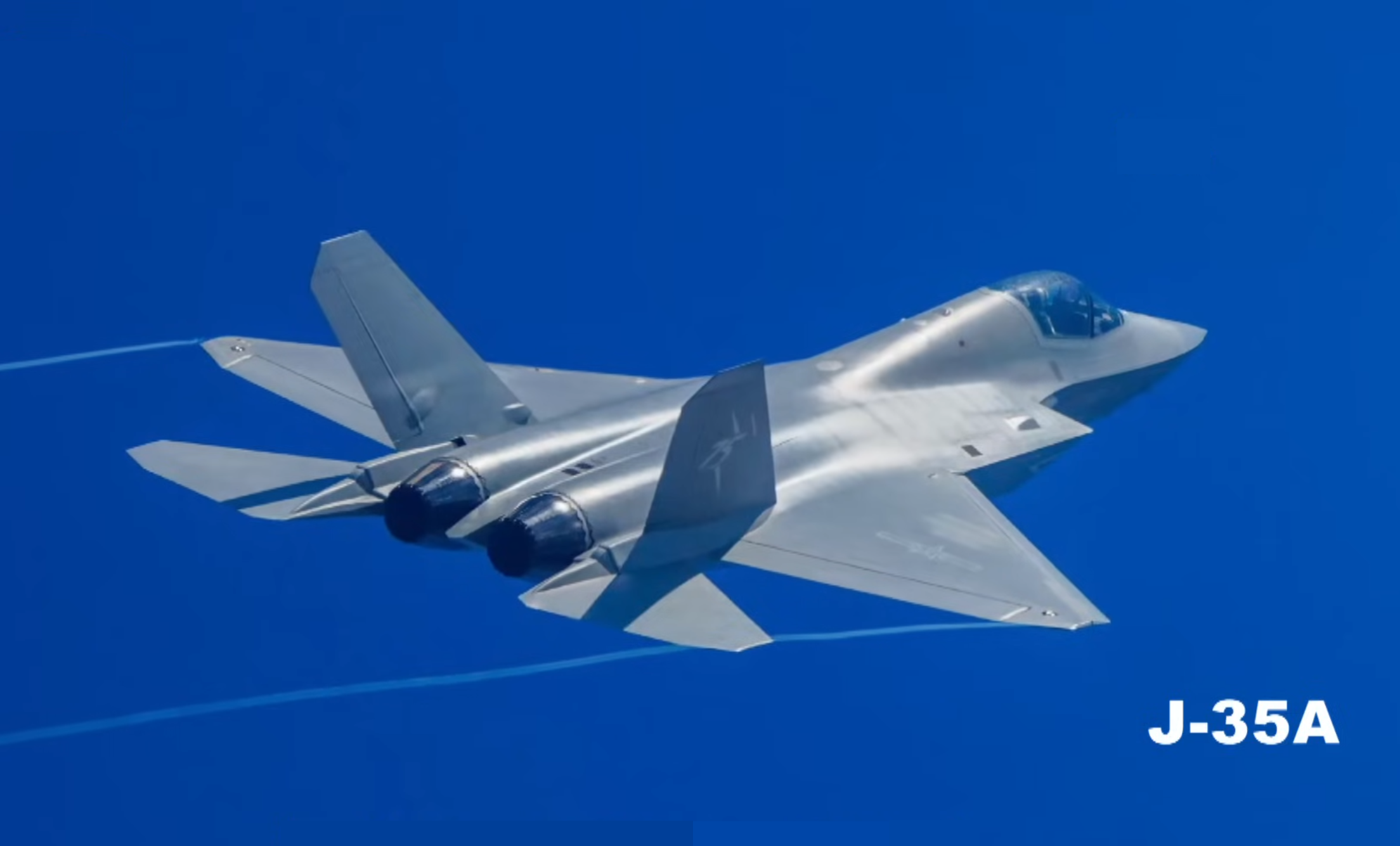
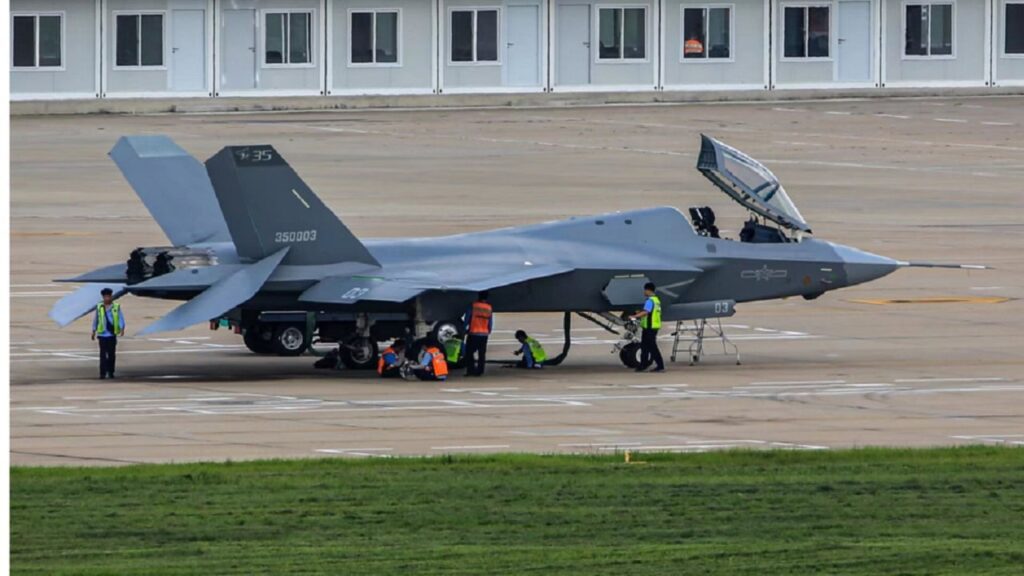
A recent program aired on China’s state-run broadcaster CCTV 13 revealed that the country has entered serial production of its fifth-generation J-35A stealth fighter jet. Footage from the Shenyang Aircraft Corporation facility showed at least five to six J-35 airframes in various stages of assembly. One of the aircraft was marked with a serial number such as “040070,” indicating it belongs to the fourth production batch—confirming that the aircraft has moved beyond prototype status.
Previously, in May 2025, leaked photos showed green-primed J-35 airframes, typical of early production units, attracting attention online.
Inducted into PLAAF: Operating Alongside the J-20
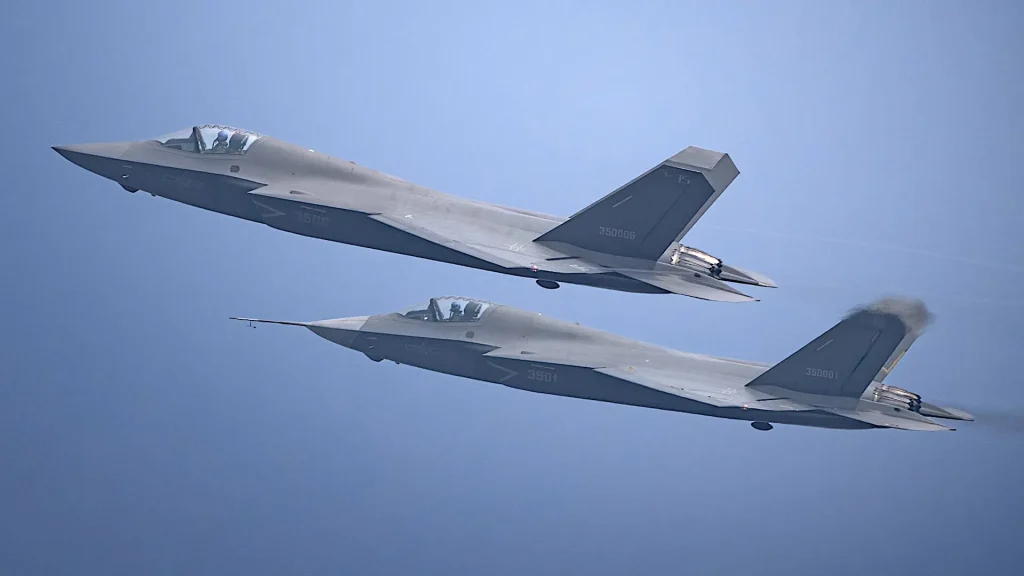
According to military analyst Andreas Rupprecht, aircraft numbered “61820” and “61821” have been delivered to the 1st Air Brigade of the People’s Liberation Army Air Force (PLAAF), located near Shenyang under the Northern Theater Command. This brigade also operates the J-20, making China the second country after the U.S. to simultaneously deploy two distinct fifth-generation fighters.
Technical Features and Integration
While the J-20 serves as a long-range air superiority platform, the J-35A offers a smaller and more cost-effective alternative. It is equipped with modern data links, distributed aperture targeting systems, radar-absorbent coatings, a digital cockpit, and network-centric warfare capabilities. Analysts believe the PLAAF is building a four-tiered fighter force composed of the J-10C, J-16, J-20, and J-35A for both defensive and offensive operations.
China plans to display these aircraft at the September 3, 2025 military parade, marking the 80th anniversary of the end of World War II. The event is expected to showcase hypersonic missiles, electronic warfare systems, and various unmanned aerial vehicles.
Development Journey: From FC-31 to J-35A
The J-35A is based on the FC-31 “Gyrfalcon” demonstrator, initially developed by Shenyang Aircraft Corporation for the export market. The FC-31’s first flight took place on October 31, 2012, and a revised prototype (31003) was unveiled in 2016 with updated inlets, vertical stabilizers, and a redesigned canopy. Interest from the PLA led to the development of two versions: the carrier-based J-35 and the land-based J-35A.
The J-35A made its maiden flight on September 26, 2023, and was officially introduced at the 2024 Zhuhai Airshow, bearing the number “75” and the PLAAF insignia. Chief designer Wang Yongqing stated that the aircraft can share radar data with other platforms and integrate into broader defense networks.
Technical Specifications: A Medium-Weight Networked Fighter
According to open-source data, the J-35A is a medium-weight, twin-engine stealth fighter with internal weapons bays, trapezoidal wings, diverterless supersonic inlets, and radar-absorbent surfaces. The aircraft is approximately 17.3 meters long with a wingspan of about 11.5 meters, and its maximum takeoff weight is estimated to be between 25 and 28 tons.
Early prototypes were powered by WS-13E or RD-93-derived WS-21 engines, while future versions may use the more advanced WS-19 engine with supercruise capabilities. The internal payload may include PL-10, PL-15, or PL-17 air-to-air missiles, while external hardpoints can carry additional guided munitions.
The cockpit reportedly features wide-screen digital displays, helmet-mounted targeting systems, AESA radar, infrared search and track (IRST), electronic warfare equipment, and radar warning receivers.
Naval Variant: Compatible with Aircraft Carrier Fujian
In addition to the land-based version, a carrier-based variant of the J-35 is being developed. According to reports from March 2025, the J-35 conducted its first electromagnetic catapult (EMALS) launch from China’s next-generation aircraft carrier, the Type 003 Fujian. The Fujian is equipped with three catapults and can reportedly carry up to 48 J-35 fighters. The Liaoning and Shandong carriers are expected to operate up to 24 J-35s each, alongside J-15 variants modified for electronic warfare missions.
Export Strategy: Targeting Pakistan and the Middle East
China also showcased the J-35A at the 2025 Paris Air Show, signaling its intention to offer the aircraft as an alternative to countries unable to procure the U.S.-made F-35. Reports claimed that Pakistan was offered 40 J-35A units at a 50% discount, with deliveries beginning in 2026. However, Pakistan’s Defense Minister Khawaja Asif dismissed these reports as speculative.
Despite the denial, Pakistan has previously expressed interest in a broader defense package that could include the J-35A, KJ-500 AEW&C aircraft, and HQ-19 missile defense systems. Egypt, Algeria, and Saudi Arabia are also among the potential export markets for the J-35A.
Strategic Implications and Future Outlook
The induction of the J-35A into the PLAAF places China among the few nations capable of fielding two fifth-generation fighters simultaneously—mirroring the U.S. Air Force’s combination of the F-22 and F-35. The J-35A is intended to function within an integrated network including electronic warfare platforms, satellites, UAVs, and AEW&C aircraft, allowing joint operations in contested environments.
While the J-35 bears superficial resemblance to the F-35, analysts caution that its capabilities are not necessarily equivalent. The Chinese fighter features a twin-engine design, dual vertical stabilizers, and different exhaust geometry. Some believe parts of the development may have been accelerated through access to restricted U.S. data, though Chinese sources claim the aircraft is entirely indigenous.
Ultimately, the J-35 serves as more than a military asset—it is also a strategic tool in China’s broader geopolitical ambitions and defense export strategy.
