

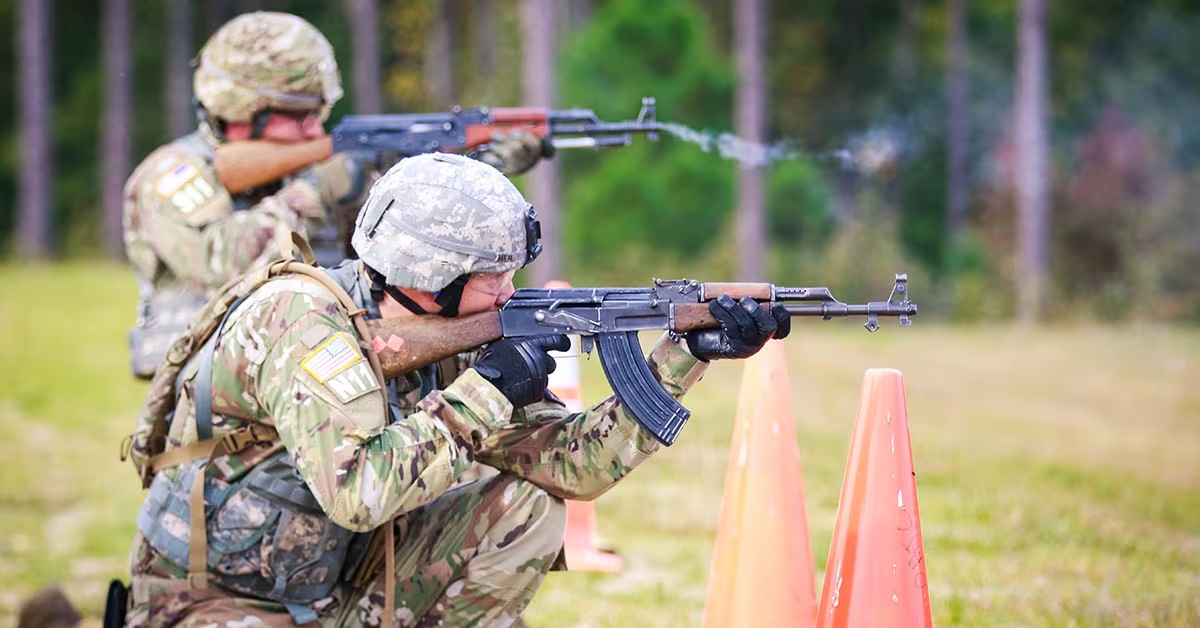
Design and Origin
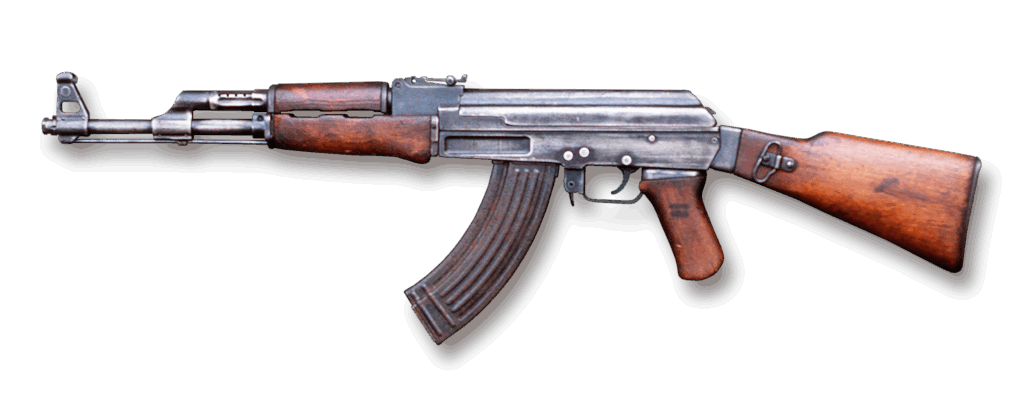
The AK-47 (Avtomat Kalashnikova 1947) is a 7.62x39mm caliber, gas-operated, selective-fire assault rifle developed by Soviet engineer Mikhail Kalashnikov in the mid-1940s. Due to its simplicity, reliability, and low production cost, it has been widely used by both state militaries and irregular armed groups around the world. It was officially adopted by the Soviet Armed Forces in 1949.
Historical Development
The design process began in 1945 with the AK-46 prototype, inspired by the German StG 44 rifle developed during World War II. The rifle underwent its first official tests in 1946, and in 1948 its fixed-stock version was introduced to elite units. By 1949, it was fully integrated into the Soviet Army’s inventory and later adopted by Warsaw Pact countries and allies.
Technical Specifications
- Caliber: 7.62x39mm
- Firing Mechanism: Gas piston, rotating bolt, semi-automatic and fully automatic modes
- Rate of Fire: Approximately 600 rounds per minute
- Effective Range: 300–400 meters
- Magazine Capacity: Standard 30 rounds, optional 40-round or 75-round drum magazines
- Operational Reliability: Functions reliably under extreme heat, mud, sand, snow, and underwater conditions
Advantages of Use
The main strength of the AK-47 is its ability to operate in harsh environments. It requires minimal maintenance and is easy to learn, making it especially suitable for low-tech or difficult terrains. These qualities have made it a preferred weapon for both regular armies and guerrilla or terrorist groups.
Prevalence and Production
It is estimated that approximately 100 million AK-47s and its variants have been produced worldwide. Many countries manufacture licensed or unlicensed copies, including China’s Type 56. Other countries producing a wide range of variants include Poland, Romania, Yugoslavia, India, Iran, Egypt, and Pakistan.
Notable Variants
- AKM: A modernized, lighter, and cheaper version of the AK-47
- RPK: A long-barreled light machine gun variant for support fire
- AK-74: An improved version chambered in 5.45x39mm ammunition
- AK-103 and AK-12: Modern models compatible with NATO ammunition and adapted to current combat conditions
International Users
Today, the AK-47 and its variants are actively used by the armed forces, security units, and paramilitary groups of more than 100 countries. It is also the weapon of choice for countless insurgent and resistance organizations. In the United States and Western Europe, it is often associated with terrorists or organized crime groups.
Cultural and Political Impact
The AK-47 is not just a weapon but also a symbol of ideology and an era. Throughout the Cold War, it appeared on the flags of socialist movements and is featured on Mozambique’s national flag as a symbol of its role in the country’s independence. Its ubiquity has made it an iconic emblem of global conflict.
The AK-47 is not only an engineering achievement but also an icon that has left a profound mark on 20th-century political and military history. Its ease of production, durability, and deadly effectiveness have made it the most widely used firearm in history.
