

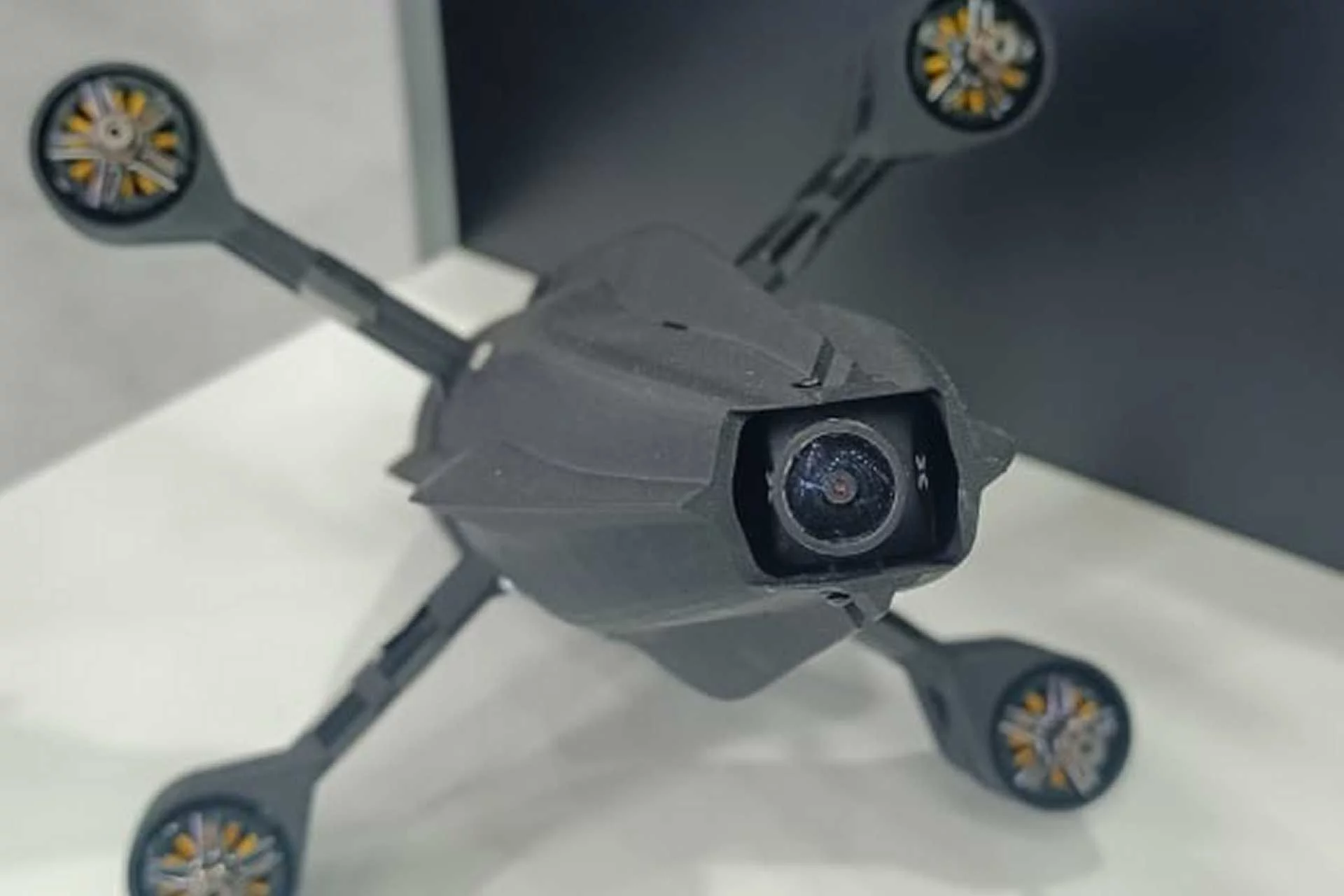
In response to the increasing threat posed by Ukrainian kamikaze drones, Russia has introduced a new kinetic interceptor drone named Kinzhal—not to be confused with its hypersonic missile of the same name. Developed by ASF‑Innovations, this unmanned aerial system is engineered to intercept hostile drones by physically ramming into them, relying on a mid-wave infrared seeker in its nose to track targets based on thermal signatures. With a top speed of 300 km/h, the Kinzhal is optimized for short-range, low-altitude interception missions.
The drone’s design draws parallels to the previously fielded Yolka FPV interceptor, sharing a similar structural framework. Multiple Russian firms contributed to the Kinzhal’s components: Farmplast built the airframe, Pro-Technology supplied the electric propulsion system, Vector manufactured the propellers, and Krait developed the flight electronics. Showcased in prototype form at Innoprom 2025, the Kinzhal may soon mark a transition from experimental stages to pre-production trials, signaling Russia’s intent to field domestically sourced, drone-on-drone defense systems.
Part of a Larger Trend in Interceptor Development
Kinzhal is the latest in a growing list of Russian interceptor UAVs, which also includes the Yolka and Tarantul-Ptitselov. While the Yolka is a fire-and-forget FPV drone designed to autonomously collide with targets, the Tarantul-Ptitselov employs a net-launching system to entangle enemy UAVs mid-flight. Although none of these systems have been adopted at scale yet, their development reflects a broader Russian effort to field a tactical layer of UAV defense capable of addressing low-altitude drone threats.
Cold War Origins, 21st Century Evolution
The concept of drone interceptors has roots in the Cold War, when the U.S. and Soviet Union experimented with unmanned platforms for target practice and limited combat roles. However, early limitations in control, guidance, and propulsion made these systems largely impractical. It wasn’t until the 2010s—spurred by innovations such as Raytheon’s Coyote interceptor—that drone-on-drone combat became a viable defense strategy. The explosive drone warfare seen in Ukraine since 2022 has since catapulted the concept into operational reality.
The Ukrainian Approach: Mass Production and Integration
In contrast to Russia’s still-maturing interceptor programs, Ukraine has rapidly industrialized drone production, reportedly manufacturing up to 200,000 drones monthly, many of them interceptors. Ukrainian forces have integrated ramming-type FPVs into a real-time “Clear Sky” air defense network, combining radars, ground observers, and decentralized drone launch teams. Interceptor variants like the Chief-1, VARTA DroneHunter, and Sting target loitering munitions such as Russia’s Lancet and Geran-2 (Shahed-136).
A Global Race for Drone Interceptors
The need for low-cost, responsive air defense has pushed nations globally to explore drone interceptors. The U.S. has fielded the Coyote Block 2, while private firms like Anduril have developed autonomous kinetic ramming drones. Israel’s XTEND offers manually guided quadcopters, and Fortem Technologies developed a net-launching system used by security forces. European firms, including Latvia’s Origin Robotics, Germany’s Argus Interception, and France’s CERBAIR, are also investing in autonomous drone defenses to protect critical infrastructure and military zones.
How They Work: Reusable vs. Expendable Interceptors
Interceptor drones fall into two categories:
- Expendable systems, like Ukraine’s Sting and Shulika, are low-cost FPVs meant for single-use collisions with enemy drones. Costing between $500 and $5,000, these are effective for defending against low-flying loitering munitions during night raids.
- Reusable drones, such as the VARTA DroneHunter or Tarantul-Ptitselov, are equipped with projectiles or net-based capture systems and can return to base after an engagement.
Reusable platforms offer endurance and repeat-use efficiency, while expendables provide faster reaction at a fraction of the cost—especially critical during saturation attacks.
Limitations and Next-Gen Solutions
Despite their utility, interceptor drones face several operational constraints:
- Limited flight time and range—typically under 30 minutes and within a few kilometers.
- Vulnerability to weather, jamming, and electronic warfare.
- Inability to intercept high-altitude or fast-moving targets like cruise missiles or large UAVs.
To counter these challenges, development is shifting toward AI-assisted guidance, swarm coordination, and integrated detection systems that work alongside traditional air defense networks. Some models are being built to operate with minimal human intervention, decreasing response time and increasing interception success in drone-saturated combat zones.
The Kinzhal Signals a Tactical Shift
The unveiling of the Kinzhal represents a critical pivot in Russia’s response to the drone-centric battlefield of today. As traditional surface-to-air missile stockpiles strain under the demands of modern warfare, kinetic interceptor drones offer an agile, scalable, and domestically produced alternative. Although still in the early phases, the Kinzhal and its sister systems point to a future where UAV-versus-UAV combat becomes a staple of layered air defense.
Russia’s defense industry is now racing not only against time but also against adversaries like Ukraine, which have already operationalized such capabilities at scale. Whether the Kinzhal can transition from prototype to a mass-produced frontline asset will determine its role in the evolving air war of the 21st century.
