

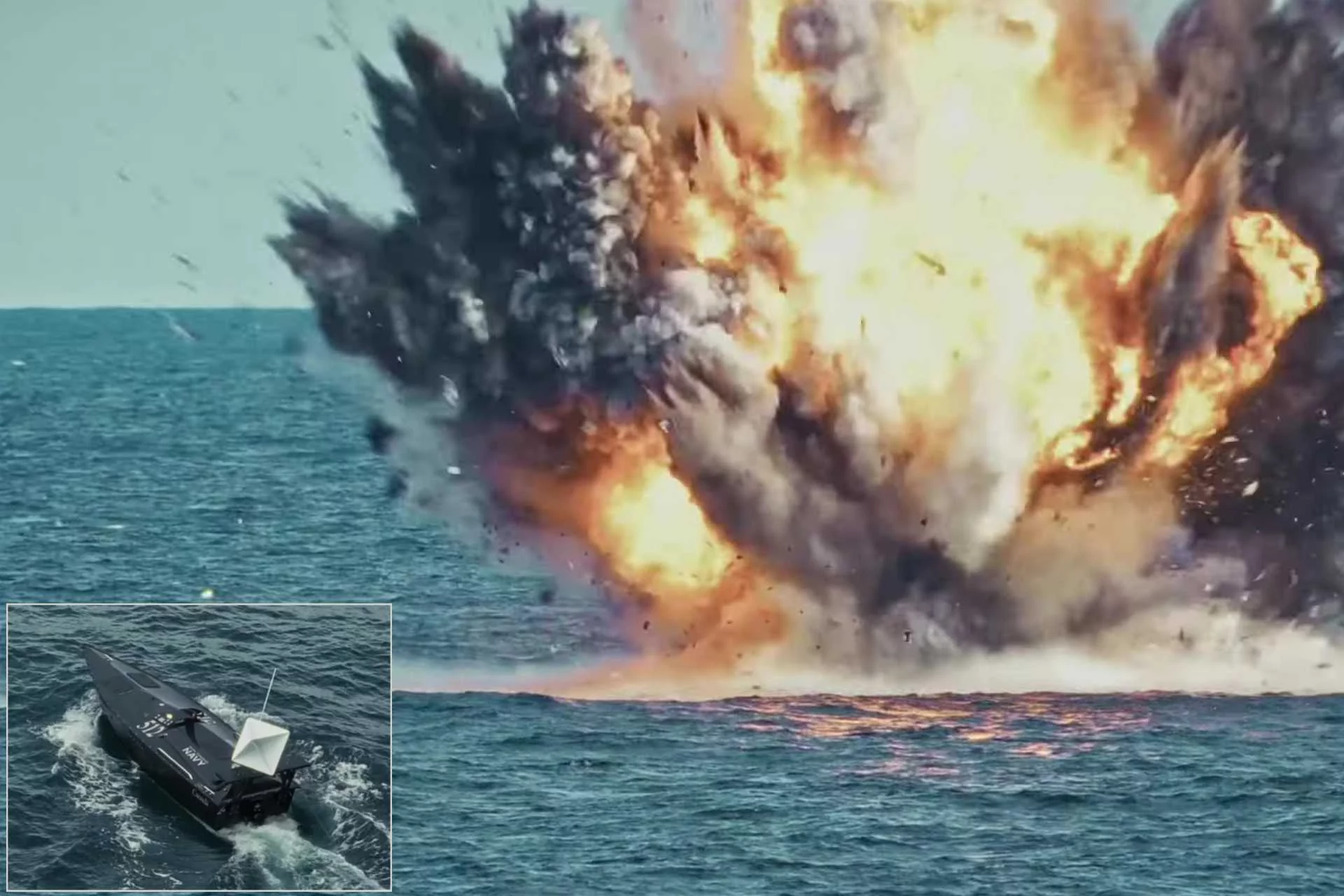
In a first for the Royal Canadian Navy (RCN), an explosive-laden Hammerhead unmanned surface vehicle (USV) was successfully deployed during the 2025 Exercise Trident Fury off Vancouver Island’s west coast. Launched from HMCS Vancouver and remotely piloted via satellite, the kamikaze-style vessel collided with a secondary Hammerhead USV, detonating on impact. This milestone, achieved through close cooperation between the Advanced Naval Capabilities Unit (ANCU), Fleet Diving Unit (Pacific), and HMCS Vancouver’s crew, marks a strategic pivot from the Hammerhead’s prior role as a training target simulating small boat attacks to a potential live-weapon platform.
While officials underline that this demonstration is not yet operationally mature, the trial serves as a proof-of-concept with promising prospects for future development. Vice-Admiral Angus Topshee revealed the concept’s rapid two-month creation utilizing existing in-service assets.
The Hammerhead, designed and built by QinetiQ Target Systems, was originally procured in 2017 to enhance training against swift, littoral threats like pirate skiffs. The 5.2-meter, 900-kg vessel is powered by a 135-horsepower MerCruiser 3.0L engine, achieving speeds up to 40 knots under favorable sea states. Capable of solo operation or functioning as part of swarms of up to 40 units, the Hammerhead can perform a variety of attack simulations including straight-line runs, zigzag patterns, and evasive maneuvers, controlled via both line-of-sight and over-the-horizon links. Its modular payload options encompass visual sensors, radar signature enhancements, and infrared emitters. Until now, it served as a valuable tool for testing missile systems such as Harpoon, Exocet, and Phalanx before entering this new experimental phase as an armed unmanned attacker.
This development echoes the RCN’s growing focus on asymmetric maritime warfare capabilities, inspired by Ukraine’s effective use of uncrewed explosive boats against Russia’s Black Sea Fleet — a tactic demonstrating cost-efficient precision strikes on larger naval targets. Canadian naval leadership, including Capt. Pedram Mohyeddin, describes the trial as a scalable demonstration of repurposing existing assets to deliver remote explosive payloads, successfully proving the concept’s feasibility.
Canada’s expansive 243,000-kilometer coastline and limited domestic shipbuilding capacity have fueled interest in affordable, adaptable naval platforms. Much ship repair and construction has been outsourced overseas, highlighting the potential value of developing indigenous uncrewed surface vessels. The Advanced Naval Capabilities Unit, evolved from specialized naval teams, is at the forefront of integrating these unmanned systems across maritime domains, managing missions ranging from high-risk boarding to port defense and ISR operations. Its personnel specialize in rapidly adopting new technologies and training methodologies for uncrewed air, surface, and subsurface platforms.
Parallel to these efforts, Canada’s long-term defense strategies emphasize enhanced surveillance and security, particularly in the Arctic and other contested waters. Autonomous maritime systems, or “ghost fleets,” are under active study for deployment in areas where crewed vessels face operational challenges. Industry leaders and defense analysts advocate for optionally-crewed vessels and NATO-compatible interoperability. Canadian tech firms such as OSI Maritime Systems and Kraken Robotics are innovating in AI navigation and autonomous underwater vehicles, promising to bolster a domestic supply chain should Canada expand production of armed or surveillance USVs.
Historically, the concept of explosive-laden unmanned boats stretches back over a century, from Germany’s WWI wire-guided motorboats to WWII’s Italian and German manned and remote-controlled explosive craft. The first modern fully uncrewed suicide boat attack was recorded in 2017 when Houthi forces targeted the Saudi frigate Al Madinah in the Red Sea. Ukraine’s recent deployment of kamikaze USVs against Russian naval forces has rekindled global interest in this asymmetric maritime capability.
Today, kamikaze USVs are increasingly recognized as game-changing assets with significant strategic and tactical impact. Inspired by Ukraine’s success, NATO countries including Canada, the U.S., and the U.K. are testing similar platforms or concepts. Meanwhile, Middle Eastern and Chinese forces continue advancing their own autonomous maritime strike technologies, viewing them as cost-effective tools to operate in contested maritime zones with minimized risk to personnel. Though human oversight remains standard for lethal missions, the rising presence of kamikaze USVs is prompting fresh debate about naval warfare doctrines, deterrence postures, and escalation risks in future maritime conflicts.
