

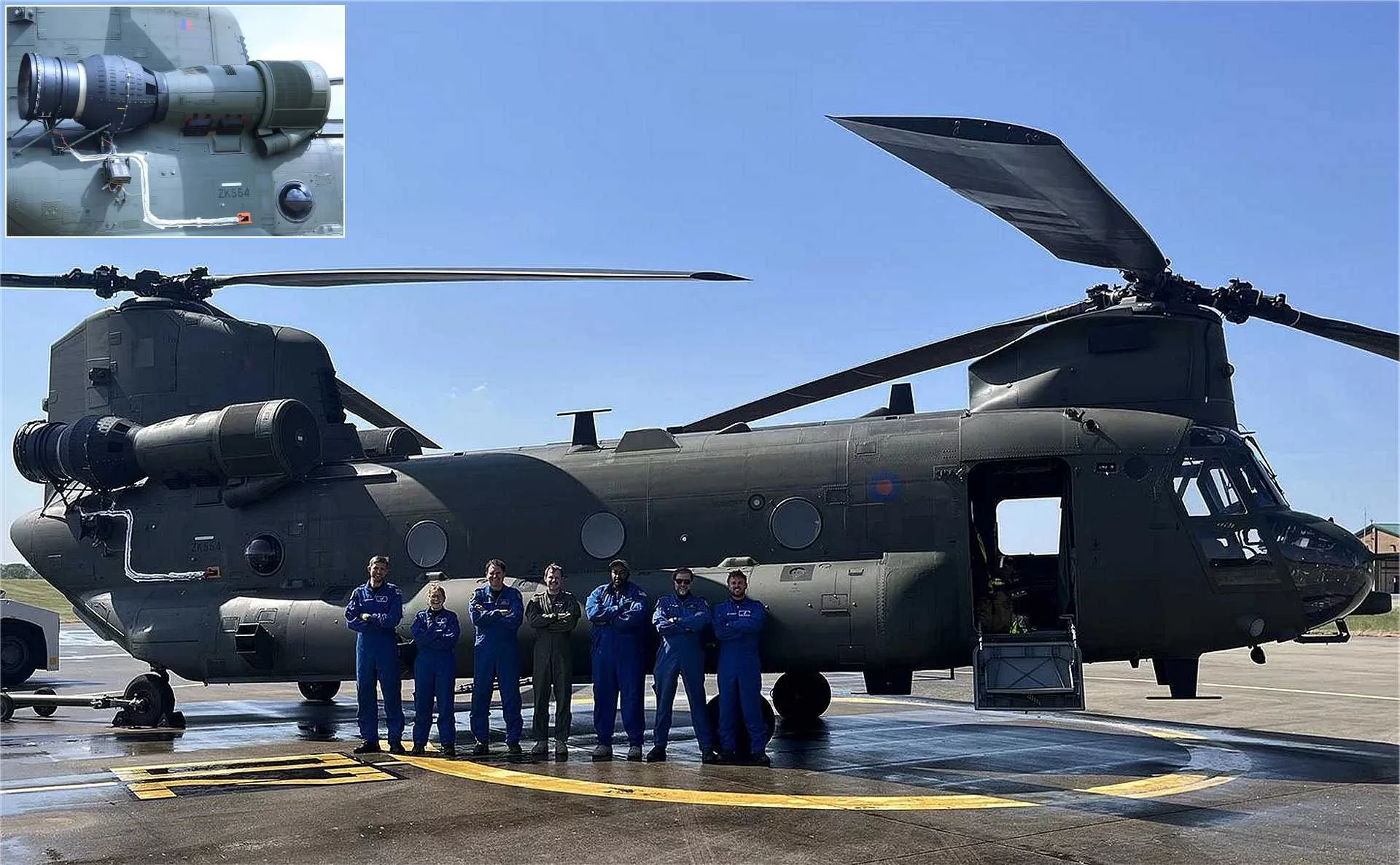
The United Kingdom’s Chinook Mk 6 tactical transport helicopter has achieved a major milestone by completing its inaugural flight equipped with an advanced Infrared Suppression System (IRSS). This technology upgrade significantly enhances the British Army’s helicopter fleet survivability by reducing vulnerability to heat-seeking missile threats—a prevalent danger in modern combat zones.
The IRSS functions by altering the aircraft’s exhaust system to minimize its infrared signature, which is the primary detection method used by MANPADS and air-to-air missiles. The test Chinook featured extended exhaust components designed to cool and dissipate engine heat, thereby making the helicopter substantially less detectable by infrared-guided munitions. This capability is crucial for operating safely in asymmetric warfare environments, where irregular forces often employ shoulder-fired missiles, as well as in future peer-level conflicts with advanced air defense threats.
The Mk 6 variant is the most sophisticated British adaptation of the CH-47 Chinook series, based on the U.S. CH-47F Block I platform but extensively customized for UK requirements. Key features include a fully digital automatic flight control system, uprated Honeywell T55-GA-714A engines producing 4,868 shp each, a glass cockpit integrated with British Army communication systems like BOWMAN-compatible radios, GPS/INS navigation with digital moving maps, and an advanced Defensive Aids Suite encompassing missile warning and countermeasure dispensing systems.
In 2021, the UK Ministry of Defence secured a $2 billion Foreign Military Sales deal with the U.S. for 14 CH-47 Extended Range (CH-47ER) Chinooks, designed to replace older Mk 5 and Mk 6 models. These new helicopters come equipped with extended fuel tanks, upgraded avionics, and survivability enhancements including the IRSS under current trials. The CH-47ER fleet is expected to remain operational into the 2040s, underpinning the British Army’s strategic and tactical airlift capabilities.
Since entering service in 1980, the Chinook has been integral to the British Army’s Joint Helicopter Command, supporting diverse missions such as troop transport, battlefield logistics, casualty evacuation, special operations, and humanitarian aid. Capable of carrying over 10 tonnes internally or up to 55 fully equipped soldiers, the Chinook remains the UK’s premier heavy-lift helicopter, having proven its worth across environments from Afghanistan to Arctic training zones.
This successful IRSS flight validates the system’s readiness for fleet-wide rollout and marks a significant leap in operational resilience against evolving infrared missile threats. Boeing’s modular IRSS integration aligns with NATO’s broader efforts to extend legacy aircraft effectiveness in contested airspaces. The Chinook Mk 6 continues to exemplify modernized heavy-lift rotorcraft, ensuring the British Army’s rotary-wing forces stay adaptive and mission-ready amid 21st-century challenges.
