

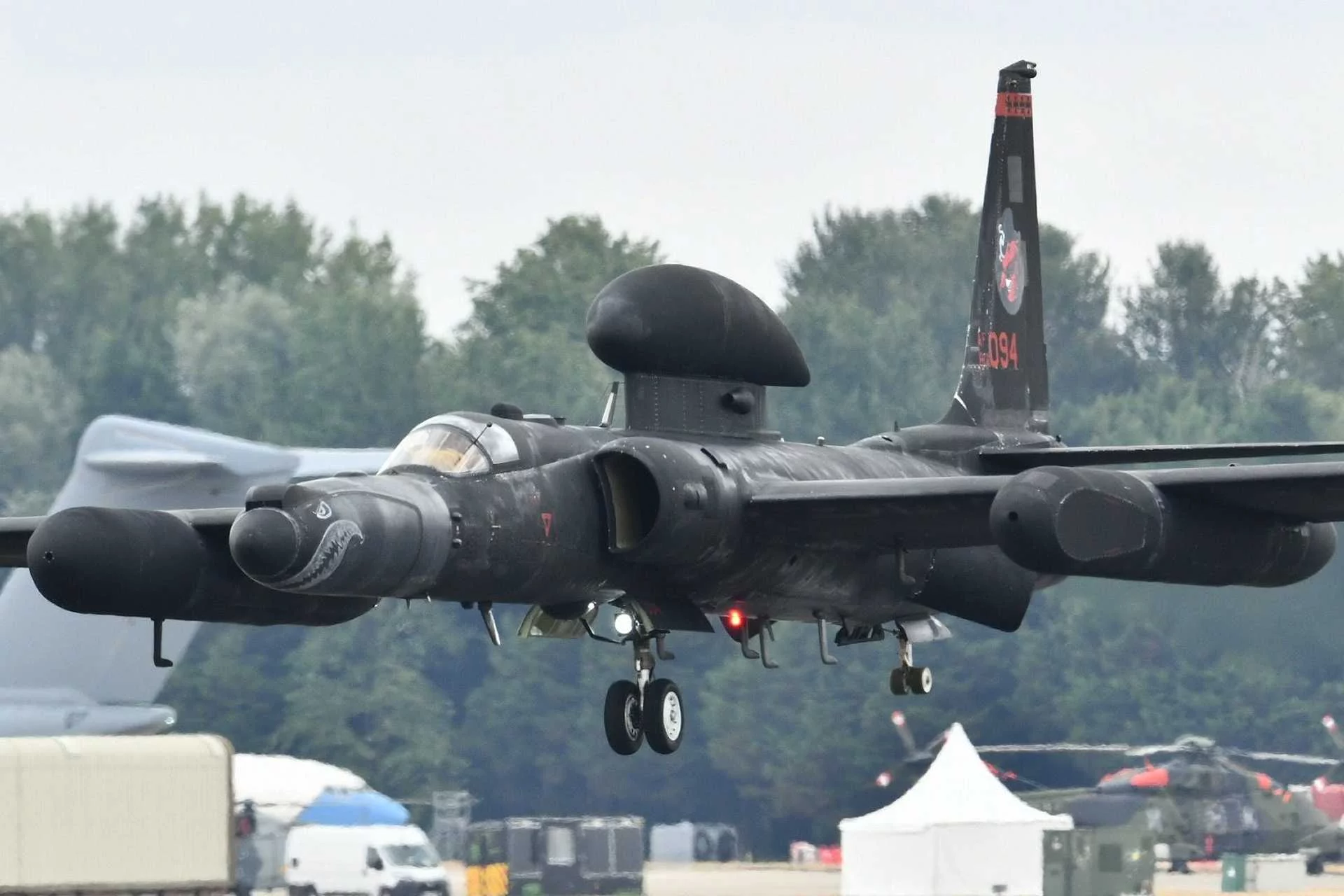
At the Royal International Air Tattoo (RIAT) 2025, held at RAF Fairford in the United Kingdom, the U.S. Air Force captivated global attention by displaying one of its most secretive and iconic aircraft—the Lockheed U-2 “Dragon Lady.” This rare and highly symbolic public appearance marked one of the few instances the high-altitude reconnaissance aircraft has been showcased at an international airshow. Drawing significant interest from military professionals, defense industry leaders, and international delegations, the U-2’s presence underscored the platform’s enduring strategic relevance in today’s complex intelligence landscape.
Originally developed during the Cold War by Lockheed’s legendary Skunk Works division, the U-2 was designed to collect intelligence deep within adversary territory while flying well above the reach of early air defense systems. Capable of operating at altitudes exceeding 70,000 feet, the aircraft can cover vast areas with advanced sensors and remain airborne for up to 10 to 12 hours per mission. With its long, glider-like fuselage, the Dragon Lady is optimized for both broad-area surveillance and pinpoint reconnaissance in high-risk airspace.
What sets the U-2 apart from other ISR (Intelligence, Surveillance, Reconnaissance) platforms is its modular payload capacity, unmatched high-altitude performance, and flexible mission adaptability. The aircraft can be outfitted with electro-optical and infrared cameras, synthetic aperture radar (SAR), signals intelligence (SIGINT) systems, and advanced communications relays. These payloads can be quickly reconfigured to suit changing operational demands, enabling seamless transition between strategic and tactical roles. Its SYERS-2C multispectral sensor delivers ultra-high-resolution imagery, while the ASARS-2A radar system ensures day-and-night, all-weather targeting capabilities. Additionally, the onboard Distributed Common Ground System (DCGS) enables real-time data transfer to combat commanders and intelligence centers.
Since entering service in the 1950s, the U-2 has been a constant fixture in nearly every major U.S. and allied military campaign. From providing critical overflight intelligence during the Cuban Missile Crisis and Vietnam War to supporting surveillance operations in Iraq, Afghanistan, Syria, and the broader Middle East, the aircraft has proven its worth time and again. It has also played a crucial role in monitoring military activities and missile developments near the Korean Peninsula, flying close to North Korean airspace.
Designed to withstand modern electronic warfare threats and operate in GPS-degraded environments, the U-2 remains operationally relevant thanks to recent upgrades under the Avionics Tech Refresh (ATR) and Open Mission Systems (OMS) initiatives. These enhancements have brought digital cockpit interfaces, next-generation flight software, and open-architecture mission systems to the platform, ensuring full compatibility with modern command-and-control (C2) networks and allied assets.
As global tensions rise and anti-access/area-denial (A2/AD) strategies become increasingly sophisticated, platforms like the U-2—capable of flexible, high-altitude operations with real-time data transmission—are more critical than ever. While satellites and unmanned systems now shoulder many ISR roles, none can fully replicate the U-2’s unique combination of altitude, persistence, mission versatility, and immediate intelligence delivery.
By choosing to display the U-2 Dragon Lady at RIAT 2025, the U.S. Air Force sent a clear and deliberate message: this is not a relic of a bygone era, but a front-line platform adapted to meet the demands of 21st-century warfare. In an age where information dominance is essential, the Dragon Lady remains one of the most strategically valuable aircraft in the world.
