

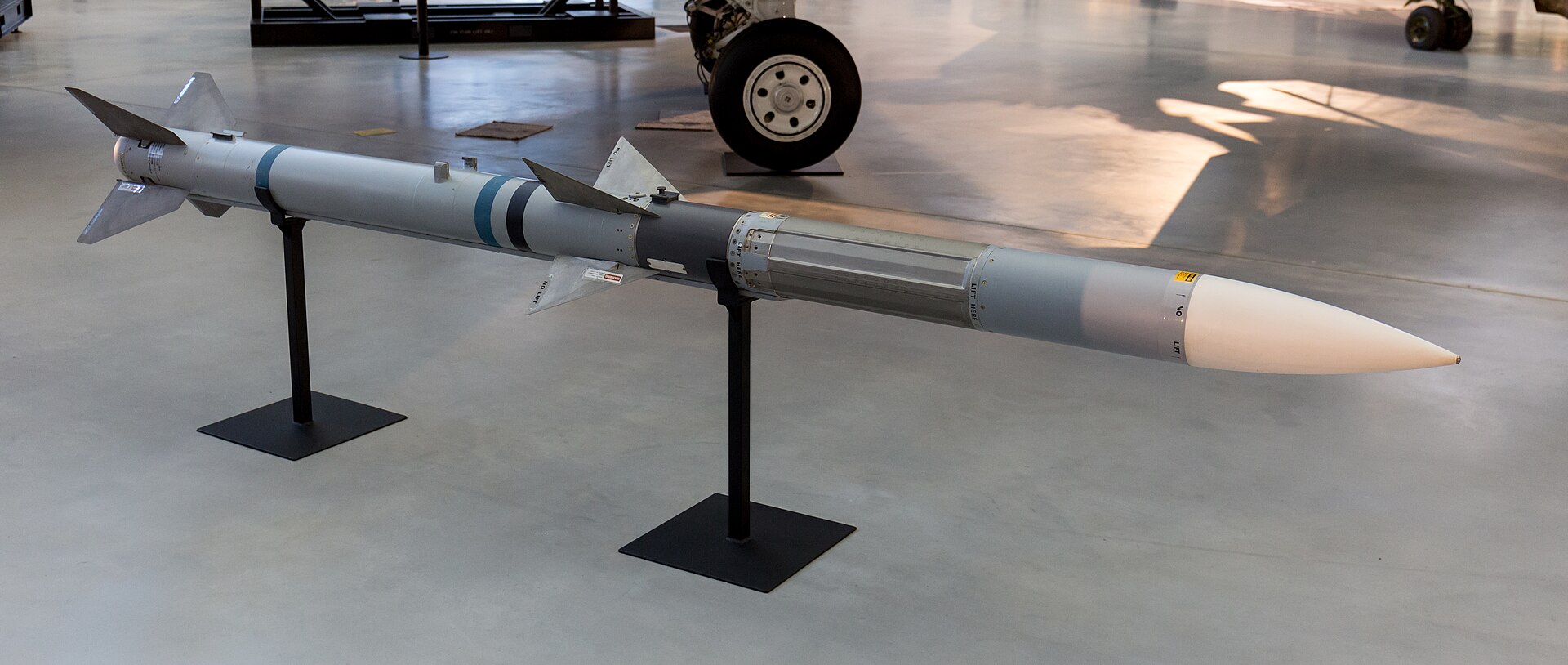
The AIM-120 AMRAAM (Advanced Medium-Range Air-to-Air Missile) is a modern beyond-visual-range (BVR) missile designed to operate in all-weather, day-and-night conditions. Developed by the United States, the AMRAAM entered service in 1991 and has since become the primary BVR air-to-air missile for many NATO and allied air forces, replacing the AIM-7 Sparrow. It also functions as a surface-to-air interceptor in certain ground-based defense systems.
Key Specifications (AIM-120C-5/6/7 Variant)
- Weight: 356 lb (161.5 kg)
- Length: 12 ft (3.65 m)
- Diameter: 7 in (178 mm)
- Wingspan: 1 ft 7 in (484 mm)
- Warhead: 44 lb (20 kg), blast-fragmentation type
- Propulsion: Solid-fuel rocket motor (reduced-smoke HTPB)
- Max Speed: Mach 4 (approx. 1,372 m/s)
- Operational Range:
- AIM-120A/B: ~40 nautical miles (75 km)
- AIM-120C: ~49 nmi (90 km)
- AIM-120D: ~70–86 nmi (130–160 km)
- Guidance: Inertial navigation with mid-course datalink, terminal active radar homing
- Steering: 40G maneuverability with forward and aft control canards
Development Background
The AMRAAM program emerged in the 1970s as part of the U.S. Department of Defense’s response to the tactical limitations of the AIM-7 Sparrow. A key outcome of the ACEVAL/AIMVAL joint evaluations was the requirement for a fire-and-forget missile capable of simultaneous multi-target engagement.
To meet this need, the U.S. initiated the AMRAAM project in partnership with several NATO allies. The missile’s development was led by Hughes (later acquired by Raytheon), with its first successful test occurring in 1982. Deployment began with the U.S. Air Force’s F-15 squadrons in 1991, followed by the U.S. Navy’s F/A-18 units in 1993.
Operational Use and Combat Record
The AMRAAM has seen extensive operational use since the 1990s, achieving a reported kill probability (Pk) of approximately 0.59. Notable engagements include:
- Iraq (1992–1993): First kills against MiG-25 and MiG-23 aircraft.
- Bosnia (1994): Used during NATO enforcement of the no-fly zone—multiple Serbian jets shot down.
- Kosovo War (1999): Multiple MiG-29s downed by NATO forces using AIM-120s.
- Syria (2017): A U.S. Navy F/A-18E shot down a Syrian Su-22 using an AMRAAM.
- Turkey-Syria Border (2014–2020): Turkish F-16s scored several kills against Syrian aircraft, including one at ~45 km, the longest confirmed AIM-120 kill to date.
- Pakistan-India (2019): Indian authorities claimed Pakistan used AIM-120C-5s during aerial engagements.
Global Operators and Exports
The AIM-120 has been exported to over 30 countries, including NATO members and strategic partners. It is compatible with a wide range of Western fighters such as the F-15, F-16, F/A-18, Eurofighter Typhoon, and F-35, and is also integrated into land-based air defense systems like NASAMS.
Saudi Arabia, for example, has extensively used AMRAAMs in intercept operations against UAV and missile threats during the Yemeni conflict, prompting replenishment through Foreign Military Sales (FMS).
Technological Advancements and Features
- Fire-and-Forget Capability: Active radar homing in the terminal phase allows pilots to disengage after launch.
- Datalink Guidance: Mid-course updates ensure higher hit probability.
- Electronic Counter-Countermeasures (ECCM): Includes home-on-jam functionality to track targets emitting jamming signals.
- Compact Design: Allows for internal carriage on stealth platforms like the F-22 Raptor and dual-mounting where a single AIM-7 was previously housed.
Future Outlook
While still widely used, the AMRAAM is expected to be succeeded in U.S. service by the AIM-260 JATM (Joint Advanced Tactical Missile), offering longer range and enhanced performance. European users are progressively transitioning to the MBDA Meteor, which offers advanced propulsion and extended no-escape zones.
