

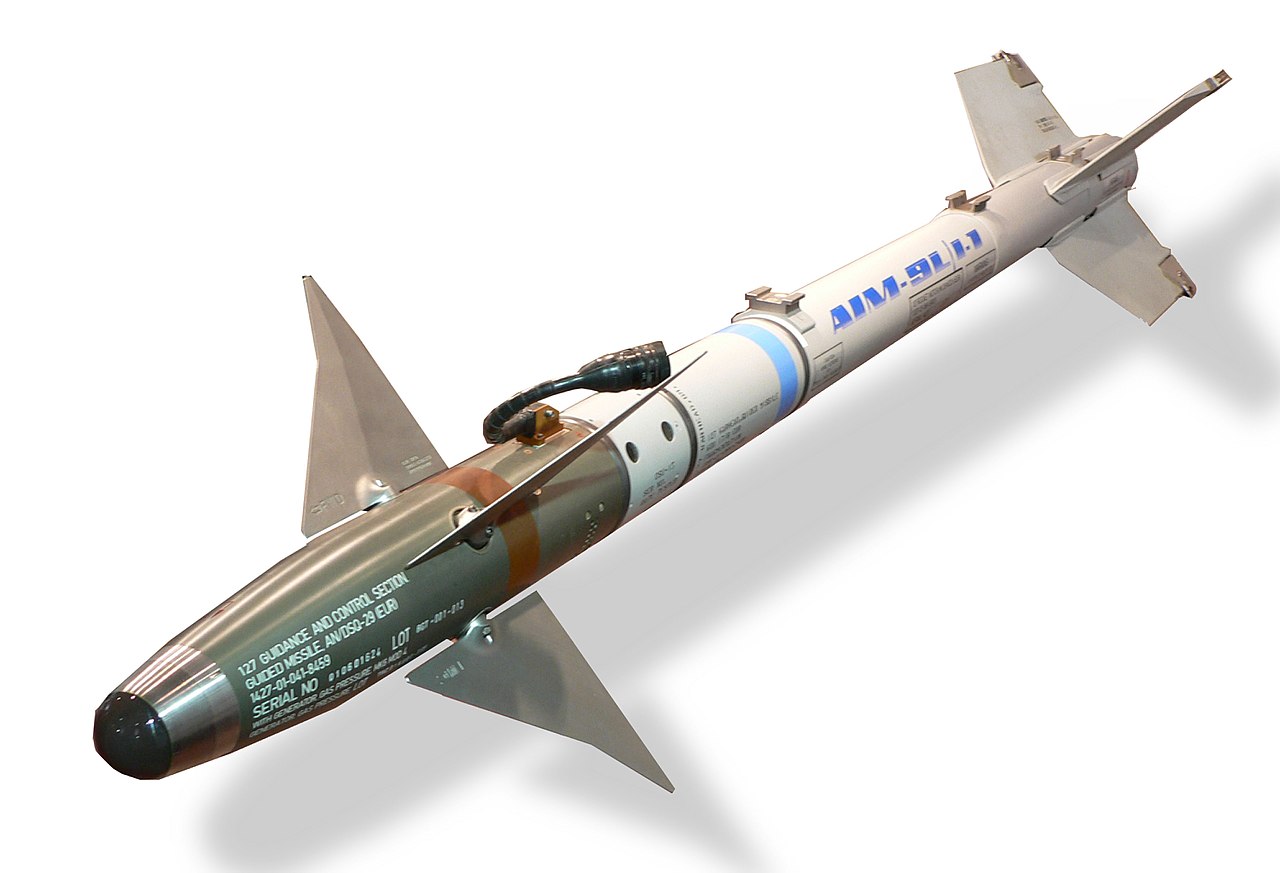
The AIM-9 Sidewinder is a highly successful American short-range, infrared-guided air-to-air missile that has been in continuous service since 1956. Developed by the U.S. Navy’s Naval Ordnance Test Station at China Lake, the Sidewinder is one of the most widely used and longest-serving missiles in military aviation history. It has seen extensive combat use across numerous conflicts worldwide and remains a staple of Western-aligned air forces.
Technical Specifications
- Weight: 188 lbs (85.3 kg)
- Length: 9 ft 11 in (3.02 m)
- Diameter: 5 in (127 mm)
- Wingspan: 11 in (279.4 mm)
- Warhead: 20.8 lb (9.4 kg) WDU-17/B continuous-rod blast-fragmentation
- Detonation: Infrared proximity fuze
- Propulsion: Hercules/Bermite Mk. 36 solid-fuel rocket motor
- Range: Approximately 1 to 35 km (0.6 to 22 miles)
- Speed: In excess of Mach 2.5
- Guidance: Primarily passive infrared homing; AIM-9C variant uses semi-active radar homing
Design Highlights
The Sidewinder’s design is compact and aerodynamic, featuring cruciform canards at the nose and tail fins for stability and maneuverability. Early models tracked only hot engine exhaust from behind the target (“rear-aspect”). Modern versions (from AIM-9L onward) incorporate cooled infrared seekers allowing all-aspect engagement, including head-on targets.
The missile achieves roll stabilization using “rollerons,” small spinning discs on the tail fins, ensuring precise flight control without active stabilization systems. The continuous-rod warhead detonates near the target to maximize damage via a ring of high-velocity metal fragments.
Guidance and Targeting
Using an infrared seeker, the missile homes in on the heat signature of enemy aircraft. The Sidewinder’s guidance system employs proportional navigation, which calculates the intercept point by maintaining a constant line-of-sight angle to the target, allowing it to “lead” the target efficiently even during high-speed maneuvers.
Advanced models, such as the AIM-9X, have greatly expanded seeker gimbal range and incorporate thrust vectoring for exceptional agility, enabling high off-boresight targeting and integration with helmet-mounted cueing systems.
Historical Development
The concept of infrared-guided missiles originated from wartime German research during World War II but matured post-war in the U.S. The Sidewinder program began in 1946 at China Lake under William B. McLean, who pioneered the infrared homing technique inspired by the heat-sensing hunting method of the Sidewinder rattlesnake.
Official development funding began in 1951, and the missile successfully intercepted a drone in flight tests by 1953. Production was authorized in 1955, with the missile entering operational service in 1956 aboard U.S. Navy aircraft such as the F9F Cougar.
Combat and Service Record
With over 110,000 units produced and exported to more than 27 countries, the Sidewinder has accumulated an estimated 270 confirmed kills. It has been deployed in numerous conflicts including:
- Vietnam War
- Yom Kippur War
- Falklands War (1982)
- Gulf War
- Bosnia and Kosovo conflicts
- Russian invasion of Ukraine
- Numerous other regional conflicts worldwide
Its combination of low cost, reliability, and continual modernization has ensured the Sidewinder’s presence in global air arsenals well into the 21st century.
