

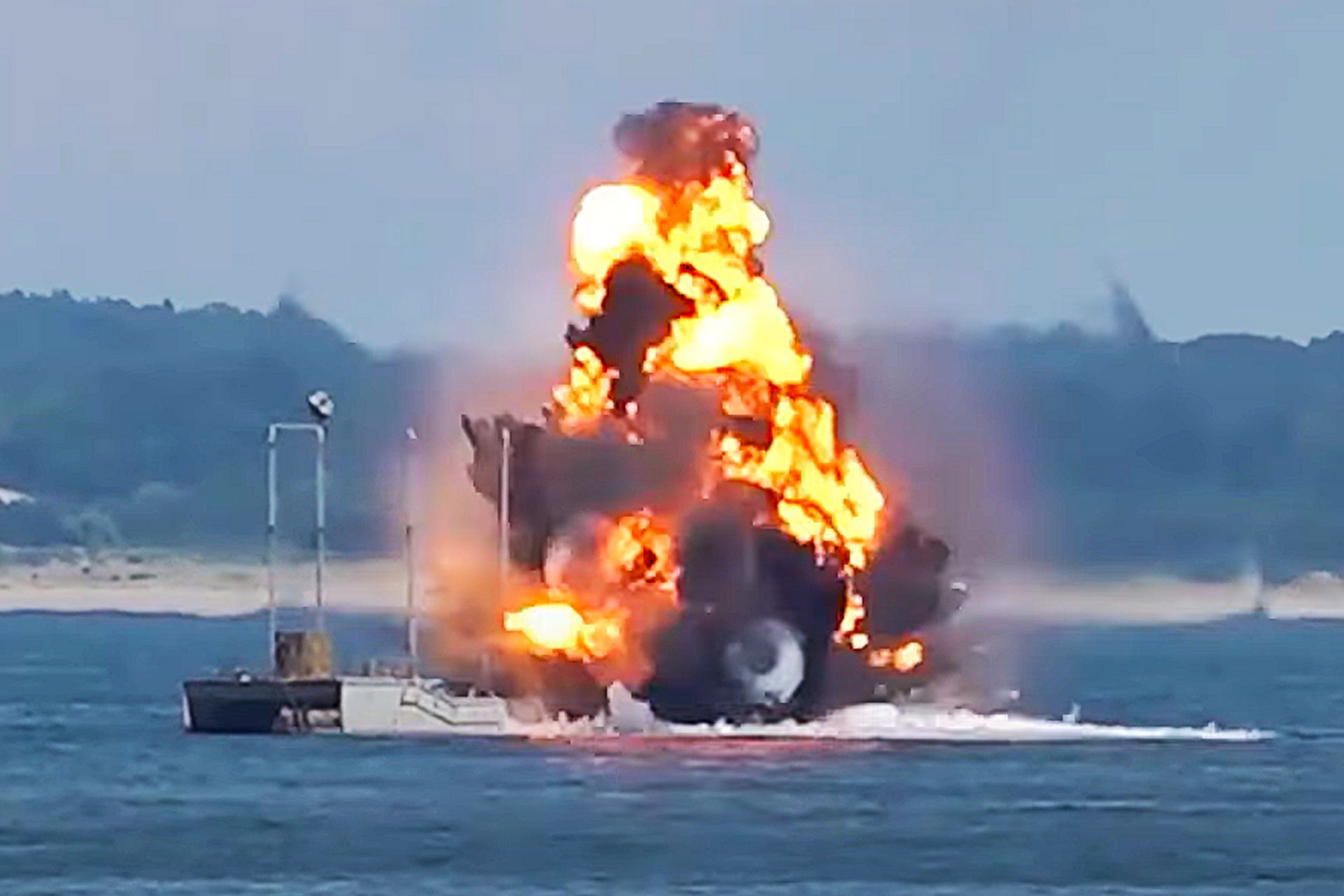
On July 26, 2025, the large-scale “July Storm” naval exercise marked a turning point in Russia’s concept of unmanned maritime warfare. During the exercise, the Russian military successfully struck and destroyed a target ship using its newly developed unmanned surface vessel (USV). This development highlights Russia’s growing emphasis on integrating autonomous systems into its navy and accelerating its technological adaptation.
Footage released by the Russian Ministry of Defense shows the unnamed USV rapidly approaching a target at sea and exploding upon impact. Visual analysis suggests the platform partially submerged during its terminal phase, indicating enhanced hydrodynamic properties and possibly a stealth-oriented design. Although the drone’s technical specifications have not been publicly disclosed, sources close to the government claim a range of up to 300 kilometers and an operational endurance of 24 hours. However, these figures have not been independently verified.
The foundation of this unmanned surface platform traces back to the “Oduvanchik” prototype introduced by KMZ in 2023. That same year, an early version of the system was reportedly used in a failed attack on a railway bridge in Odesa. By 2024, the Russian Navy had established specialized units dedicated to unmanned systems capable of integrating aerial, ground, surface, and underwater drones.
The new naval drone shares characteristics with Ukrainian FPV and kamikaze drones such as the Magura V5 and Sea Baby—low radar signature, expendability, and rapid attack capabilities. However, unlike Ukraine’s combat-proven platforms, Russia’s successful strike was conducted against an unarmed and stationary target. While this points to a technological lag, it also suggests the exercise served as a proof of concept and preparation for industrial-scale production.
Russia’s Kingisepp Machine-Building Plant (KMZ) in Saint Petersburg is positioned as the production hub for these systems. The facility’s indoor testing pools and modular production lines indicate readiness for rapid serial manufacturing. Though cost details remain undisclosed, state-supported production programs are expected to award major contracts to firms like KMZ.
Strategically, this development signals Russia’s entry into a new era of submarine defense, coastal protection, and long-range strike capabilities in the Black Sea and Baltic regions. The potential to conduct unmanned attacks from Crimea on targets such as Odesa and Izmail introduces a new pressure point against conventional naval threats.
In conclusion, Russia’s first successful use of a naval attack drone in the “July Storm” exercise represents not just a technical achievement but a doctrinal shift. While still lagging behind Ukraine in combat experience and operational effectiveness, the growing use of such systems could reshape regional maritime dynamics—especially in the Black Sea—in the near future.
