

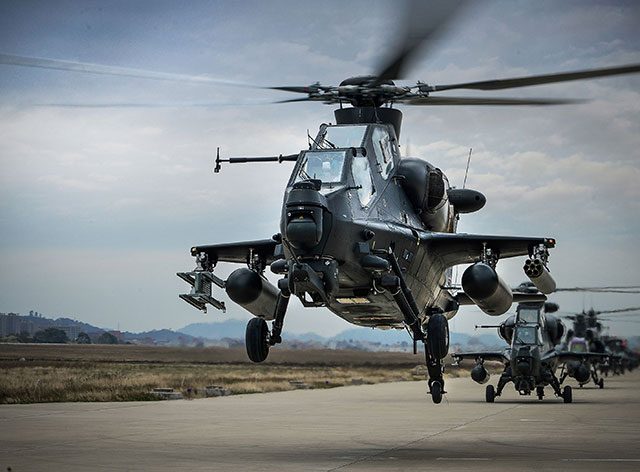
In July 2025, Pakistan began retiring its decades-old fleet of U.S.-origin AH-1F Cobra attack helicopters and started operating Chinese-built Z-10ME/P attack helicopters. According to sources from Crazy Baiyang, the Pakistan-specific Z-10ME/P helicopters arrived at the end of the previous month. Images and videos circulated on social media confirmed their presence, showing national markings, dark camouflage, and operational equipment. This delivery signals Pakistan’s shift in rotary-wing air power from Western platforms to Chinese-made systems, following delays in previous procurement attempts involving U.S. and Turkish helicopters.
The Z-10ME/P helicopters delivered so far do not feature the mast-mounted millimeter-wave radar dome but are equipped with upgraded engines, electronic warfare systems, and electro-optical sensors. Although no official statements specify the exact numbers, at least one helicopter with a visible serial number has been identified, and these aircraft have been used in counterinsurgency operations in the Bajaur region.
Pakistan’s interest in the Z-10 helicopter dates back to 2015, when China provided three trial units. Tests conducted at high-altitude locations such as Qasim Base (above 4,000 meters) revealed the limitations of the then-installed WZ-9 engines, which produced 957 kW and struggled to operate with full weapon loads under those conditions. As a result, Pakistan returned the helicopters and sought alternatives. In 2018, Pakistan signed a $1.5 billion contract with Turkey for 30 T129 ATAK helicopters, but the deal stalled due to the U.S. refusing to issue export licenses for the CTS-800-4A engines. After this contract was canceled in 2022, China’s upgraded Z-10ME model, equipped with the more powerful 1,500 kW WZ-9G engine, emerged as the preferred choice. The new engine provided over a 30% power increase compared to the original, significantly enhancing performance in high-altitude and high-temperature environments such as the Hindu Kush and Siachen regions. The helicopter’s weight increased to nearly 7 tons, and ceramic composite armor and weapon pylons were fully restored. This model’s appearance at 2024 defense exhibitions in Africa and Southeast Asia renewed Pakistan’s strong interest.
The Z-10ME/P variant supplied to Pakistan incorporates significant improvements in propulsion, armament, survivability, and avionics. The engine exhaust outlets have been rerouted upward, reducing the infrared (IR) signature by 63% and, combined with rotor downwash, improving resistance against IR-guided MANPADS. It features a sand-filtered centrifugal intake suitable for desert operations. Weapon hardpoints increased from four to six, enabling it to carry up to 16 CM-502KG air-to-ground missiles with a 25 km range and fire-and-forget capability, TY-90 air-to-air missiles specifically designed for helicopter dogfights, and GR5 guided rockets with sub-2-meter accuracy and an 18-meter lethal radius. It is also compatible with CM-501XA loitering munitions and SW-6 drones, allowing for layered standoff and reconnaissance missions. The main gun was upgraded from 23 mm to a 30 mm chain gun, tripling ammunition capacity and enhancing close fire support. Recent footage shows Pakistan’s Z-10ME/Ps armed with CM-series guided munitions. These enhancements enable safe and effective engagement beyond MANPADS range. Some sources suggest that the Z-10ME/P may eventually integrate with UAVs and command platforms via data links to extend sensor and strike ranges in mountainous terrain.
Protection systems include modular ceramic and graphene-based armor for the cockpit and engine compartments, crash-resistant pilot seats, and self-sealing fuel tanks. Defensive electronics comprise radar warning receivers, laser and missile approach warning systems based on ultraviolet detection, and directional infrared countermeasures (DIRCM). Although the Pakistani helicopters have yet to be seen equipped with the mast-mounted millimeter-wave radar dome, the system supports its integration. This radar offers a 20 km detection range with 360-degree coverage and can simultaneously track up to 16 targets. Its presence on other export variants suggests that some helicopters may receive the radar later, sharing data securely via encrypted links with other units.
Avionics improvements feature helmet-mounted sights, thermal imaging, electro-optical/infrared targeting turrets, glass cockpit displays, heads-up displays (HUD), and fly-by-wire flight control systems. The navigation suite integrates BeiDou satellite positioning, inertial navigation, Doppler radar, radio altimeters, and IFF transponders. The helicopter’s combat radius ranges between 800 and 1,120 kilometers, with up to 3.5 hours of endurance. It can operate at altitudes up to 6,000 meters. High-altitude testing at Khunjerab Pass and the Karakoram Range showed the helicopter maintained full payload with only an 18% engine power loss. Its maneuverability at low altitudes and in confined terrain was a key factor in selection. Exercises indicated it outperformed the AH-64E Guardian, which reportedly had to remove its Longbow radar to reduce weight under similar conditions.
Pakistan views the acquisition of the Z-10ME/P as part of broader military modernization and increasing defense cooperation with China. These helicopters are being integrated into combined arms formations alongside VT-4 main battle tanks, SH-15 155 mm truck-mounted howitzers, and Chinese-built J-10CE and JF-17 Block III fighter jets. These systems operate with networked command and control and coordinated ISR coverage. Recent exercises demonstrated a Z-10ME-equipped strike unit, receiving real-time data from ZDK-03 airborne early warning platforms, engaging simulated enemy targets within seconds. The estimated cost per Z-10ME is approximately $15 million, with a flight-hour cost around $38,000 — roughly half that of the AH-64E Apache. The initial batch likely comprises about 30 helicopters, forming at least one dedicated attack helicopter regiment.
India has responded to Pakistan’s Z-10ME induction by strengthening AH-64E deployments along the border and increasing air patrols with Su-30MKI and Rafale fighters. Indian analysts note that while the Apache has superior armor and payload, Pakistan’s new platform brings asymmetric advantages such as long-range loitering munitions and faster sensor-to-shooter cycles. The inclusion of dedicated helicopter air-to-air missiles and broader battlefield integration may allow the Z-10ME/P to challenge Indian operations in forward areas like Ladakh and Kashmir. Consequently, Indian rotary-wing aircraft, including Apaches and Mi-17s, may require tighter escort and enhanced air defense support.
For China, delivering the Z-10ME to Pakistan represents the first confirmed export of its dedicated attack helicopter platform and supports its defense export goals. AVIC has promoted the Z-10ME at international events such as the 2024 Singapore Air Show, the 2024 Africa Aerospace and Defence (AAD) exhibition, and the Zhuhai Air Show, positioning it as an alternative to U.S., European, and Russian platforms. Alongside the Z-10ME, China has also proposed the J-35 stealth fighter and advanced Hangor-class submarines to Pakistan. The helicopter’s deployment in combat zones and integration within Pakistan’s military is expected to serve as a reference for other nations considering non-Western rotary-wing platforms. Future developments may include radar upgrades, cooperative ISR operations with UAVs, and potential co-production or joint training agreements.
