

As maritime competition with China increasingly exposes the U.S. Navy’s industrial and doctrinal limitations, the service has taken a major step toward transforming its surface fleet. On July 28, 2025, the Navy issued an industry solicitation for the Modular Attack Surface Craft (MASC) program. Announced by the Program Executive Office for Unmanned and Small Combatants (PEO USC), this initiative marks a strategic shift in the design and procurement of unmanned surface vessels. The program is built on principles of modularity, flexibility, and rapid deployment. The solicitation was published on NAVSEA’s official website and remains open until August 11, inviting technical proposals and presentations from industry stakeholders.
The MASC program aims to consolidate previous trials with Medium and Large Unmanned Surface Vessels (MUSV and LUSV) under one umbrella. Instead of categorizing vessels by size, the Navy is now pursuing a standardized, ISO container-based modular architecture to enhance mission versatility and streamline mass production. Leveraging Other Transaction Agreements (OTAs)—non-traditional acquisition tools—the Navy seeks to accelerate integration of commercial technologies by sidestepping bureaucratic delays.
With this modular system, the U.S. Navy aims to reduce reliance on large, crewed, and costly ships. Instead, it envisions a new fleet of unmanned systems capable of executing multi-mission roles—ranging from surface warfare and long-range strikes to intelligence gathering, electronic warfare, and information operations—while supporting distributed lethality and situational awareness.
NAVSEA’s official statement outlines the transformation logic behind MASC, emphasizing speed, low cost, production simplicity, and logistical agility—core qualities for 21st-century naval warfare. Technical details from the solicitation, analyzed by The War Zone on July 31, confirm this vision. Three vessel types are planned: a baseline model that can carry two 40-foot ISO containers, a high-capacity version for four containers, and a compact model capable of carrying a single 20-foot container. Each payload may weigh up to 36.3 metric tons (or 24 metric tons for the compact version), with up to 75 kW of power usage—suitable for directed energy weapons or advanced electronic warfare suites. The vessels are expected to reach a minimum speed of 25 knots, a range of 2,500 nautical miles, and operate effectively in at least Sea State 4 (ideally Sea State 5).
These platforms must be fully autonomous—even during communication loss, low visibility, or in radio-silent environments. Full compliance with international maritime rules (COLREGS) is required. Systems must also be able to automatically adjust electromagnetic emissions based on mission needs, enabling operations in contested environments.
The solicitation specifies that vessels must be producible within 18 months, easily repairable to commercial standards, and capable of extended operation without preventive maintenance. Exportability to allied nations and the optional inclusion of a small crew are listed as beneficial features, promoting interoperability and mission flexibility.
A key strategic benefit of modularity is tactical ambiguity. By using ISO container standards, adversaries cannot easily determine whether a vessel is carrying weapons, sensors, jamming systems, or simply an empty load. This ambiguity complicates enemy targeting and enhances operational unpredictability.
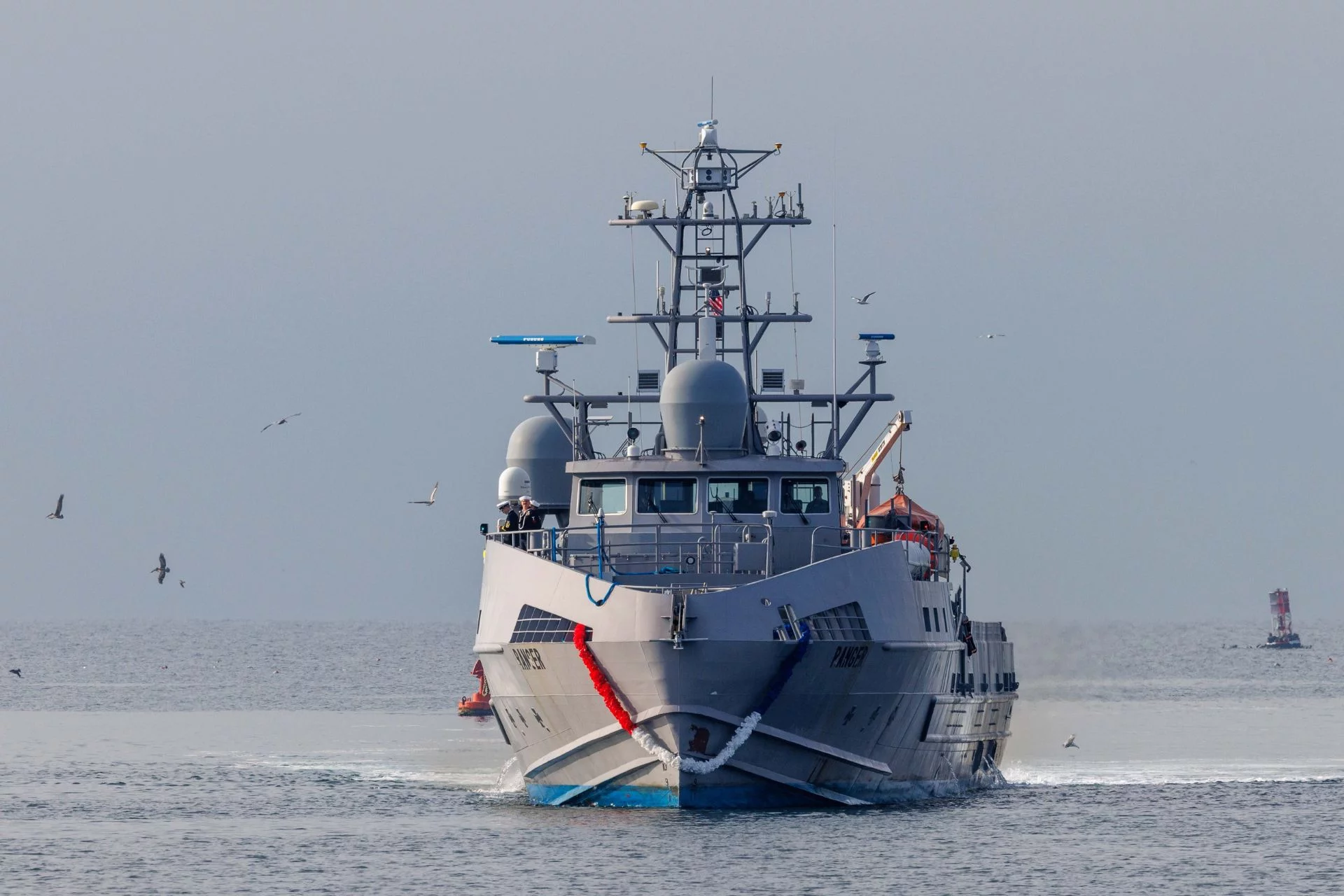
MASC builds on lessons from current experimental platforms such as Ranger, Mariner, Seahawk, Sea Hunter, and DARPA’s Defiant USV under the NOMARS program. The fully unmanned Defiant already meets many of MASC’s core requirements. A larger version, Dauntless, is under development, featuring expanded weapons capacity and vertical launch systems like the Mk 70, compatible with SM-6 and Tomahawk missiles.
According to the FY2026 budget documents, the Navy intends to begin prototyping with support from the Defense Innovation Unit (DIU). By combining private sector agility, off-the-shelf technologies, and Navy operational expertise, the goal is to quickly deploy a functional unmanned fleet. MASC is expected to become a cornerstone of the Navy’s future force, offering flexible responses to budget constraints, industrial bottlenecks, and emerging threats.
By breaking from legacy platforms and embracing modular standardization, autonomy, and close industry collaboration, the U.S. Navy aims to make a strategic leap forward. MASC is more than a technological upgrade—it represents a doctrinal evolution built on dispersion, adaptability, redundancy, and cost-effectiveness.
ChatGPT’ye sor
