

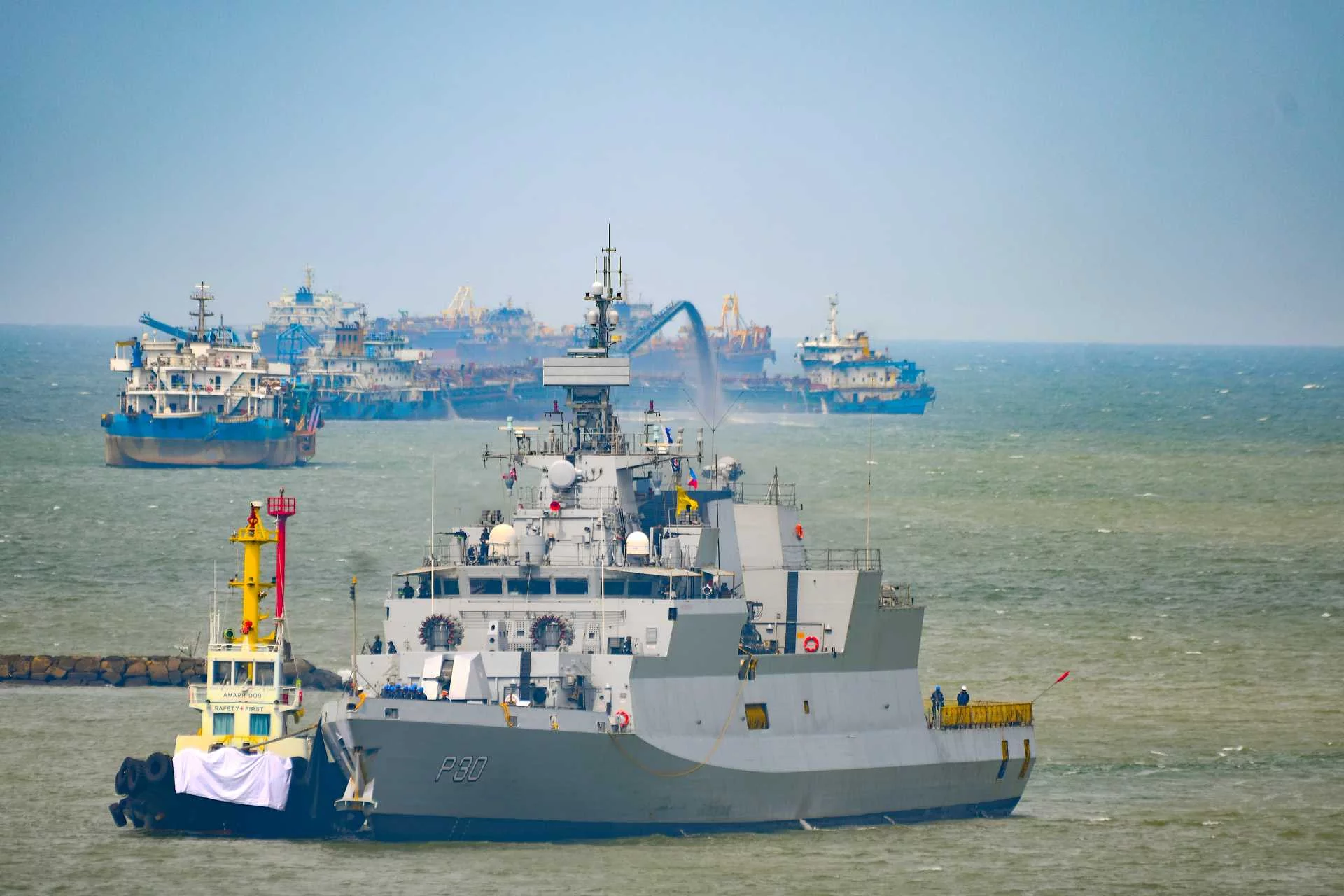
As part of an ongoing operational deployment to Southeast Asia, the Indian Navy’s Eastern Fleet vessels—INS Delhi (guided-missile destroyer), INS Shakti (fleet tanker), and INS Kiltan (anti-submarine warfare corvette)—under the leadership of Rear Admiral Susheel Menon, arrived in Manila. The Philippine Navy received the Indian ships with full ceremonial honors, underscoring the growing strategic maritime partnership between India and the Philippines in the Indo-Pacific. Upon arrival, Rear Admiral Menon spoke to local media, highlighting the shared dedication to maritime security, regional stability, and deeper operational collaboration.
Over the past decade, India and the Philippines have steadily expanded their naval cooperation based on a shared vision of a free, open, and rules-based Indo-Pacific. Their bilateral defense engagements have become increasingly sophisticated, encompassing high-level defense talks, naval ship visits, and agreements on training, capacity building, and technology sharing. The upcoming Maritime Cooperative Activity (MCA) represents a significant milestone, moving beyond port calls to structured at-sea exercises that evaluate real-time interoperability between the two navies. Both nations maintain a strong alignment on upholding the 2016 arbitral tribunal ruling on the South China Sea, with India affirming its support for the Philippines’ sovereign rights within its exclusive economic zone, highlighting deepening strategic convergence.
The port visit includes an extensive program of professional and operational exchanges aimed at enhancing bilateral naval ties. These consist of high-level planning meetings, expert exchanges, cross-ship visits, and cultural engagements designed to build mutual understanding and trust. Given rising maritime tensions across the Indo-Pacific—especially in the West Philippine Sea—such interactions are increasingly vital to joint readiness and coordinated responses to shared challenges like illegal fishing, maritime coercion, piracy, and humanitarian emergencies.
Central to this deployment is the historic first bilateral MCA scheduled for August 3-4 near Scarborough Shoal. The exercise will involve tactical surface maneuvers, seamanship drills, coordinated communication protocols, and maritime domain awareness activities. These drills will improve both navies’ capabilities to operate jointly in contested maritime environments, reaffirming their commitment to peace and stability along critical sea lanes.
A Maritime Cooperative Activity is a non-combat, bilateral naval engagement framework focused on operational coordination, trust-building, and interoperability enhancement between friendly maritime forces. Unlike large-scale joint exercises, MCAs emphasize practical mission-oriented skills such as navigation, formation sailing, communication interoperability, and coordinated responses to non-traditional threats like maritime terrorism, smuggling, or humanitarian crises. MCAs typically combine at-sea drills with in-port planning sessions and are tailored to regional security contexts. For the Indian and Philippine navies, this inaugural MCA marks a carefully calibrated yet strategically important step toward a structured operational partnership amid increasing maritime competition.
This visit aligns with India’s broader strategic approach under its Act East policy and SAGAR (Security and Growth for All in the Region) doctrine. It signals India’s deliberate effort to expand its naval presence in the Western Pacific and strengthen maritime partnerships with like-minded regional players. For the Philippines, this cooperation diversifies defense relations and enhances operational resilience amid growing regional assertiveness. Philippine Navy spokesperson Commander John Percie Alcos emphasized the MCA’s role as a critical initiative to boost interoperability and regional security coordination.
Taking place just ahead of Philippine President Ferdinand Marcos Jr.’s official visit to India, the MCA adds diplomatic significance to ongoing defense engagements. It sends a strong message of bilateral resolve to uphold international maritime law and protect shared interests in one of the world’s most contested maritime zones. In exclusive comments, Rear Admiral Menon described the activity as a milestone in institutionalizing naval cooperation and reaffirmed India’s lasting commitment to collaborative security frameworks in the Indo-Pacific.
