

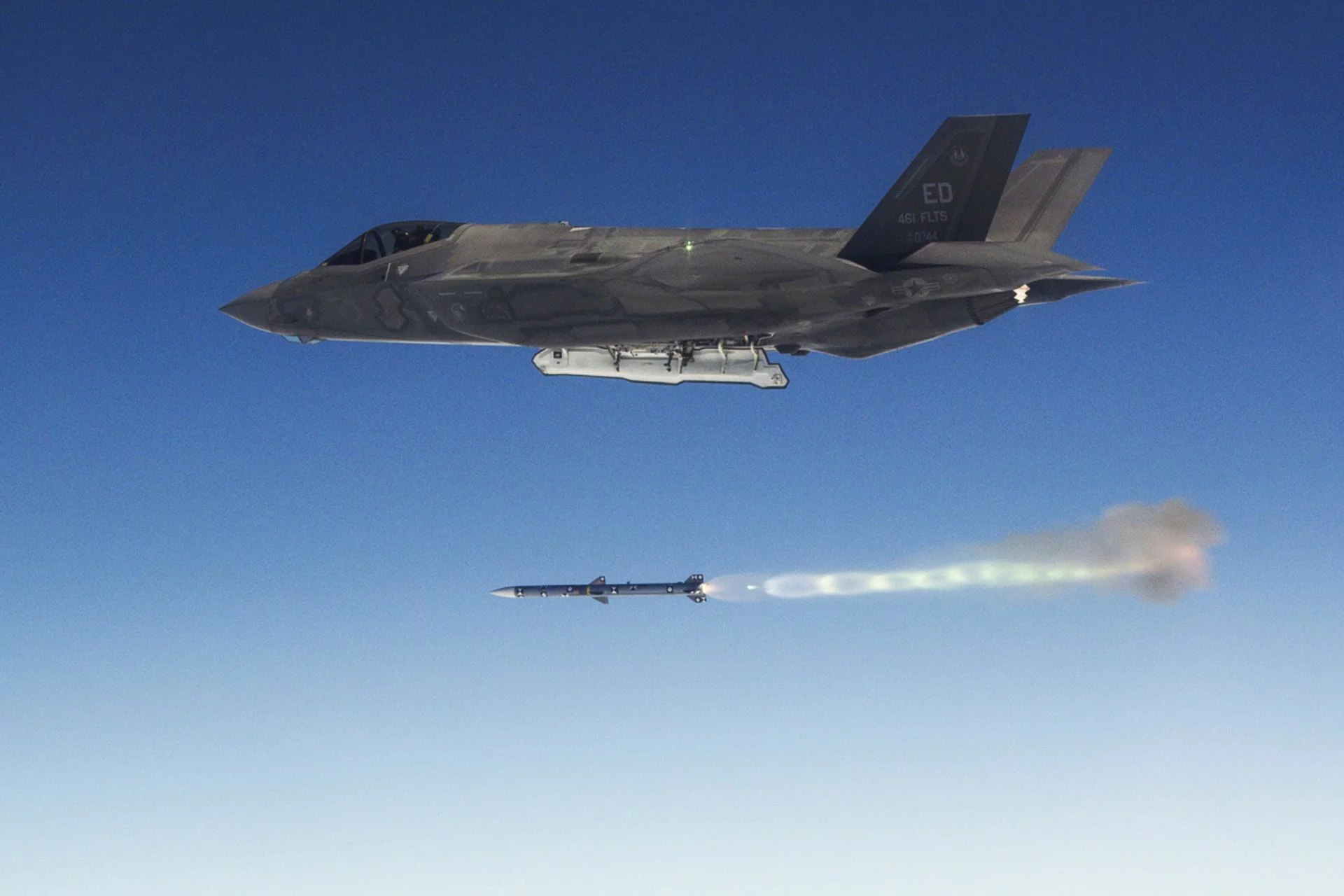
The United States has finalized its largest AIM-120 AMRAAM missile contract to date, a $3.5 billion deal aimed at reinforcing U.S. and allied air-to-air capabilities amid mounting global demand for high-performance interceptors. Issued as a firm fixed-price incentive agreement to Raytheon, the contract includes the production of undisclosed quantities of AMRAAM missiles, telemetry kits, spare parts, and technical services.
The deal covers Foreign Military Sales (FMS) to 19 partner nations, including key allies such as the United Kingdom, Japan, Germany, Finland, Taiwan, and Ukraine. Production will take place at Raytheon’s Tucson, Arizona facility, with deliveries expected to continue through fiscal year 2031.
Multi-Year, Multi-Source Funding Structure
Over $621 million was obligated at the time of award, drawn from Air Force and Navy procurement budgets, R&D accounts, operations and maintenance funds, and partner-nation contributions. The contract was awarded without competition, reflecting urgency and continuity in AMRAAM production. Oversight is managed by the Air Force Life Cycle Management Center’s Air Dominance Division at Eglin AFB, Florida.
Renewed Relevance of the AMRAAM
Raytheon officials emphasized that recent high-tempo operations—including in Ukraine, Israel, and the Red Sea—have reaffirmed the missile’s relevance. Since its combat debut in the 1990s, the AIM-120 has remained a cornerstone of beyond-visual-range (BVR) air combat, credited with dozens of aerial victories and integrated across a wide range of Western aircraft including the F-35, F-15, F/A-18, Typhoon, Gripen, and NASAMS ground-based systems.
Equipped with an active radar seeker and mid-course data-link guidance, the AMRAAM is a fire-and-forget missile with a range exceeding 160 km in its extended-range variants. With Mach 4 speeds, 20 kg warhead, and 40G maneuverability, it is effective against agile, stealthy, and unmanned threats.
Evolving to Meet Emerging Threats
The AMRAAM family has undergone continuous upgrades. The D-3 variant, currently in service, offers a 50% range increase over the C-7, improved aerodynamics, and digital upgrades under the F3R (Form, Fit, Function Refresh) program. Recent documents also hint at a possible AIM-120E version, as the U.S. Air Force prepares to field the next-generation AIM-260 JATM alongside AMRAAMs.
With global inventories under pressure due to recent conflicts and increasing concerns over state-level threats and mass drone attacks, this record-setting procurement reflects both a readiness imperative and a strategic modernization effort. Despite its age, the AMRAAM continues to be the primary air-to-air weapon for over 40 allied nations, ensuring interoperable and layered defense across joint operations.
