

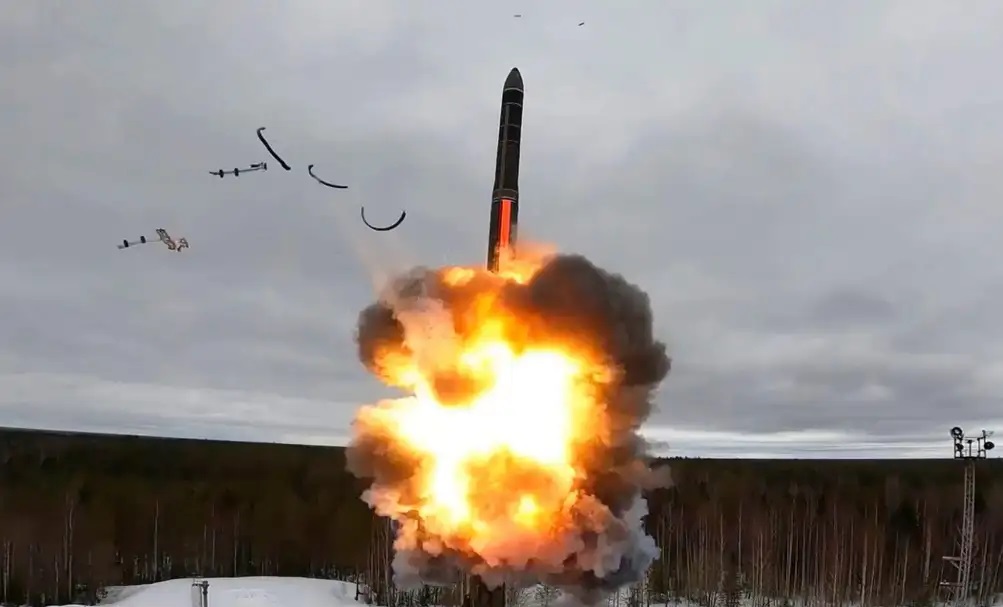
On August 1, 2025, Russian President Vladimir Putin confirmed the entry into serial production of the Oreshnik intermediate-range ballistic missile (IRBM), with the first unit already delivered to Russian forces. Speaking alongside Belarusian President Alexander Lukashenko on Valaam Island, Putin added that the deployment of Oreshnik to Belarus would be finalized by the end of the year. Russian and Belarusian military teams have selected the launch site, and construction is underway to secure the area and build the necessary infrastructure.
Known under NATO reporting name SS-X-34, Oreshnik is a road-mobile, solid-fueled IRBM developed as a derivative of the previously sidelined RS-26 Rubezh. It is estimated to weigh 40 tons with a range of 800 to 5,000 km. Built on the MZKT-79291 mobile launcher, it features a two-stage propulsion system and is believed to be MIRV-capable—carrying up to six independently targetable warheads, each potentially armed with submunitions or decoys.
The first confirmed operational launch took place on November 21, 2024, when a missile struck Ukraine’s Pivdenmash defense plant in Dnipro. Fired from the Kapustin Yar range, the missile reportedly reached speeds of Mach 11. U.S. and Ukrainian sources said the missile carried inert warheads and caused only minor structural damage. The launch was pre-notified to U.S. authorities via deconfliction protocols.
Experts from CSIS and other think tanks noted the missile’s technology is primarily based on older Soviet and Russian designs, with limited new components. While its use of MIRVs at hypersonic speeds is notable, analysts argue that its military effectiveness in conventional strikes is questionable, suggesting that the launch was more symbolic—a political message to deter Western support for Ukraine.
In early August, discussions emerged about the potential overseas deployment of the system, with military analysts pointing to Venezuela or Cuba as possible forward bases. These moves could expand Russia’s missile coverage to parts of the southern U.S. and Caribbean, while also enabling broader geopolitical leverage and potential missile tech transfer to partners like Iran or North Korea.
This development fits into Russia’s broader strategic doctrine shift, especially following the 2024 defense pact with Belarus. The treaty includes Russian security guarantees and provisions for deploying tactical nuclear weapons. New doctrine permits nuclear response even in cases of conventional threats to Belarus’s sovereignty. Russia has officially discarded its previous compliance with the INF Treaty, signaling its return to deploying long-range systems along NATO’s periphery.
