

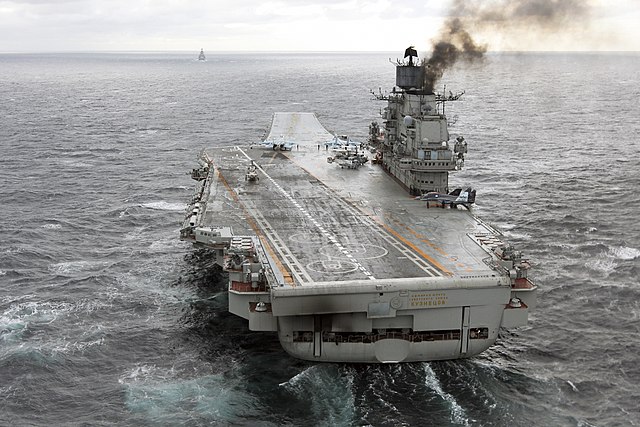
In the late 1970s, the Soviet Union set out to develop a new generation of carrier capable of launching fixed-wing aircraft from the sea without the need for catapults. This effort materialized as Project 1143.5, better known as the Kuznetsov class, which used a ski-jump configuration to get planes airborne.
The concept evolved from the far larger and more advanced nuclear-powered Project 1153 Orel, which was designed for 70 aircraft and equipped with catapult launch systems. Budgetary and strategic constraints, however, forced a reduction in size and complexity, resulting in a STOBAR carrier displacing between 55,000 and 67,000 tons.
Design & Capabilities
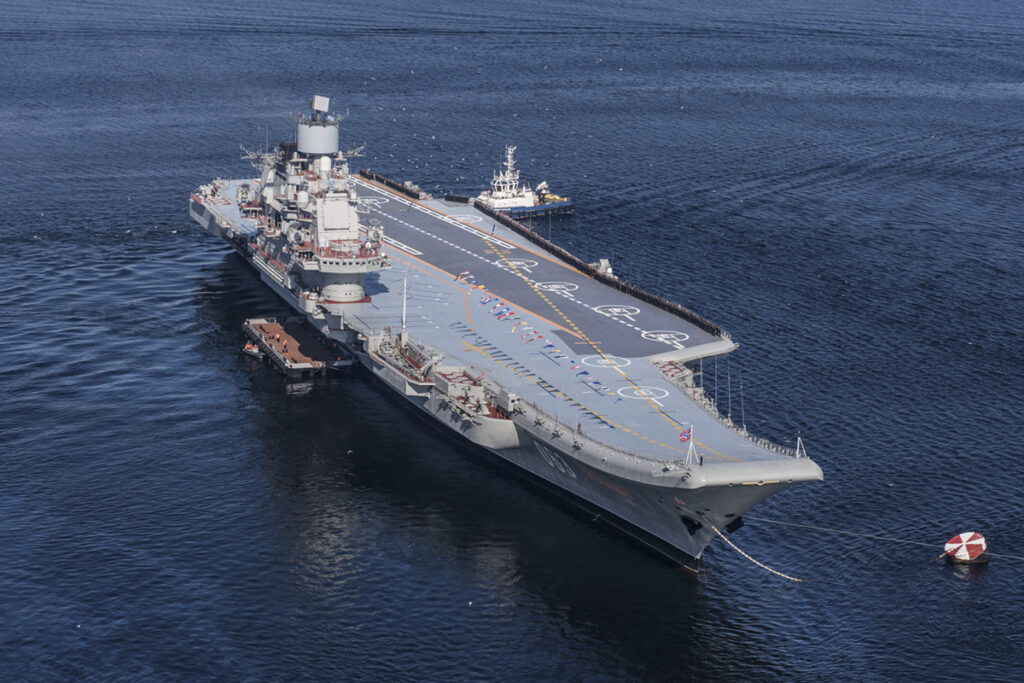
The Admiral Kuznetsov stands among the largest warships ever commissioned by Russia, featuring a full-length flight deck, a prominent starboard-side island, and a ski-jump ramp for aircraft takeoff—though it was never fitted with steam or electromagnetic catapults.
Unlike most carriers, the Kuznetsov carries heavy offensive weapons. Its arsenal includes 12 P-700 Granit anti-ship missiles, long-range Kinzhal surface-to-air missiles, multiple Kortik and AK-630 close-in weapon systems, as well as anti-submarine rockets and decoys—underscoring its dual role as both a cruiser and an aircraft carrier.
Propulsion & Survivability
Propelled by four steam turbines delivering a combined output of around 200,000 shaft horsepower, powered by eight boilers, the vessel can achieve speeds of up to 29 knots and sustain a range of roughly 8,500 nautical miles at 18 knots.
Its survivability features include layered internal protection, fuel-filled bulkheads to absorb the shock of torpedo hits equivalent to 400 kg of TNT, redundant machinery spaces, and a structural design intended to withstand the blast effects of a nearby low-yield nuclear detonation.
Aviation Facilities
The original air group plan accommodated approximately 33 fixed-wing fighters and 12 helicopters. Over time, this evolved into a mix of Su-33 air superiority fighters, MiG-29K multirole aircraft, and Kamov series helicopters such as the Ka-27, Ka-29, and Ka-52K.
The ski-jump takeoff system, combined with limited hangar space, reduced aircraft fuel and weapons loads compared to catapult carriers. To offset these disadvantages, upgrades such as more powerful engines, advanced radar with active electronically scanned arrays (AFAR), and modern reconnaissance equipment were integrated.
Service History & Modernization
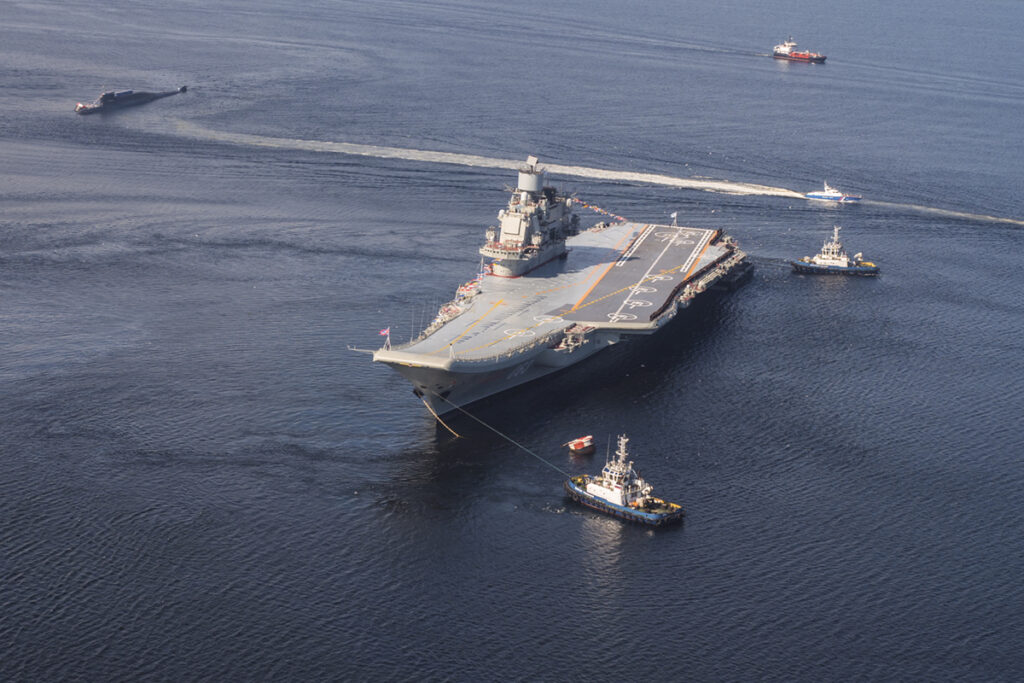
Construction began in 1982 at the Black Sea Shipyard in Ukraine. Before entering service in the early 1990s, the ship cycled through several names—Riga, Brezhnev, Tbilisi—before being commissioned as Admiral Kuznetsov. Following the Soviet collapse, she sailed north to join the Northern Fleet in 1991 under challenging and politically charged conditions.
Throughout the 1990s and 2000s, the carrier undertook multiple Mediterranean cruises, participated in operations such as the Kursk submarine disaster response, and in 2016–2017 deployed off Syria, launching hundreds of combat sorties.
A major overhaul from 2017 to 2024 modernized the ship’s combat systems, replacing the Granit missiles with Pantsir-M air defense systems, upgrading electronics, and repairing damage from both a floating dock accident and onboard fires.
By late 2024, significant portions of her crew were reportedly reassigned to the war in Ukraine, casting doubt on the ship’s immediate operational future.
Special Legal Status
Thanks to its heavy missile armament, the Kuznetsov is legally designated as a “heavy aircraft-carrying cruiser” rather than an aircraft carrier under the Montreux Convention. This classification grants her the right to pass through the Turkish Straits—an exception to the treaty’s restrictions on carrier movement between the Black Sea and the Mediterranean.
