

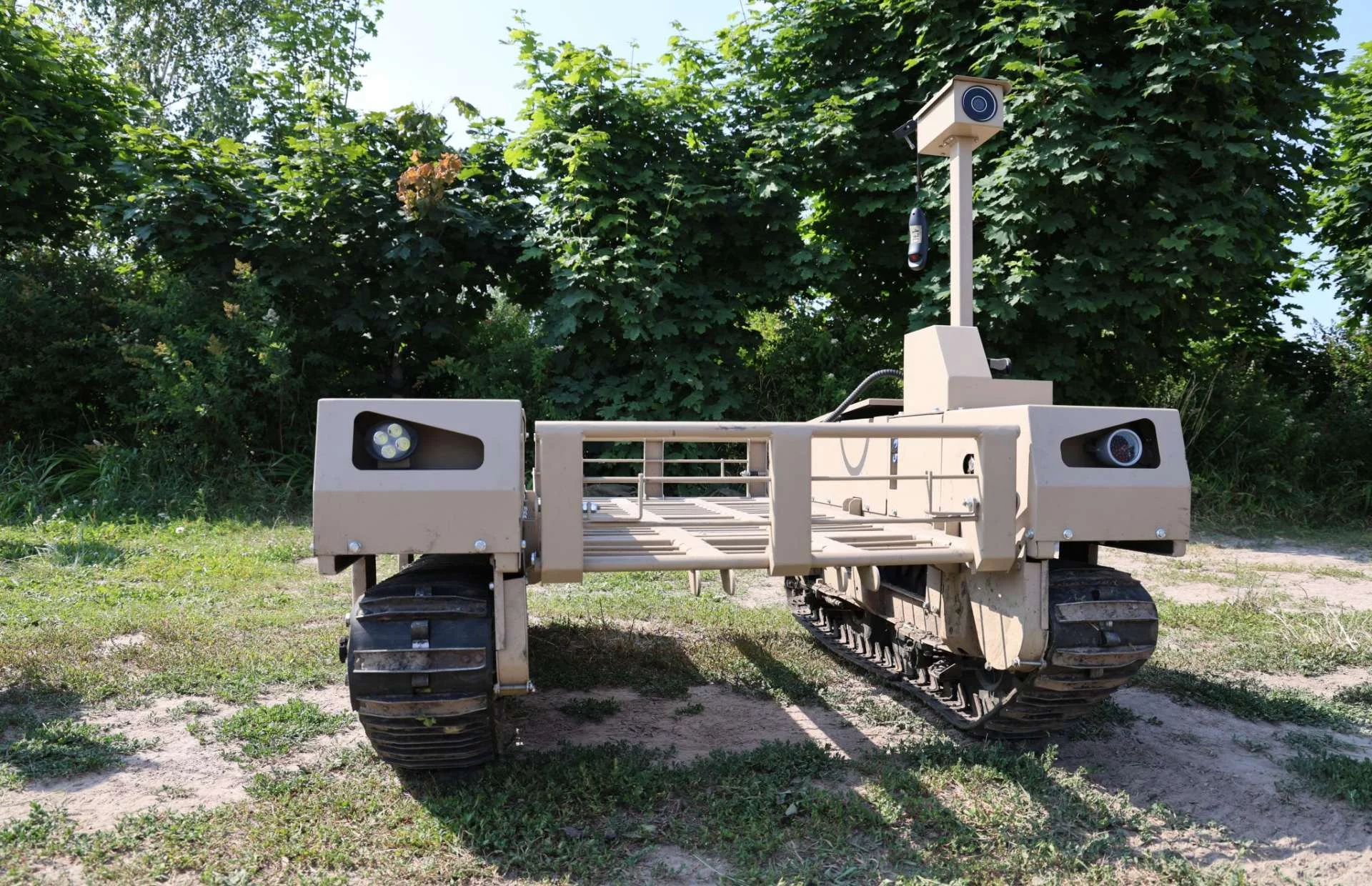
Ukraine’s Armed Forces are entering a new phase of combat medical support by deploying unmanned ground vehicles (UGVs) to speed casualty evacuation across increasingly dangerous frontlines. Commander-in-Chief Oleksandr Syrskyi announced the expansion on August 11, 2025, noting that modern long-range strike drones have widened engagement zones, forcing medics to operate farther from the front and under greater risk.
Syrskyi has ordered units to integrate ground robotic complexes more rapidly, supported by additional armored ambulances, specialized evacuation platforms, and new logistical frameworks to ensure fast and safe extraction of the wounded.
The initiative draws on proven combat experience. The 25th Separate Airborne Brigade has successfully tested robotic evacuation systems in high-threat areas where conventional armored vehicles could not be used. In June 2025, the K-2 Drone Regiment conducted four evacuations under bomber fire using unmanned platforms, while the 13th Khartiia Brigade rescued a soldier across 12 km of contested terrain with the Tarhan platform.
Ukraine’s UGV fleet blends foreign-supplied and domestic systems. Estonia’s Milrem Robotics provides the THeMIS modular tracked vehicle, capable of casualty evacuation, logistics, ISR, EOD, and combat support, with weapon mounting options from machine guns to anti-tank missiles. Ukrainian-developed platforms include the Ironclad (armed, thermal-equipped, 350 kg payload), Rys and Rys PRO (logistics and casualty transport, 150 kg and 300 kg payloads), and modular designs like Tarhan created directly in partnership with frontline units.
These robots operate within a high-intensity war zone dominated by precision artillery, loitering munitions, and persistent drone surveillance—where any movement in contested terrain is risky. Ukraine’s approach pairs aerial drones for reconnaissance and targeting with ground robots for evacuation, resupply, and even direct fire missions.
Challenges remain. Dense vegetation can block sensors, and mud or flooding can hinder mobility. Yet the benefits—removing medics from the line of fire and sustaining combat effectiveness—are significant.
By integrating robotics into both medical and combat support roles, Ukraine is showcasing how unmanned systems can transform battlefield doctrine. This experience could guide future procurement priorities, not only in Ukraine but also among allied militaries seeking adaptable, armored, and semi-autonomous ground platforms for modern warfare.
