

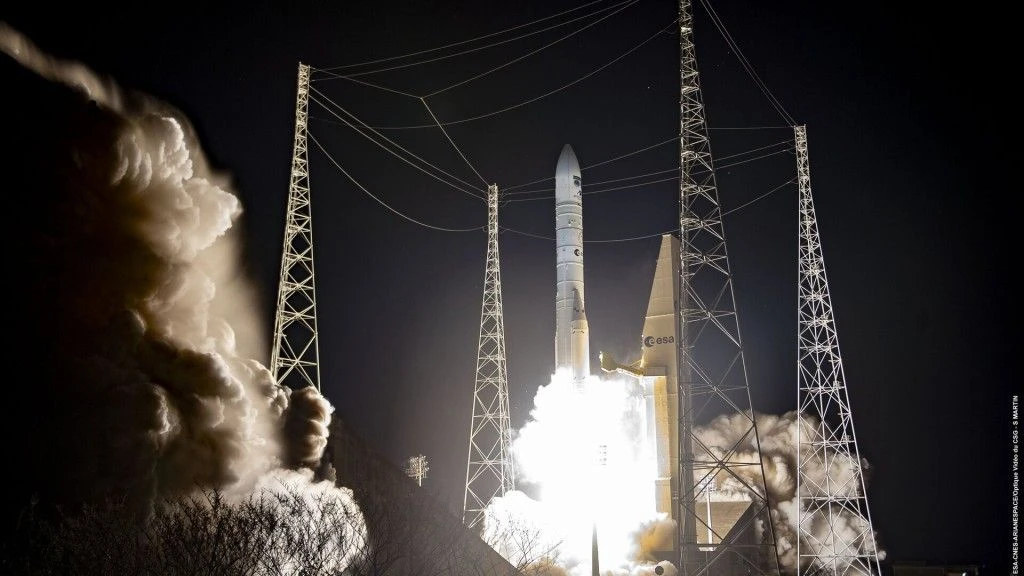
On the night of July 12-13, Arianespace carried out the third launch of the Ariane 6 rocket, Europe’s latest heavy-lift launch vehicle.
The launch took place from the spaceport in Kourou, French Guiana. Designated as mission VA264, this was the rocket’s second commercial flight. Its primary objective was to place the Metop-SG A1 weather satellite into orbit around Earth. The operation proceeded smoothly, with no technical issues, and the satellite successfully detached from the rocket. The European Space Agency confirmed that Metop-SG A1 deployed its solar panels correctly and is now fully operational. “MetOp-SG-A1 is functioning well in orbit,” the agency reported.
Ariane 6, which weighs around 900 tons and stretches approximately 60 meters, represents a major step forward for European space access. The VA264 mission used a version of the rocket with four boosters, capable of lifting 21.6 tons into low Earth orbit.
Mission Details
Metop-SG A1, constructed by Airbus Defence & Space for ESA, was placed in a sun-synchronous orbit about 800 km above Earth. The satellite carries a suite of instruments for meteorological observations, including METimage, a multispectral visible and infrared camera, and MWS (Microwave Sounder) for atmospheric measurements. According to Paul Counet, EUMETSAT’s Director of Strategy, Communications, and International Relations, “Second-generation Metop data will enhance weather forecasting, improve early warnings, and provide a deeper understanding of climate change.”
This satellite is the first of six planned for the new generation of the EUMETSAT Polar System (EPS-SG), continuing Europe’s MetOp program that has been operational since 2006. These satellites are expected to serve until the mid-2040s.
Looking Ahead
With the introduction of Ariane 6 and Vega-C, Europe now has an independent capability to launch payloads into space. Ariane 6 replaced Ariane 5, which had its final flight in July 2023. Following VA264, Ariane 6 has completed three missions, including two commercial launches. Upcoming flights include Galileo’s next-generation satellites, the Sentinel-1D satellite, and satellites from Amazon’s Kuiper constellation.
