

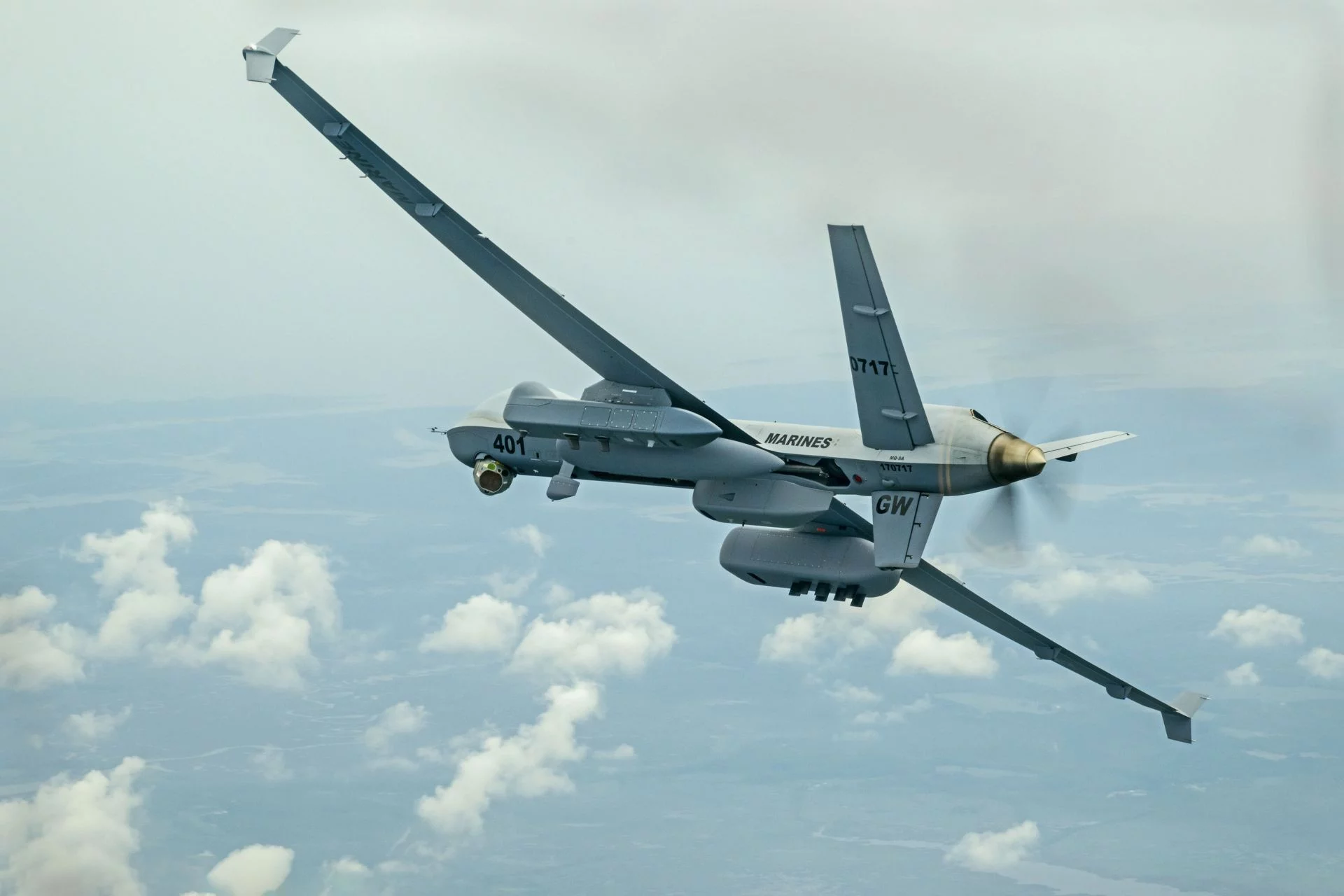
On August 12, 2025, the Naval Air Systems Command (NAVAIR) announced the first flight of an MQ-9A Reaper equipped with new communication and electronic support pods, marking a key milestone toward achieving Initial Operational Capability (IOC) later this year. The aircraft, assigned to Air Test and Evaluation Squadron (UX) 24, flew with the SkyTower II and RDESS/SOAR pods, confirming successful integration of these systems on a platform central to U.S. maritime and expeditionary operations.
SkyTower II Pod
Developed by GALT and integrated through NAVAIR’s middle-tier acquisition process, the SkyTower II pod enhances airborne networking and data-sharing capabilities across forces. It is essential for executing Intelligence, Surveillance, and Reconnaissance (ISR) operations and enables MQ-9s to act as airborne “digital quarterbacks” supporting Marine Corps missions in the Indo-Pacific. The first operational deployment is planned for 2026 with Marine Unmanned Aerial Vehicle Squadron (VMU) 3 at Kaneohe Bay, Hawaii.
RDESS/SOAR Pod
Developed jointly by General Atomics and L3Harris, the RDESS/SOAR pod is a broad-spectrum passive electronic support payload capable of detecting, collecting, and geolocating signals at standoff ranges. It has been tested on U.S. Air Force MQ-9s since 2021. According to Marine Corps Commandant General Eric M. Smith, the system can replicate detected signals for retransmission, providing an additional layer of operational protection.
MQ-9A Reaper Features
Derived from the Predator B, the turboprop-powered MQ-9A is a multi-mission unmanned aircraft designed for long-endurance operations over land and sea. It can remain airborne for over 27 hours, reach speeds of 240 knots, and operate at altitudes up to 50,000 feet, carrying up to 3,850 pounds of payload. The aircraft features modular architecture to accommodate EO/IR systems, multimode radar, maritime surveillance radars, SIGINT/ESM systems, communications relays, and precision-guided munitions. The Extended Range (ER) version increases endurance to 34 hours with additional fuel tanks and reinforced landing gear.
Operational Impact
The Marine Corps plans to use the upgraded MQ-9As to support the Marine Littoral Regiment, performing ISR-T (Intelligence, Surveillance, Reconnaissance, and Targeting), Maritime Domain Awareness, Airborne Network Extension, Airborne Early Warning, and Electronic Support missions. The integration of SkyTower II and RDESS/SOAR pods expands the MQ-9A’s connectivity, resilience, and signal detection capabilities, making it particularly valuable in contested Indo-Pacific environments.
The first flight of the MQ-9A with SkyTower II and RDESS/SOAR pods represents a significant advancement for U.S. forces, enhancing multi-domain operational capabilities and preparing the platform for full operational service in 2026. This modernization strengthens the Marine Corps’ ability to operate in complex, contested environments across the Pacific theater.
