

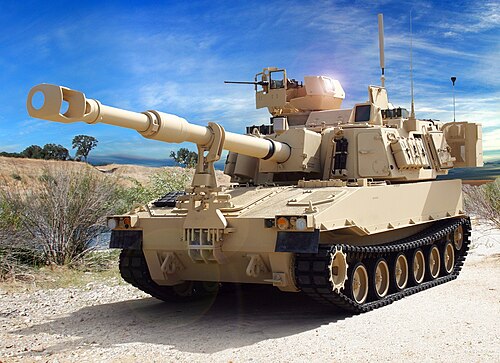
The M109 is a 155mm self-propelled howitzer (SPH) developed by the United States, forming a key component of modern artillery forces. Renowned for its mobility, firepower, and versatility, the M109 has been continuously upgraded since its introduction in the 1960s to meet evolving battlefield requirements.
- Platform & Mobility: The M109 is tracked and armored, allowing it to operate alongside mechanized and armored units in diverse terrains. Its mobility ensures rapid repositioning for “shoot-and-scoot” tactics, reducing vulnerability to counter-battery fire.
- Caliber & Firepower: Armed with a 155mm cannon, the M109 can deliver high-explosive, precision-guided, smoke, or illumination rounds over ranges exceeding 24 kilometers with standard rounds, and up to 30 kilometers with rocket-assisted projectiles.
- Crew & Operation: Typically operated by a five- to six-person crew, the M109 can fire in direct support of maneuver units or as part of coordinated artillery barrages. Modern variants feature automated loading and digital fire control for faster response.
- Upgrades & Variants: Over the decades, multiple versions have been introduced, such as the M109A6 Paladin, which includes improved armor, GPS-guided navigation, enhanced fire-control systems, and automated ammunition handling for increased accuracy and rate of fire.
- Strategic Role: The M109 provides mobile, long-range fire support, capable of engaging enemy positions, fortifications, and troop concentrations while maintaining high survivability and flexibility on the battlefield.
- Global Use: Beyond the U.S., the M109 series is used by numerous allied nations, often customized with local upgrades to fit operational requirements.
The M109 155mm self-propelled howitzer remains a cornerstone of modern artillery, combining powerful fire support, mobility, and adaptability to sustain ground combat effectiveness in contemporary operations.
