

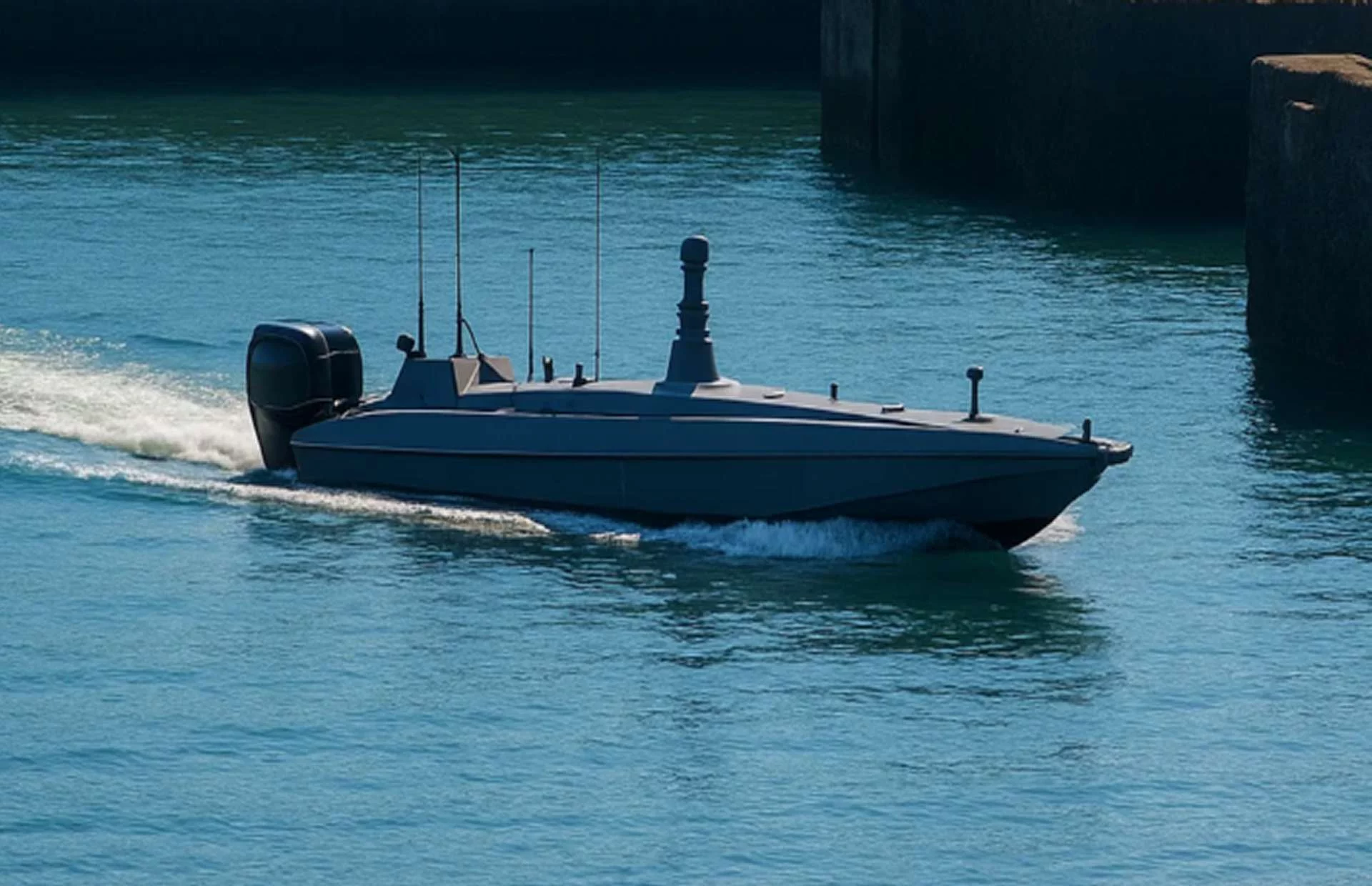
According to the Taipei Times on August 25, 2025, Taiwan’s armed forces have approved the procurement of 1,320 Kuai Chi uncrewed surface vessels (USVs) to expand asymmetric naval capabilities. The decision follows a successful live-fire demonstration at Jiupeng Military Base during the Sea and Air Precision Ammunition Firing Exercise, where the drones struck targets effectively under simulated electronic warfare conditions.
The Kuai Chi is a fast, low-cost naval drone designed for swarm operations, capable of suicide attacks, electronic jamming, and coordinated actions with UAVs to disrupt amphibious landings and damage enemy fleets. Developed by the Chungshan Institute of Science and Technology, the USV features a lightweight hull optimized for speed, maneuverability, and reduced radar signature. Payloads can include high-explosive charges, sensors, and communication suites, with both remote and autonomous navigation options.
The system’s key advantage lies in swarm operations. Deployable in groups from a few units to several dozen, Kuai Chi drones can saturate enemy radar, force the use of precision munitions, and ensure that some units reach their targets. They can also act as decoys to protect Taiwan’s more valuable missile and drone assets. When integrated with Ching Feng I FPV or Albatross II UAVs, the system forms a comprehensive kill web linking sea, air, and electronic warfare capabilities.
Kuai Chi units are likely to operate along Taiwan’s western coast and critical maritime chokepoints such as the Taiwan Strait and Bashi Channel. Their expendable nature and relatively low cost make them a highly cost-effective countermeasure against larger surface combatants and advanced missile systems.
This initiative fits Taiwan’s broader “porcupine strategy,” emphasizing survivability, dispersion, and asymmetric deterrence. By complicating access to its coastline and integrating with land-based anti-ship missiles, mobile artillery, and drone networks, Taiwan increases the risk for any potential aggressor.
Additionally, Taiwan’s Executive Yuan has approved a NT$949.5 billion (US$31.04 billion) defense budget for 2026, funding next-generation frigates under the Zhenhai Project. These ships, equipped with advanced radar and vertical launch systems, will operate alongside unmanned platforms to form a modern surface fleet.
The Kuai Chi program, set to be highlighted at the Taipei Aerospace and Defense Technology Exhibition in September, demonstrates Taiwan’s advances in indigenous unmanned naval warfare and reinforces its readiness to counter evolving maritime threats.
