

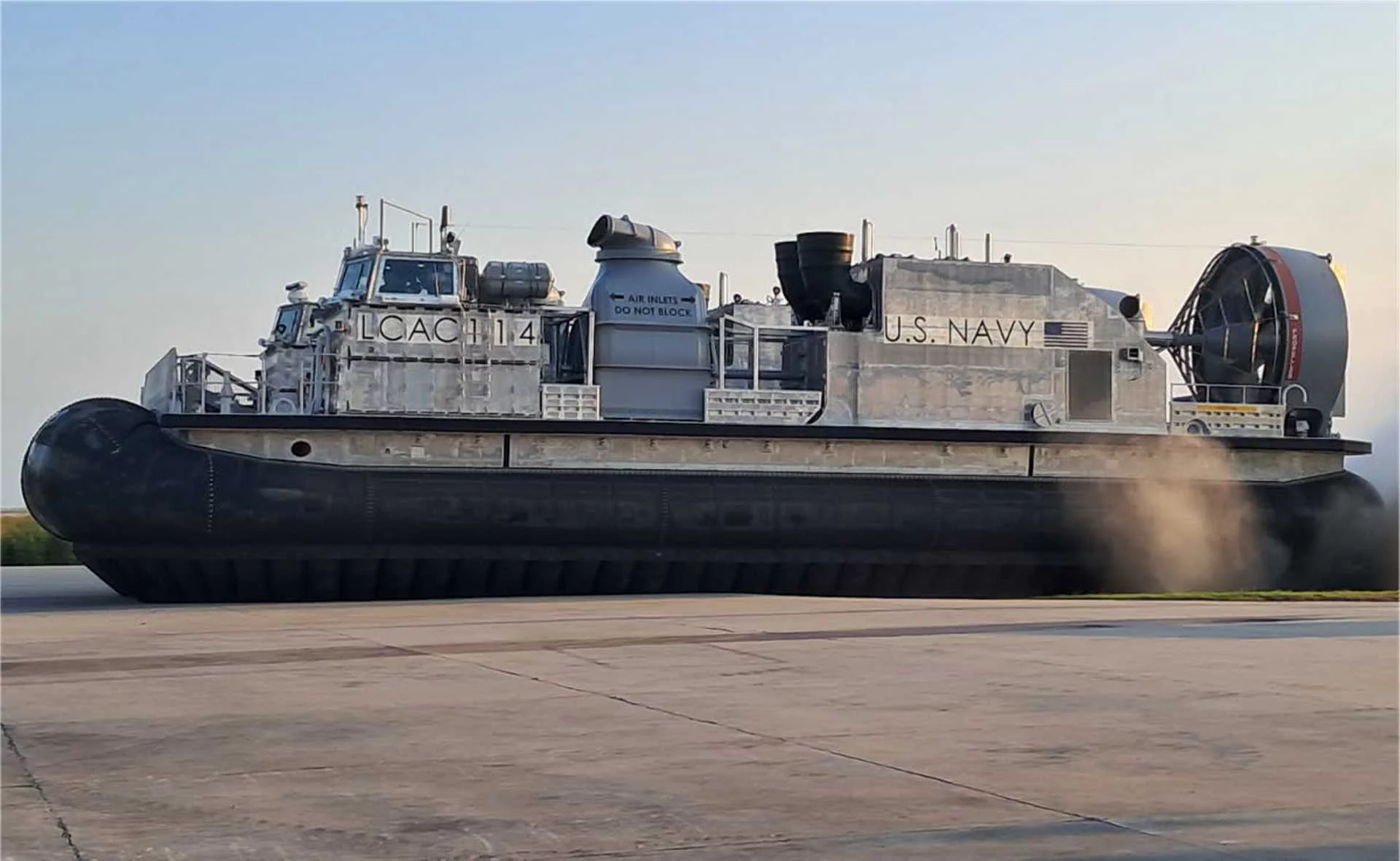
The U.S. Navy has officially accepted delivery of the LCAC 114 Ship to Shore Connector (SSC) from Textron Systems on August 28, following successful acceptance trials that confirmed its operational readiness. The event marks another milestone in the Navy’s modernization program to replace aging LCACs with advanced connectors for contested littoral operations.
The SSC, measuring 92 feet long and 48 feet wide, retains compatibility with existing Wasp and America-class amphibious assault ships. Powered by four Rolls-Royce MT7 engines derived from the V-22 Osprey, it provides greater fuel efficiency, enhanced output, and lower maintenance costs than its predecessors. A fly-by-wire system, modernized command-and-control, and advanced navigation equipment improve both maneuverability and crew safety.
With a payload capacity of 60–75 tons, LCAC 114 can transport an M1A2 Abrams tank, armored vehicles, artillery, or heavy logistics loads directly from sea to shore. Its ability to operate at speeds above 35 knots and land on more than 70% of the world’s coastlines makes it indispensable for both combat operations and humanitarian relief missions.
The craft is central to Indo-Pacific expeditionary concepts, enabling Marines to establish forward bases on remote islands while deploying armored vehicles or missile systems where adversaries may attempt to deny access. This capability significantly boosts U.S. deterrence in strategic chokepoints.
The Navy plans to acquire 73 SSCs in total, with 11 already delivered and production extending through 2031 at Textron’s New Orleans shipyard. Contracts worth over $1 billion have been awarded since 2024, ensuring long-term industrial capacity and sustaining amphibious shipbuilding expertise.
The arrival of LCAC 114 is more than just a fleet expansion—it embodies the fusion of modern technology, industrial resilience, and strategic necessity. As global competition intensifies, the SSC fleet will remain a cornerstone of America’s amphibious dominance well into the 2030s.
