

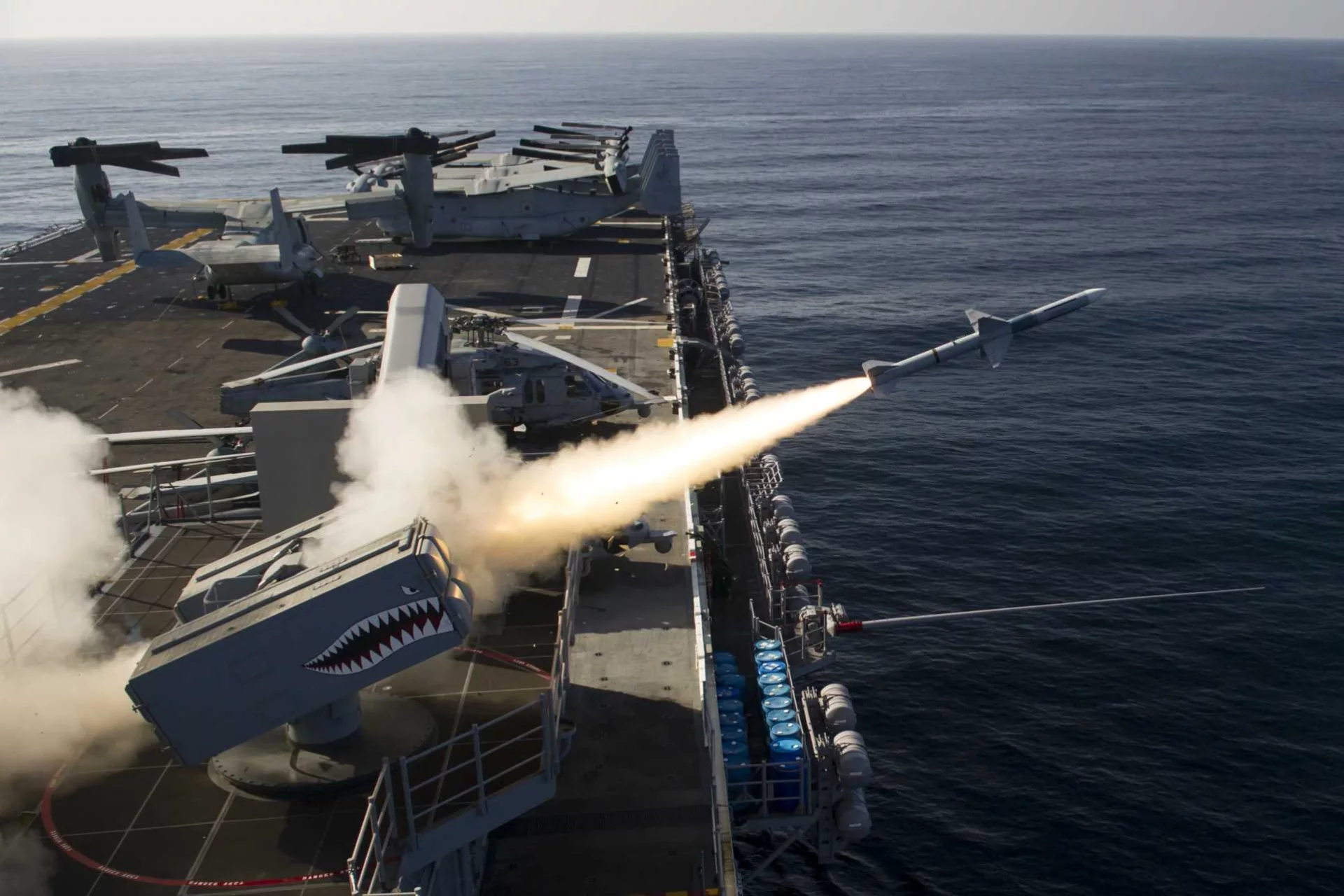
The RIM-7 Sea Sparrow is a radar-guided, medium-range surface-to-air missile (SAM) designed to protect naval vessels from aerial threats, including anti-ship missiles, aircraft, and UAVs. Developed in the 1960s–1970s as a derivative of the AIM-7 Sparrow air-to-air missile, it has evolved through multiple upgrades to remain relevant in modern naval defense. The missile is widely deployed on ships from various navies around the world and serves as a key component of layered fleet air defense systems.
Description and Development
- Purpose: Fleet air defense, intercepting supersonic and low-flying threats
- Developers: Originally Hughes Aircraft, now Raytheon (USA)
- Service Entry: 1976
- Platform Compatibility: Vertical Launch Systems (VLS), deck-mounted launchers (MK 29/48 GMLS), compatible with Aegis-equipped ships
- Operational Concept: Provides medium-range interception, protecting high-value assets like carriers and amphibious ships
Variants
- RIM-7A: Original SAM, semi-active radar homing, 1976
- RIM-7B: Mid-1980s upgrade with improved guidance and countermeasure resistance
- RIM-7C: Late 1980s, enhanced propulsion and integration with advanced ship fire control
- RIM-7E: Early 1990s, upgraded radar seeker, VLS compatibility, better low-altitude interception
- RIM-7P: Late 1990s, multimode radar seeker, enhanced electronics, VLS-ready
- RIM-162 ESSM: Early 2000s, active radar seeker, extended range, high maneuverability, NATO collaboration
- RIM-7X: Early 2010s, interim upgrade focused on radar and countermeasure improvements
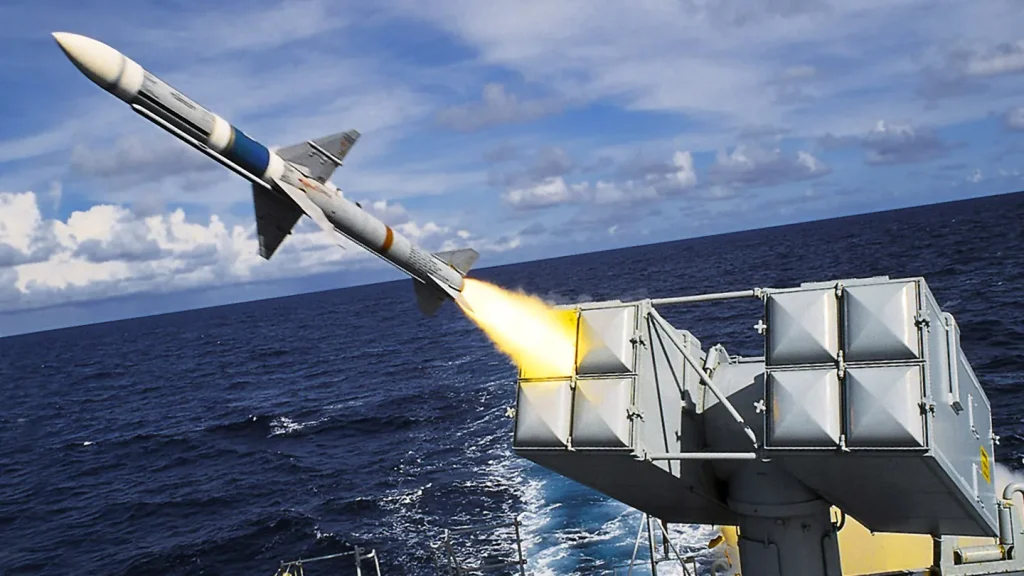
Design
- Length: 3.66 m
- Diameter: 0.18 m
- Wingspan: 1.15 m
- Aerodynamics: Cylindrical body, nosecone with radar seeker, mid-mounted fixed wings, rear stabilizer fins
- Propulsion: Solid-fuel rocket motor, supersonic speed (Mach 2.5)
- Warhead: 34 kg (75 lbs) high-explosive fragmentation, effective against missiles and aircraft
- Guidance: Semi-active radar homing (RIM-7A to RIM-7P), active radar homing (ESSM/RIM-162)
Performance
- Range: 15–25 km (9–16 miles)
- Speed: Mach 2.5 (~3,000 km/h or 1,864 mph)
- Launch Weight: ~227 kg (500 lbs)
- Launchers: VLS, MK 29 GMLS, MK 48 GMLS, and other naval-compatible systems
Combat Use
- Primary Role: Fleet air defense against anti-ship missiles, fast aircraft, and UAVs
- Operational Concept: Medium-range interception, protecting high-value naval assets
- Advantages:
- Intercepts low-flying and supersonic targets
- Compact size for versatile deployment on multiple ship classes
- Effective in electronic warfare and countermeasure-rich environments
Users
- Countries: Australia, Canada, Denmark, Germany, Greece, Japan, Netherlands, Norway, South Korea, Spain, Turkey, United Kingdom, United States, Saudi Arabia, Qatar
The RIM-7 Sea Sparrow remains a key medium-range air defense missile for navies worldwide, combining compact design, high speed, and precision guidance to defend ships against modern aerial threats.
