

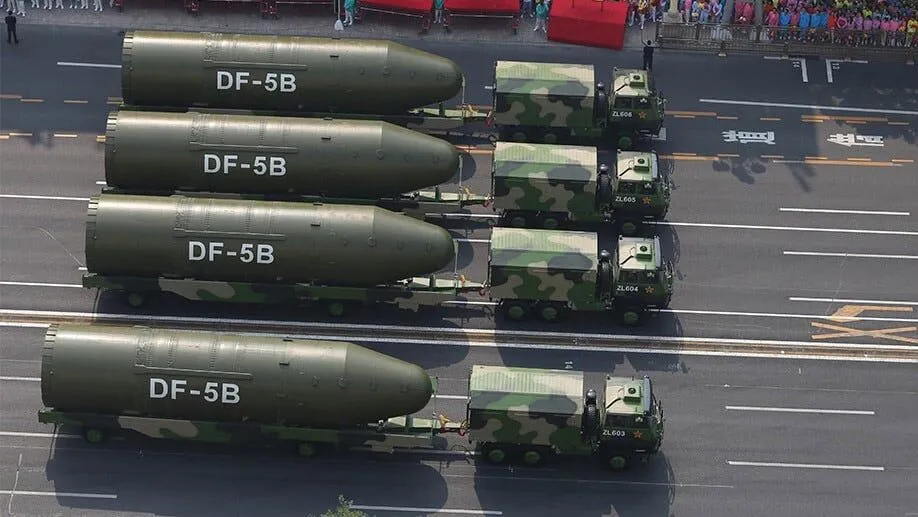
On 3 September 2025, China unveiled its DF-5C intercontinental ballistic missile (ICBM) during the Victory Day Parade in Beijing’s Tiananmen Square, commemorating the 80th anniversary of the end of World War II. The missile was presented in three separate sections—first stage, upper stage, and warhead—reminiscent of the original DF-5 debut in 1984. The parade also showcased China’s land, sea, and air nuclear forces together for the first time, highlighting the establishment of a nuclear triad.
The DF-5C is a silo-based, two-stage, liquid-fueled missile. Its first stage is powered by four engines, suggesting significant payload capacity. Analysts report a range exceeding 20,000 kilometers, enabling strikes anywhere on Earth. The missile can carry 10–12 MIRVs or a single multi-megaton warhead, with options for mixed nuclear and conventional payloads or decoys. Guidance combines inertial navigation, star tracking, and the Beidou satellite system for intercontinental accuracy.
The DF-5C continues the evolution of the DF-5 family, which began in the late 1960s. The original DF-5 entered service in 1981, with subsequent DF-5A and DF-5B variants extending range and adding MIRV capability. The DF-5C is positioned as a successor to the DF-5A and a heavier strategic option than the DF-5B.
Other nuclear systems were also displayed. The navy presented the JL-3 submarine-launched ballistic missile, while the air component showcased the JL-1 air-launched missile aboard H-6N bombers. This marked the first public display of China’s nuclear triad.
New land-based systems drew attention as well. The DF-61, carried on a 16-wheeled transporter, resembles the DF-41 and may represent a modified or advanced variant. The DF-31BJ appears as a transporter or silo support vehicle for China’s large ICBM fields. Analysts identified nine different ICBM versions, reflecting a diverse developmental approach across propulsion types, basing, and payloads.
Chinese officials emphasized that the DF-5C and related systems align with a long-standing defensive nuclear strategy, reaffirming no-first-use policy and non-use against non-nuclear states. Western analysts interpreted the parade as a strategic deterrence message, highlighting the nuclear triad.
The DF-5C’s silo-based, multi-warhead design, combined with decoys, complicates missile defense interception. Claims of global strike capability and rapid launch readiness enhance its strategic significance. Some analysts linked DF-5C to potential fractional orbital bombardment (FOBS) capability, which reduces warning time and makes attack trajectories unpredictable.
Overall, the DF-5C’s debut demonstrates both China’s technical progress and strategic intent, influencing U.S., NATO, Indian, Japanese, and Australian defense planning.
