

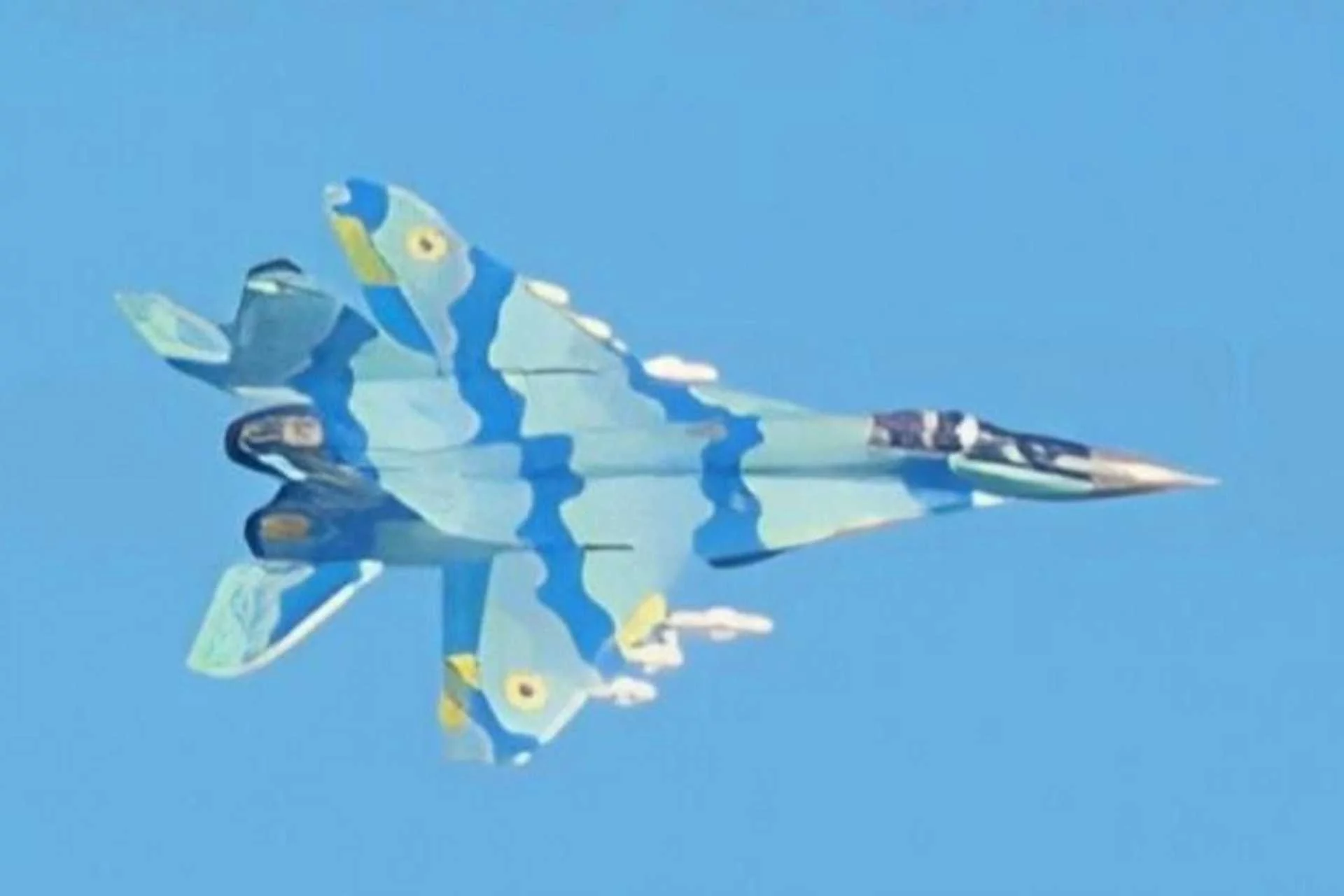
Photographs emerging on September 3, 2025, show a Ukrainian Air Force MiG-29 painted in an Azerbaijani-style camouflage, armed with R-27 medium-range and R-73 short-range air-to-air missiles. Shared on the X account Cloooud, the image—though undated and of undisclosed location—appears consistent with standard combat-ready MiG-29 configurations. It suggests that at least one fighter previously linked to Azerbaijan is now operating in Ukraine.
Background: Azerbaijani MiGs in Lviv
On February 24, 2022, three Azerbaijani MiG-29s were undergoing repairs and modernization at Ukraine’s Lviv State Aircraft Repair Plant. Shortly after, Russian missile strikes hit the facility, destroying a hangar and initially raising concerns that the jets were lost. Subsequent evidence confirmed that at least one aircraft survived and returned to operational service. How these aircraft came under Ukrainian control remains unclear, with sources speculating a mix of emergency requisition and possible Azerbaijani consent.
The MiG-29 in question retains Azerbaijani-style paint and is equipped with a standard weapon loadout—R-27 missiles for beyond-visual-range engagements and R-73 missiles for close combat. While the exact number of aircraft transferred to Ukraine has not been confirmed, the presence of even a single operational jet strengthens Kyiv’s air defense capabilities amid sustained fleet losses.
Ukraine’s MiG-29 Fleet: Challenges and Adaptations
Inherited from the Soviet Union and later upgraded domestically to MU1 and MU2 standards, Ukraine’s MiG-29s have remained central to its air defense strategy. At the onset of Russia’s full-scale invasion in February 2022, dozens were active, though many required modernization. With U.S. support, Ukrainian engineers adapted the jets to launch AGM-88 HARM missiles, extending their role into suppression of enemy air defenses. Despite heavy losses—at least 29 destroyed by March 2025—reinforcements from Poland and Slovakia helped sustain operations. MiG-29s continue to intercept drones, cruise missiles, and aircraft, serving as an interim capability alongside incoming F-16 fighters.
Azerbaijan’s Role and Historical Connections
Azerbaijan has maintained a cautious stance between Russia and Ukraine, providing humanitarian and energy aid to Kyiv while avoiding military involvement. The MiG-29s themselves have a long-standing connection with Ukraine, having been purchased secondhand beginning in 2007 and repeatedly sent to Lviv for upgrades. The Azerbaijani fleet consists of single-seat and twin-seat trainers, some equipped with advanced avionics and electronic countermeasure systems.
MiG-29: Legacy and Modernization
Known as the Fulcrum by NATO, the MiG-29 was designed in the 1970s for air superiority against Western fighters such as the F-15 and F-16. Powered by twin Klimov RD-33 engines, it can exceed Mach 2 and carry roughly 4,000 kilograms of weapons, including R-27, R-73, and later R-77 missiles. Modern Ukrainian variants have also been adapted to fire U.S.-supplied HARM missiles using improvised tablet interfaces. Advanced versions like the MiG-29M, MiG-29K, and MiG-35 continue to evolve, enhancing radar, avionics, fuel capacity, and survivability.
Strategic Implications
For Ukraine, reintegrating these aircraft offers a tangible air defense boost during a prolonged conflict. Leveraging surviving MiG-29s—whether domestic or formerly Azerbaijani—allows Kyiv to maintain a multi-role fighter presence until larger numbers of Western aircraft are operational.
