

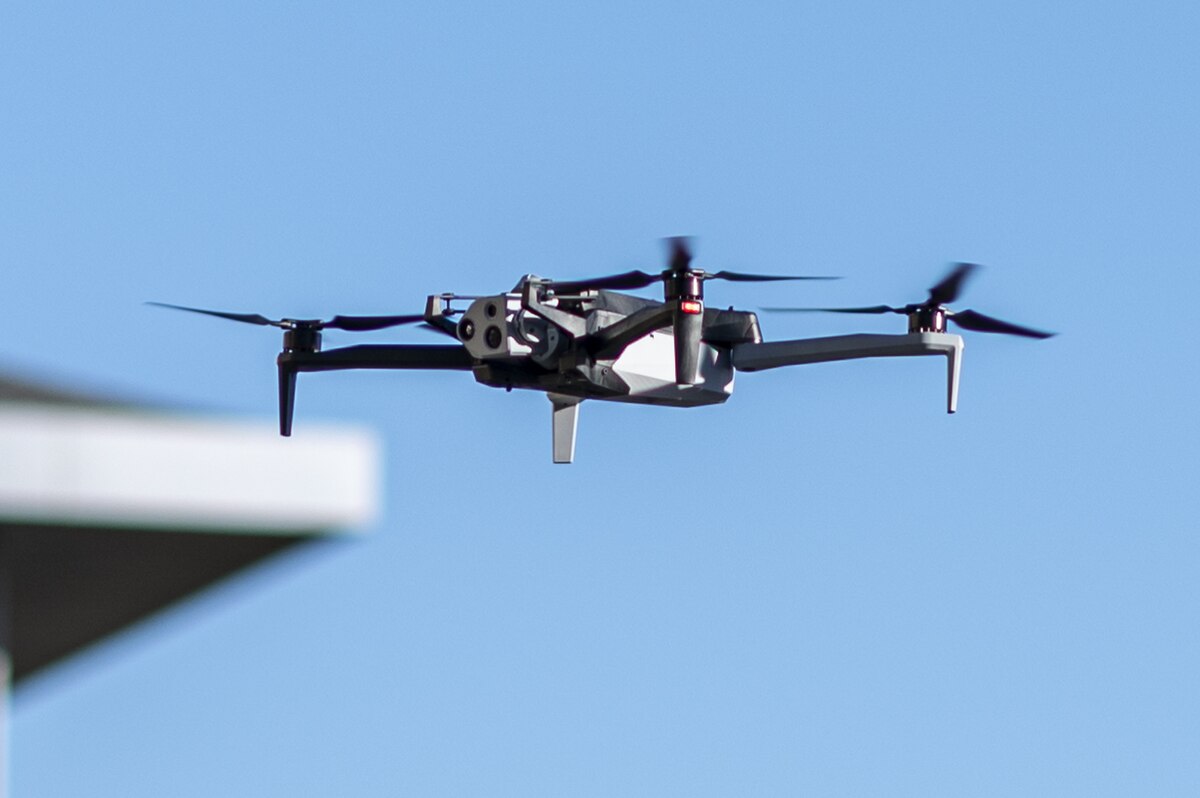
At Grafenwoehr Training Area in Germany, the Joint Multinational Training Group–Ukraine (JMTG-U) UAV innovation team conducted a live-fire exercise from September 9–12, 2025, using Skydio X10 Delta drones to drop 117 live M67 fragmentation grenades. Supported by the U.S. Army Combat Capabilities Development Command (DEVCOM), the test represents a step toward integrating precision-guided firepower into small tactical formations.
The Skydio X10 Delta, a compact quadcopter designed for military and security missions, was fitted with a second-generation Audible Dropper, enabling controlled release of hand grenades from the air. This marks an evolution from earlier prototypes, offering greater reliability and accuracy under operational conditions.
Each M67 grenade weighs roughly 400 grams, producing a lethal fragmentation radius of about five meters. Drone deployment extends their range from a soldier’s throw of 30 meters to over one kilometer, providing frontline units with a low-risk option for lethal or suppressive fire.
During the trials, engineers and soldiers tested the system’s limits, adjusting release timing, flight stability, and reliability in real time. The compact dropper maintained drone stability, and accuracy improved throughout the exercise.
At the tactical level, this capability alters small-unit combat dynamics. Infantry can engage entrenched positions, clear cover, or disrupt supply points without exposing themselves. In urban environments, drones can strike targets from rooftops or alleyways, maintaining standoff safety while sustaining operational pressure.
This multinational training program, designed to support Ukrainian defense reforms, serves as a laboratory for lessons learned from current conflicts, where drones have become precision strike tools. The U.S. Army aims to institutionalize safe, repeatable methods rather than rely on improvised commercial solutions, reflecting a shift toward rapid prototyping and battlefield-informed innovation.
