

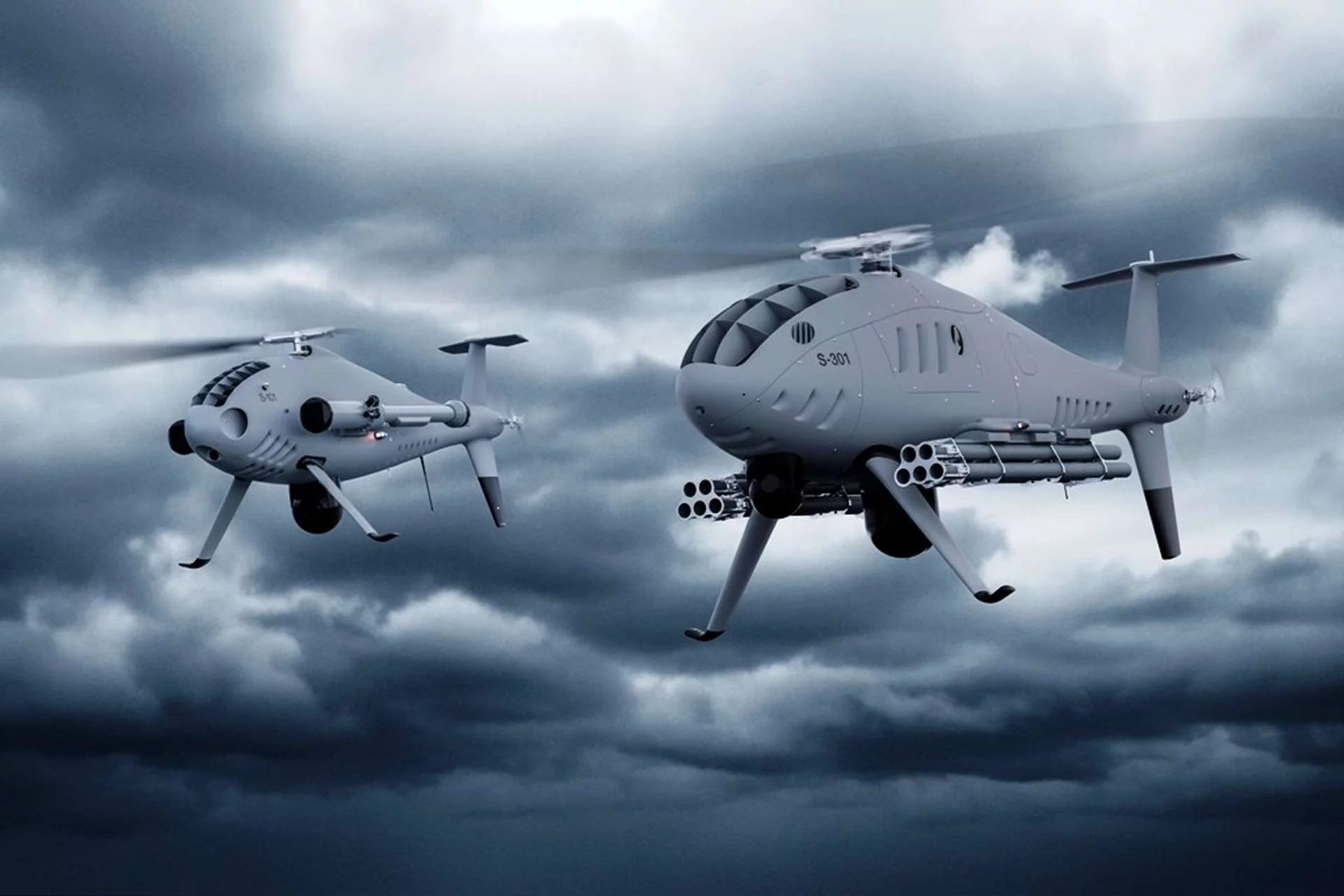
At DSEI UK 2025, Schiebel announced two new rotary-wing unmanned air systems designed specifically for weapon integration: the CAMCOPTER S-101 and S-301. These platforms represent a major expansion of the Camcopter family into the armed UAS market, offering combined intelligence, surveillance, and precision-strike capabilities.
Both systems build on the proven S-100 lineage but feature redesigned architectures optimised for weaponisation, modular payload integration, and military-grade avionics. Developed by Schiebel Defence GmbH in Wiener Neustadt, Austria, the S-301 stands out with a payload capacity of roughly 250 kg — five times that of the S-100. This enables the integration of EO/IR sensors, laser designators, compact radars, and weapons such as Thales FZ605 rocket launchers firing FZ275 laser-guided rockets with ranges up to 7 km. Industry sources also suggest compatibility with lightweight missiles like Martlet/LMM, enabling a scalable sensor-to-shooter capability.
While the Royal Navy operates the S-100 (known as Peregrine) for ISR missions, its payload limitations prevent meaningful weaponisation. The S-101 and S-301 are designed to overcome that limitation, delivering both reconnaissance and strike capability while retaining shipborne and VTOL flexibility. Compared to fixed-wing UAS, their rotary-wing configuration allows operations from confined spaces and rapid sensor repositioning, ideal for naval and land forces.
Schiebel’s move into armed UAS reflects a broader trend toward distributed, unmanned strike systems at the tactical level. For navies, these platforms offer cost-effective ways to extend surveillance and strike reach without manned aircraft. For ground forces, they deliver organic precision fires against asymmetric or conventional threats. Their progress will be closely monitored by militaries seeking dependable armed UAS solutions for contested, multi-domain environments.
