

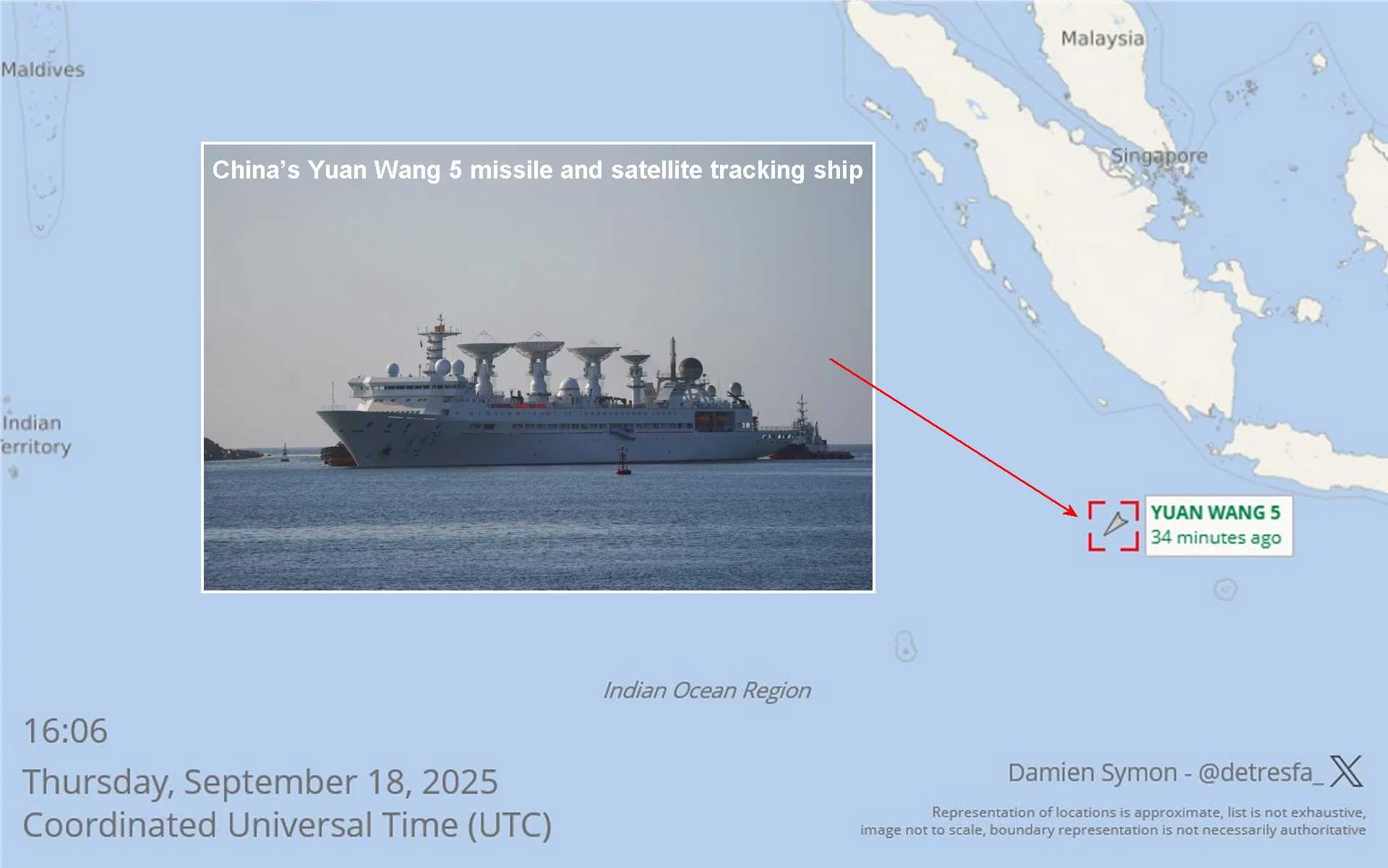
China’s Yuan Wang 5 missile and satellite tracking ship has sailed into the Indian Ocean, reigniting concerns in Washington and New Delhi about Beijing’s expanding maritime surveillance network. The deployment comes at a moment of intensified U.S.-India defense cooperation and raises new questions over China’s long-range intelligence ambitions in the Indo-Pacific.
A Strategic Intelligence Asset
Operated by the PLA Strategic Support Force, the Yuan Wang 5 is one of China’s most advanced missile tracking vessels. Equipped with massive radar dishes, sophisticated telemetry receivers, and encrypted satellite links, it can monitor ballistic missile tests, satellite orbits, and naval maneuvers thousands of kilometers away. While Beijing calls it a “scientific research platform,” defense analysts see it as a dual-use asset feeding real-time intelligence to the Chinese Navy.
India’s Rising Concern
The vessel became infamous in 2022 after docking in Sri Lanka, sparking Indian fears that it could observe missile trials and track nuclear-powered submarine movements. Its latest appearance coincides with the Malabar 2025 naval exercises, where India, the U.S., Japan, and Australia conduct joint drills in the Indian Ocean.
A Challenge to U.S. Surveillance Dominance
Pentagon officials consider the ship’s presence part of a wider PLA effort to erode American intelligence and surveillance advantages. By deploying long-range tracking assets to critical sea lanes, China signals its ability to monitor allied operations, disrupt logistics, and provide targeting support for long-range strike systems like the DF-21D and DF-26.
The New Battlefield: Information
Analysts stress that the Indo-Pacific competition is no longer just about carrier strike groups or submarines—it is about who controls the information environment. For the U.S. and India, this deployment strengthens the case for deeper integration of satellite communications, joint maritime domain awareness, and expanded QUAD ISR cooperation.
Technical and Strategic Implications
Launched in 2007, the 25,000-ton Yuan Wang 5 can remain on station for weeks. Its advanced sensors and electronic warfare suite allow it to collect radar signatures, intercept communications, and deliver real-time data to Chinese strategic command networks—capabilities that could directly shape future conflict scenarios.
