

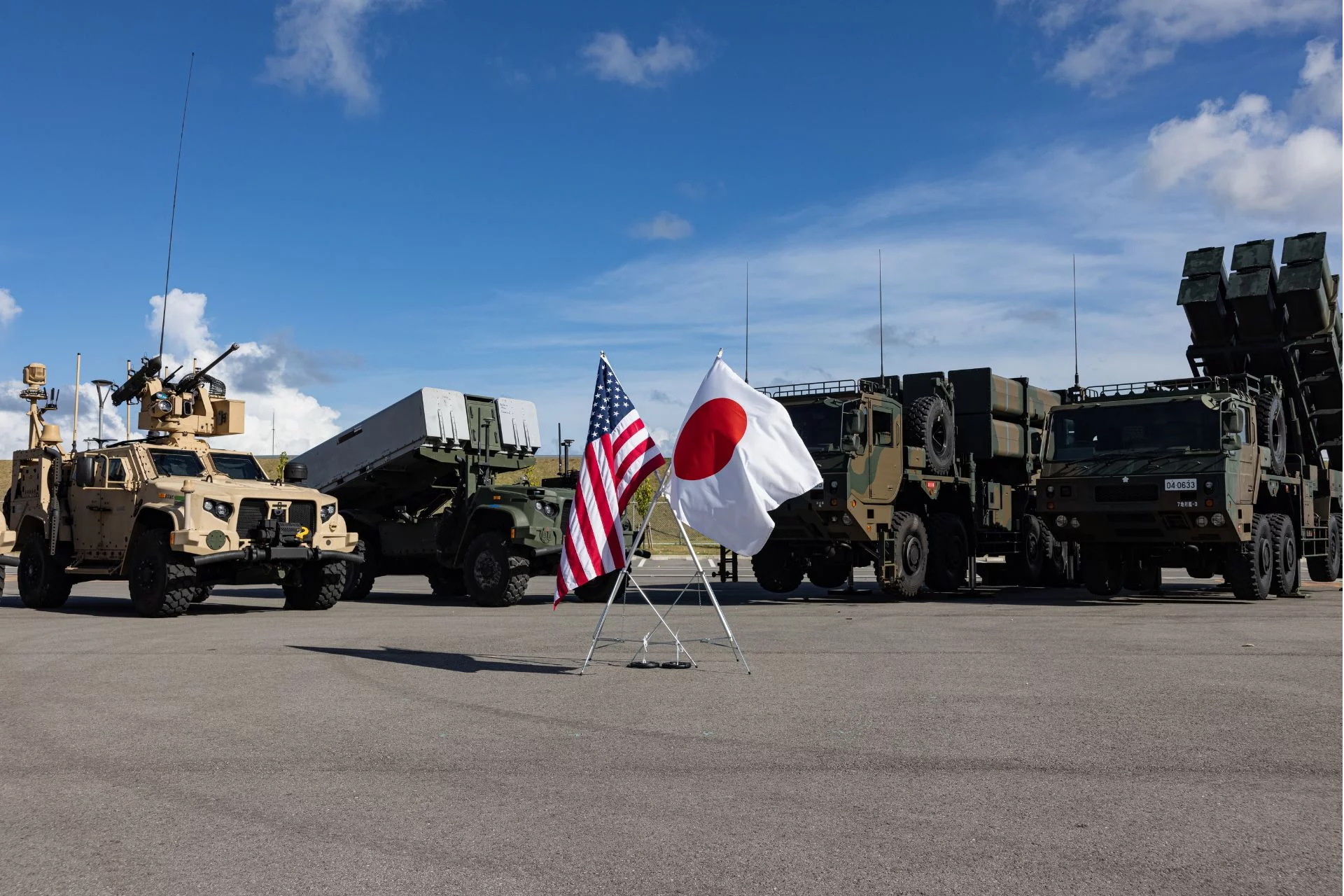
On September 17, 2025, the U.S. Marine Corps and Japan’s Ground Self-Defense Force jointly displayed their latest missile and air defense systems during Exercise Resolute Dragon 25 at Camp Ishigaki, Okinawa. The lineup included the U.S. NMESIS (Navy-Marine Expeditionary Ship Interdiction System) anti-ship system, the MADIS (Marine Air Defense Integrated System), Japan’s Type 12 Surface-to-Ship Missile, and the Type 03 Medium-Range Surface-to-Air Missile. The event was attended by Lt. Gen. Roger Turner, commanding general of III Marine Expeditionary Force, and Lt. Gen. Seiji Toriumi, commanding general of the Western Army.
U.S. Systems: NMESIS and MADIS
NMESIS is based on the ROGUE Fires Carrier mounted on a JLTV chassis, launching the Naval Strike Missile (NSM). With a range of roughly 185 km, the sea-skimming NSM uses INS, GPS, and infrared guidance for near-precision strikes within 10 meters. As the Marine Corps’ first land-based anti-ship capability, NMESIS is a core part of the Force Design 2030 strategy to enhance mobility and lethality in littoral operations.
MADIS, mounted on JLTVs, consists of two complementary vehicles. The Mk1 variant is equipped with Stinger missiles and a 30 mm cannon for engaging aircraft and helicopters, while the Mk2 provides drone detection and command-and-control through its RPS-62 radar. Together, they form a short-range air defense shield protecting forward bases and maneuver units from aircraft, drones, and cruise missiles.
Japanese Systems: Type 12 and Type 03
Japan’s Type 12 SSM, produced by Mitsubishi Heavy Industries, serves as the backbone of its coastal defense strategy. Initially with a 200 km range, upgraded versions can strike targets up to 400 km away, with a 1,000 km-range variant under development. The Type 03 SAM delivers critical medium-range air defense coverage, safeguarding ground forces and key infrastructure.
Strategic Message and Taiwan Context
Resolute Dragon 25 is more than a technical drill — it is a message of deterrence. “These activities send a clear message to anyone who might threaten regional security,” said Turner.
Ishigaki Island, located only 270 km from Taiwan, was chosen deliberately, underscoring its strategic relevance. The combined presence of NMESIS, MADIS, and Japanese systems demonstrates allied ability to control sea lanes and protect airspace in a potential crisis scenario. The exercise tested interoperability between U.S. EABO concepts and Japan’s island defense strategy, highlighting seamless cooperation.
For both Washington and Tokyo, the display reinforces their commitment to the Indo-Pacific and signals to Beijing that any attempt to alter the status quo will meet a coordinated and credible response.
