

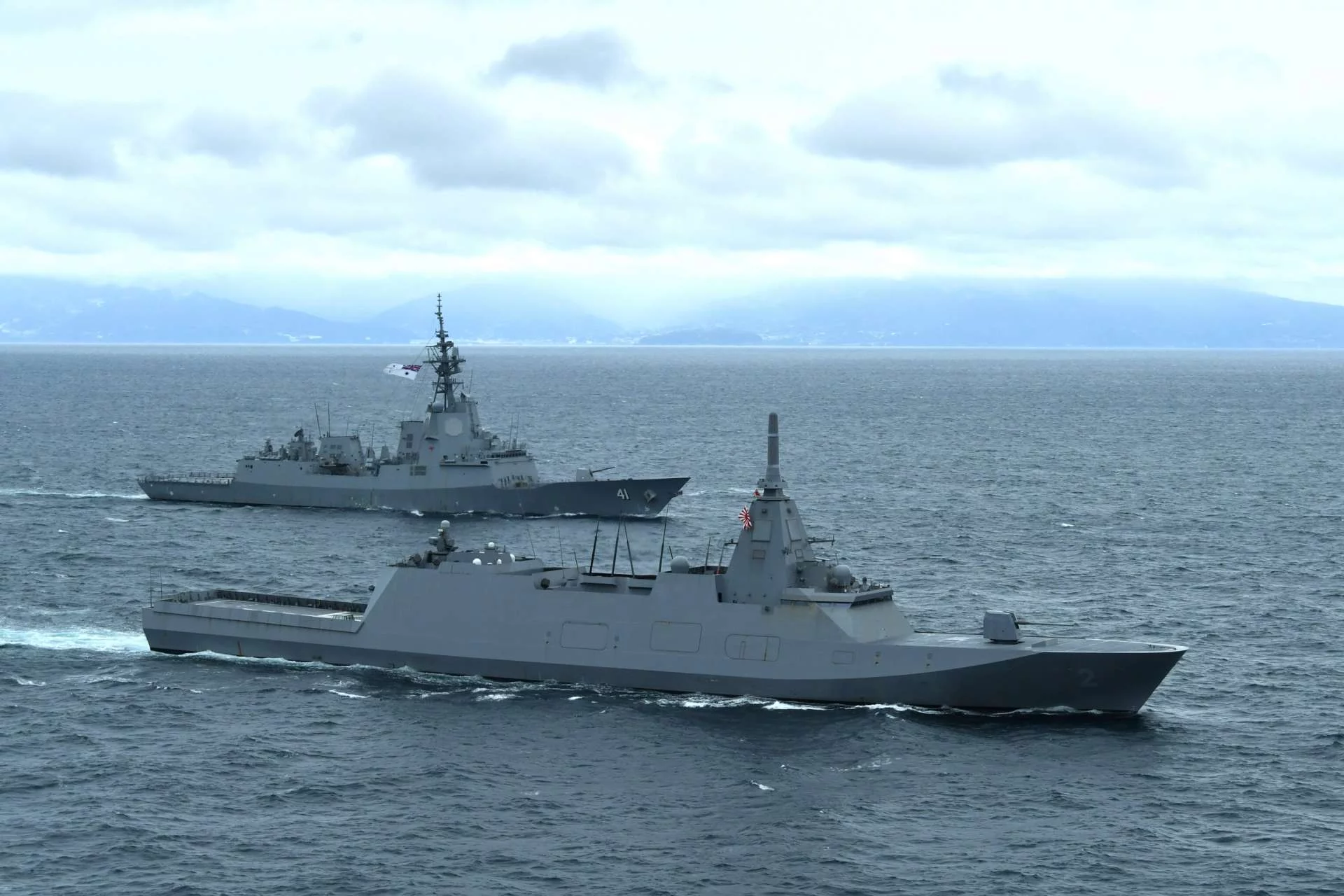
The Japan Maritime Self-Defense Force (JMSDF) and the Royal Australian Navy (RAN) conducted a high-profile bilateral drill in the strategically vital waters of Sagami Bay. Known as “Nichi-Gou Trident 25-3,” the exercise brought together the JMSDF’s state-of-the-art multi-mission frigate JS Kumano and the RAN’s advanced air-warfare destroyer HMAS Brisbane.
The drill focused on seamless data sharing, tactical maneuvering, and realistic operational scenarios, including LINKEX communications, PHOTOEX sessions, and formation maneuvers. These activities tested and enhanced the two navies’ ability to operate jointly under real-world conditions.
JS Kumano, part of the Mogami-class stealth frigate fleet, is equipped with advanced sensor fusion, automation for reduced crew needs, and stealth features optimized for both littoral and open-ocean missions. HMAS Brisbane, armed with the Aegis combat system and SM-2 missiles, provides robust layered air defense. Together, the two warships form a powerful maritime force capable of integrated air defense, anti-submarine warfare, and precision surface strike missions.
Beyond technical training, this exercise sends a strong message of deterrence. Japan and Australia are signaling their commitment to preserving a rules-based order in the Indo-Pacific and countering China’s growing military assertiveness. By deepening interoperability, the two allies are reinforcing a credible security architecture that complements U.S. presence while building an independent layer of regional deterrence.
