

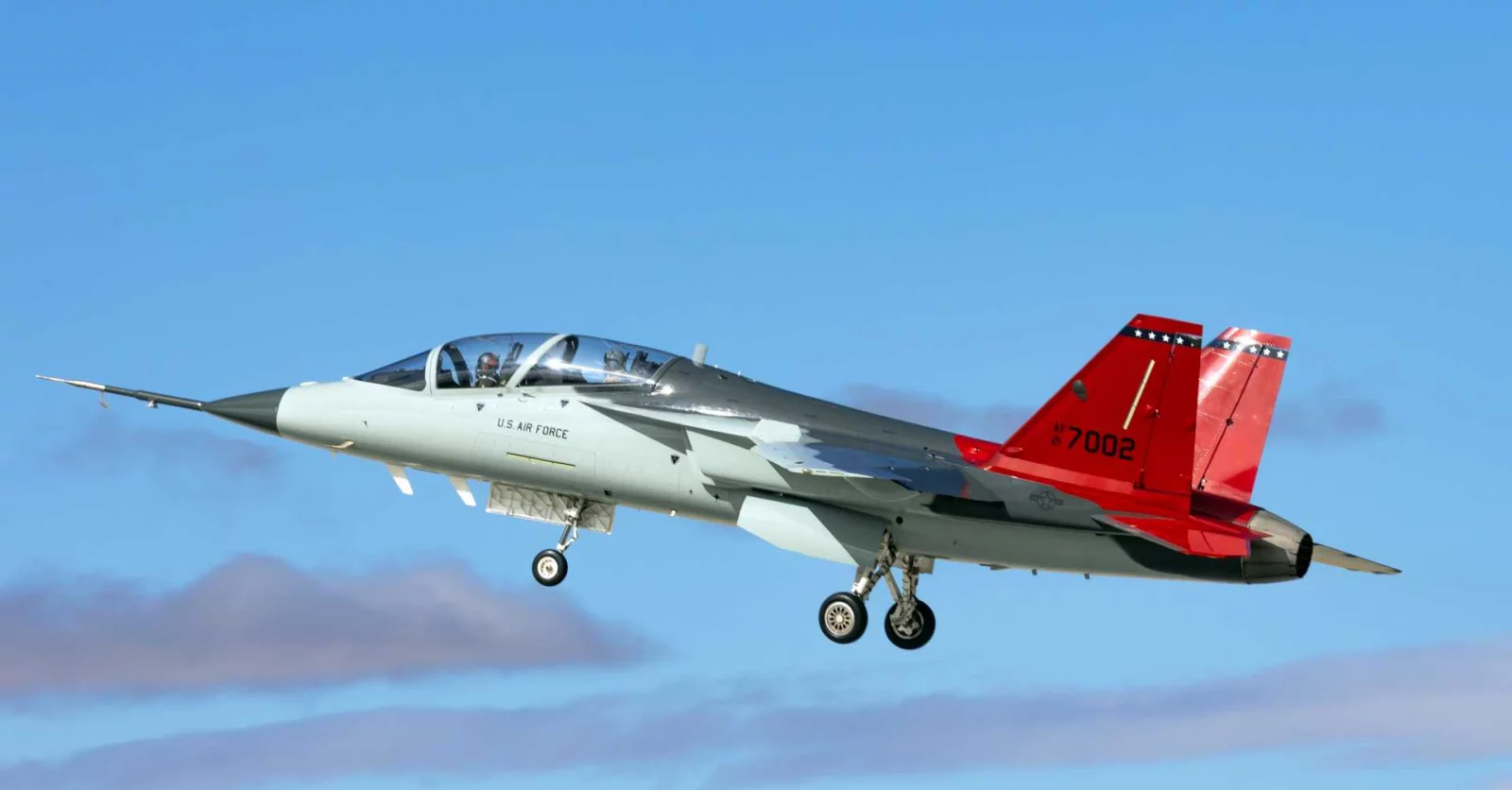
Boeing has successfully connected a T-7A Red Hawk simulator with a U.S. Air Force T-7A trainer flying over 130 miles away, a major step forward for “blended training” that could transform how pilots are prepared for combat.
The demonstration achieved a seamless, low-latency data link between the simulator’s virtual battlespace and the live aircraft, enabling both pilots to interact as if sharing the same environment. This success moves the Air Force closer to its goal of integrating live, virtual, and constructive (LVC) systems into a unified training architecture.
Boeing officials highlighted that this capability elevates the T-7A beyond being just a jet trainer, turning it into a digital backbone for future air combat readiness. Mixed live-virtual training allows student pilots to gain complex mission experience while reducing flying hours on costly frontline fighters, preserving aircraft lifespan and lowering training expenses.
The T-7A Red Hawk, co-developed by Boeing and Saab, represents a leap forward over the aging T-38 Talon. Equipped with a General Electric F404 engine, fly-by-wire controls, and an open systems architecture, the Red Hawk is optimized to prepare pilots for fifth-generation fighters such as the F-22 and F-35. Its fully integrated simulator suite mirrors the cockpit layout, allowing a smooth transition from ground-based training to flight.
Defense analysts suggest that such networked training could eventually include operational fighters, bombers, and unmanned platforms, overlaying a synthetic environment on real-world missions. This would enable U.S. forces to rehearse complex operations more safely and cost-effectively while maintaining combat realism.
