

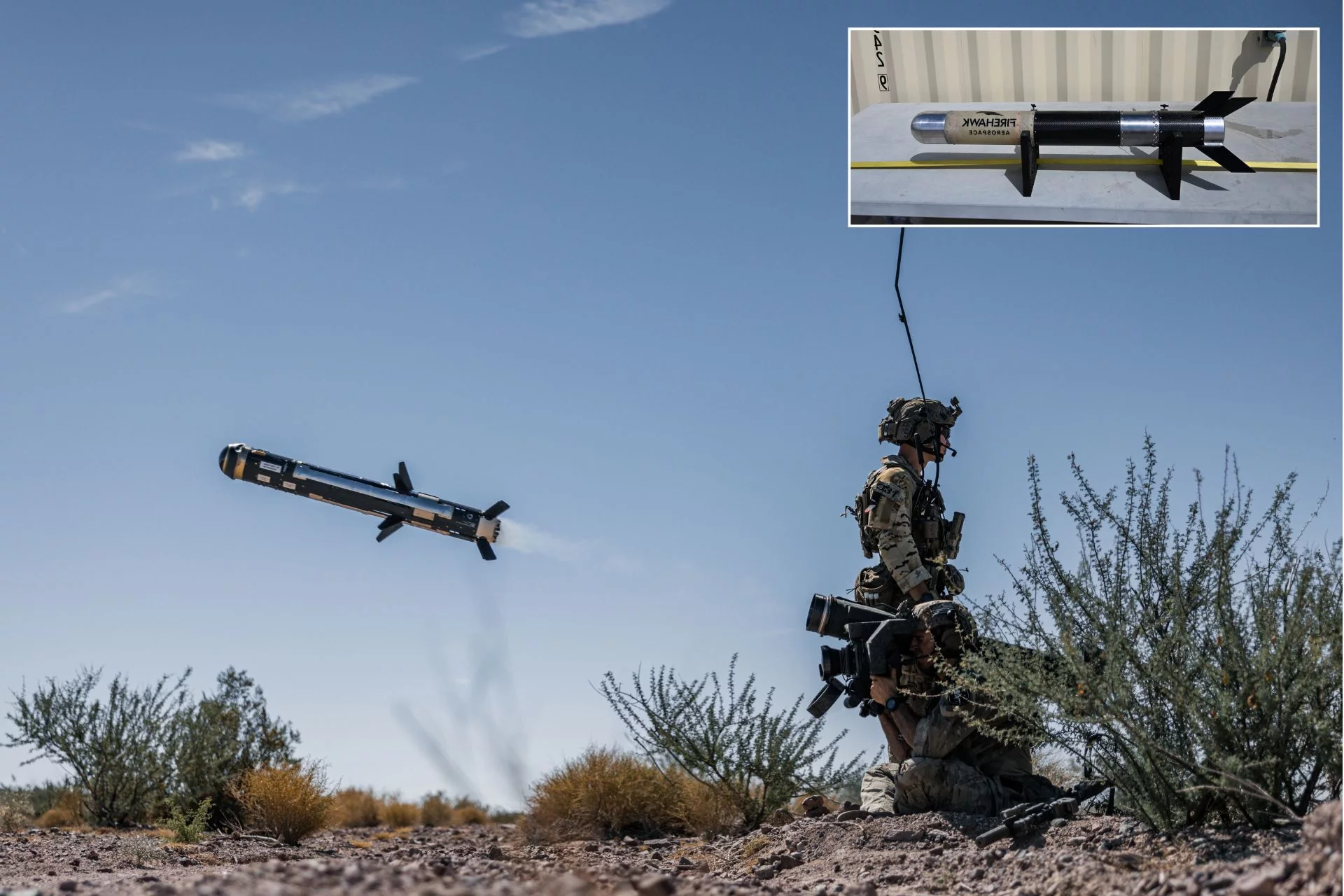
Firehawk Aerospace announced on Sept. 30, 2025, in Dallas that it has completed flight tests of launch motors sized to Javelin and Stinger classes using 3D-printed solid propellant, concluding a Phase III SBIR effort conducted with the Army Applications Laboratory. The company said the trials—branded as “Analog”—focused solely on propulsion performance rather than full missile firings.
The tests point to a potential manufacturing shift: additive-printed grains could shorten lead times and increase production flexibility compared with conventional cast-and-cure propellant processes. Coupled with Firehawk’s Aug. 26 demonstration of a GMLRS-class hybrid engine, the work suggests a broader push to expand additive options across multiple rocket-motor families.
From an operational standpoint, the key requirement is consistent, predictable thrust and signature. Javelin’s soft-launch profile, climb-and-dive attack arc, long-wave infrared seeker, and tandem warhead all rely on a stable propulsion chain—meaning a well-made printed grain that delivers the expected thrust curve can, in principle, slot into the existing firing sequence without altering sensor or launch interfaces. For Stinger, the challenge is the compact ejection and two-stage sustainer sequence needed for a shoulder-launched, fire-and-forget intercept; any new motor must match these timing and performance constraints.
Industrial advantages of printed propellants include reduced tooling needs, the ability to iterate grain geometries digitally, and the potential to run multiple small production cells—reducing batch size risks and enabling tailored lots for different temperature or thrust profiles. But major caveats remain: repeatability, insensitive-munitions compliance, qualification timelines, and cost parity must be proven before printed propellant displaces established cast lines. In that sense, the Phase III flight data add a complementary pathway rather than a wholesale replacement.
Given ongoing missile consumption for operational support and training, plus policy initiatives to onshore precursors and diversify suppliers, having an alternative production route—if it can be certified—would bolster resilience and shorten resupply timelines closer to deployed forces. Firehawk’s results therefore represent a meaningful step toward more agile rocket-motor production, while substantial validation work still lies ahead.
