

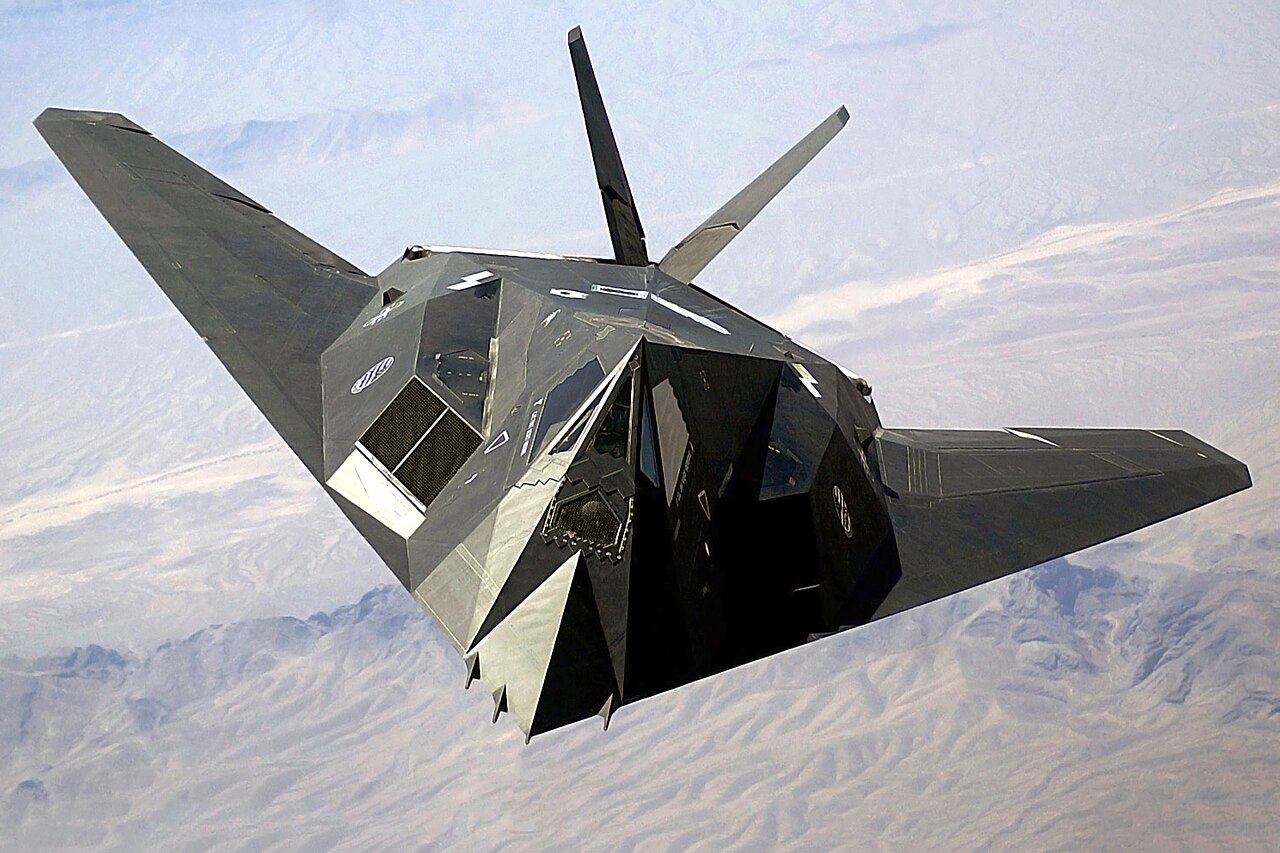
The Lockheed F-117 Nighthawk is a retired American single-seat, twin-engine stealth attack aircraft developed by Lockheed’s secretive Skunk Works division for the United States Air Force (USAF). It became the world’s first operational aircraft designed around stealth technology, setting the foundation for modern low-observable combat aviation.
Development and Origins
The F-117 program stemmed from the growing threat of advanced Soviet surface-to-air missile systems during the 1970s. Seeking a way to counter these defenses, the Defense Advanced Research Projects Agency (DARPA) awarded Lockheed a contract in 1976 to produce the Have Blue technology demonstrator. Test results proved successful, leading Lockheed to proceed with full development of the F-117 in 1978.
The first prototype flew in June 1981 at Groom Lake, Nevada, and the aircraft entered service in October 1983. A total of 64 aircraft were built, including five prototypes and 59 production models, with final delivery completed in July 1990.
Design and Stealth Features
The Nighthawk’s distinctive faceted shape gave it an exceptionally low radar cross-section—around 0.001 m². Its non-circular engine exhausts mixed hot gases with cooler outside air to reduce infrared signature, while the absence of afterburners limited it to subsonic speeds.
Although popularly nicknamed the “Stealth Fighter,” the F-117 was not a fighter in the traditional sense but a dedicated ground-attack aircraft built to penetrate heavily defended airspace and strike high-value targets.
Operational History
Initially shrouded in secrecy, the existence of the F-117 was not officially acknowledged until November 1988. Its first combat mission took place during the 1989 U.S. invasion of Panama.
The aircraft rose to prominence in the 1991 Gulf War, where F-117s flew around 1,300 sorties, striking over 1,600 critical Iraqi targets with pinpoint precision. The jet also saw action in the Yugoslav Wars, where one was famously shot down by a Serbian surface-to-air missile in 1999. Later, it participated in Operation Enduring Freedom (2001) and Operation Iraqi Freedom (2003).
Retirement
With the introduction of the F-22 Raptor, the F-117 was gradually retired, with the official retirement ceremony held in April 2008. Despite this, several Nighthawks remain flightworthy and have been spotted flying in the years following their retirement, suggesting they may still serve in limited test or training roles.
Technical Specifications
- Crew: 1 pilot
- Length: 20.08 m
- Height: 3.78 m
- Wingspan: 13.20 m
- Empty Weight: 23,814 kg
- Service Ceiling: 10,000 m
- Maximum Speed: 1,040 km/h
- Combat Radius: 860 km
- Engines: 2 × General Electric F404-F1D2 turbofan engines, 96 kN thrust
- Armament:
- Bombs: BLU-109, GBU-10 Paveway II, GBU-27 laser-guided bombs
- Missiles: AGM-65 Maverick, AGM-88 HARM
