

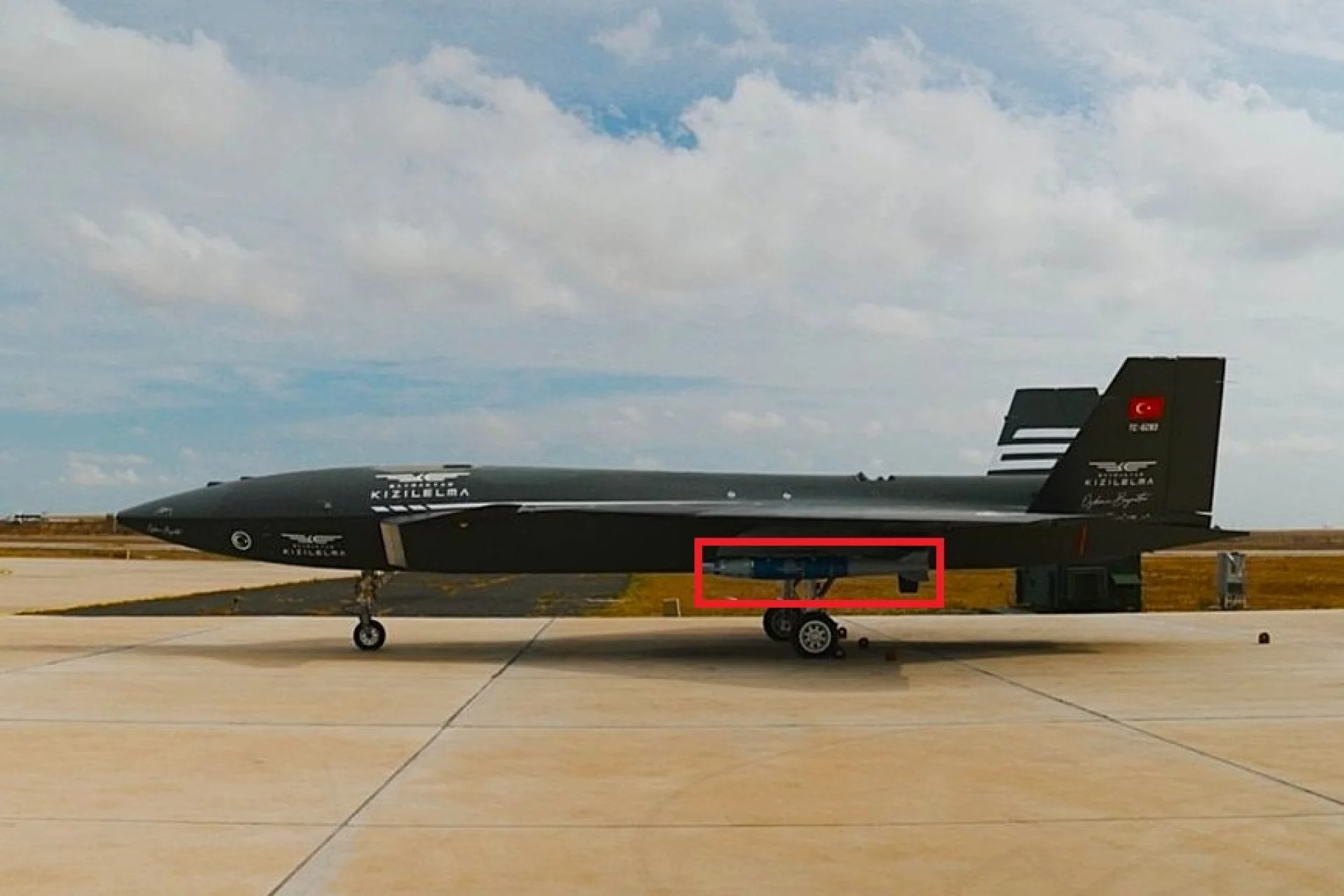
Baykar’s Kizilelma unmanned combat jet successfully completed a second captive‑carry trial carrying Roketsan’s TEBER‑82 guidance kit, confirming the platform can safely carry a 500‑pound class guided munition and marking a clear step forward in weapons integration.
Built to accept both internal and external stores, Kizilelma’s configuration means adding a 500‑lb precision weapon expands its mission set — from close air support and interdiction to time‑sensitive targeting. Captive‑carry testing focuses on aerodynamic behavior, carriage loads and the aircraft–munitions interface to validate safe carriage before moving on to separation and release trials.
The TEBER‑82 guidance kit converts a standard Mk‑82 family bomb into a precision munition by pairing GNSS/INS navigation with a semi‑active laser seeker for terminal homing. That dual‑mode approach provides satellite‑aided accuracy while retaining the ability to home on a laser‑designated aim point in the terminal phase, useful against moving or relocatable targets.
Kizilelma’s test program has progressed from early propulsion and flight‑envelope work into iterative mission‑systems validation; the recent captive‑carry run represents the transition from carriage verification toward live separation and drop testing. Software and autonomy updates run in parallel to expand networked employment and mission flexibility.
Operationally, coupling a carrier‑capable unmanned jet with a mature 500‑lb guidance kit offers forces additional options for distributed precision strike, shifts higher‑risk or endurance‑heavy tasks off crewed aircraft, and supports an indigenous strike ecosystem suited to both national needs and potential export markets.
In short, the captive‑carry milestone demonstrates tangible progress in making Kizilelma a practical precision‑strike asset; the program’s next phases will focus on safe separation, controlled release trials and operational integration.
