

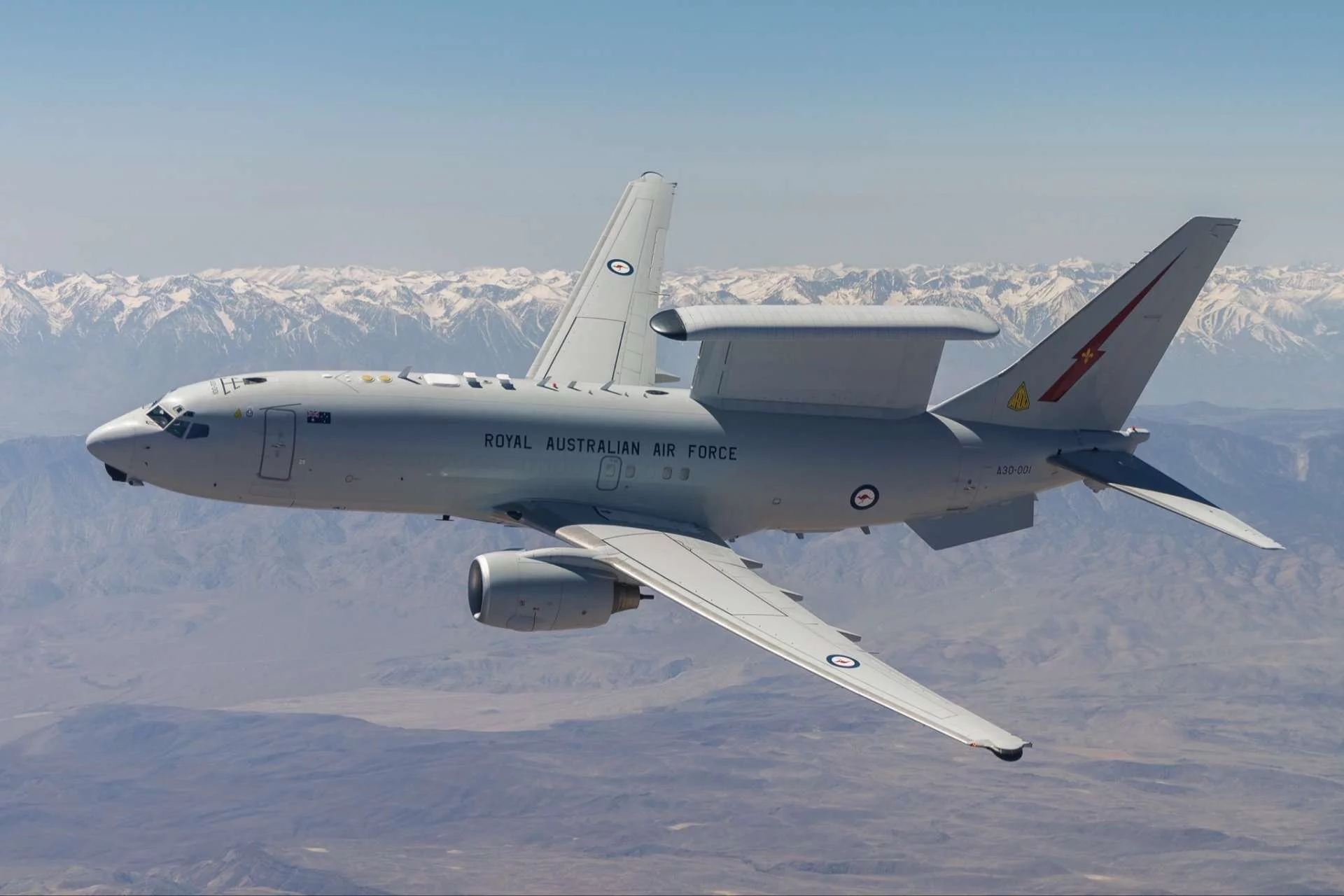
An Australian E-7A Wedgetail airborne early warning and control aircraft was tracked operating over Poland on October 4, marking a significant extension of NATO’s Operation Eastern Sentry. The mission, detected through open-source flight monitoring, indicates Australia’s active integration into the Alliance’s expanding eastern air surveillance network amid renewed Russian drone and missile incursions.
NATO’s Eastern Sentry Expands Coverage
The increased air activity followed a night of heavy Russian strikes on Ukraine. Flight data showed an Australian E-7A Wedgetail orbiting Polish airspace alongside an F-35A, suggesting coordination within the Eastern Sentry mission. While Canberra has not formally confirmed this sortie, the Royal Australian Air Force (RAAF) previously deployed a Wedgetail to Łask Air Base in July 2025 to bolster NATO’s situational awareness on its eastern flank.
E-7A Wedgetail: Key Capabilities
Developed by Boeing, the E-7A Wedgetail is based on the 737 platform and features Northrop Grumman’s MESA radar, providing 360° coverage with a detection range exceeding 400 km. The system integrates ten operator consoles, Link-16 connectivity, and advanced self-protection suites, allowing it to track air and maritime targets simultaneously. Its long endurance, air-to-air refueling compatibility, and high reliability make it ideal for persistent surveillance orbits across Europe’s eastern frontier.
The Wedgetail’s active electronically scanned array (AESA) radar enables instant beam steering without moving components, reducing maintenance and crew requirements compared to legacy E-3 AWACS aircraft. It also serves as a communications and data gateway, connecting F-35s, Eurofighters, Rafales, and NATO’s ground-based defenses into a unified tactical picture.
Operational and Strategic Context
Australia’s Wedgetail deployment builds on its earlier use in Middle East operations and its growing role in European airspace monitoring since the escalation of the Ukraine conflict. Under Eastern Sentry, NATO’s eastern air surveillance has become a continuous, multinational effort — now featuring contributions not only from U.S. and European fleets but also from partners such as Türkiye, whose E-7T Peace Eagle recently patrolled the Baltic region.
For Poland and neighboring countries, the Wedgetail’s early detection capabilities strengthen defenses against low-flying drones and cruise missiles, enhancing interception efficiency and extending missile defense reach.
Geopolitical Implications
Canberra’s participation highlights Australia’s evolving security alignment with NATO. Providing high-end surveillance rather than combat forces allows it to demonstrate commitment without direct escalation. Strategically, it reinforces the resilience and interoperability of NATO’s sensor network from the Baltics to the Black Sea.
Although Australia’s Defense Ministry has not officially acknowledged the October 4 mission, the message to Moscow is evident: NATO’s airspace is being watched by a broader, more integrated coalition. The addition of Indo-Pacific allies to European air operations marks a new phase of globalized deterrence and shared early-warning capability across the Alliance.
