

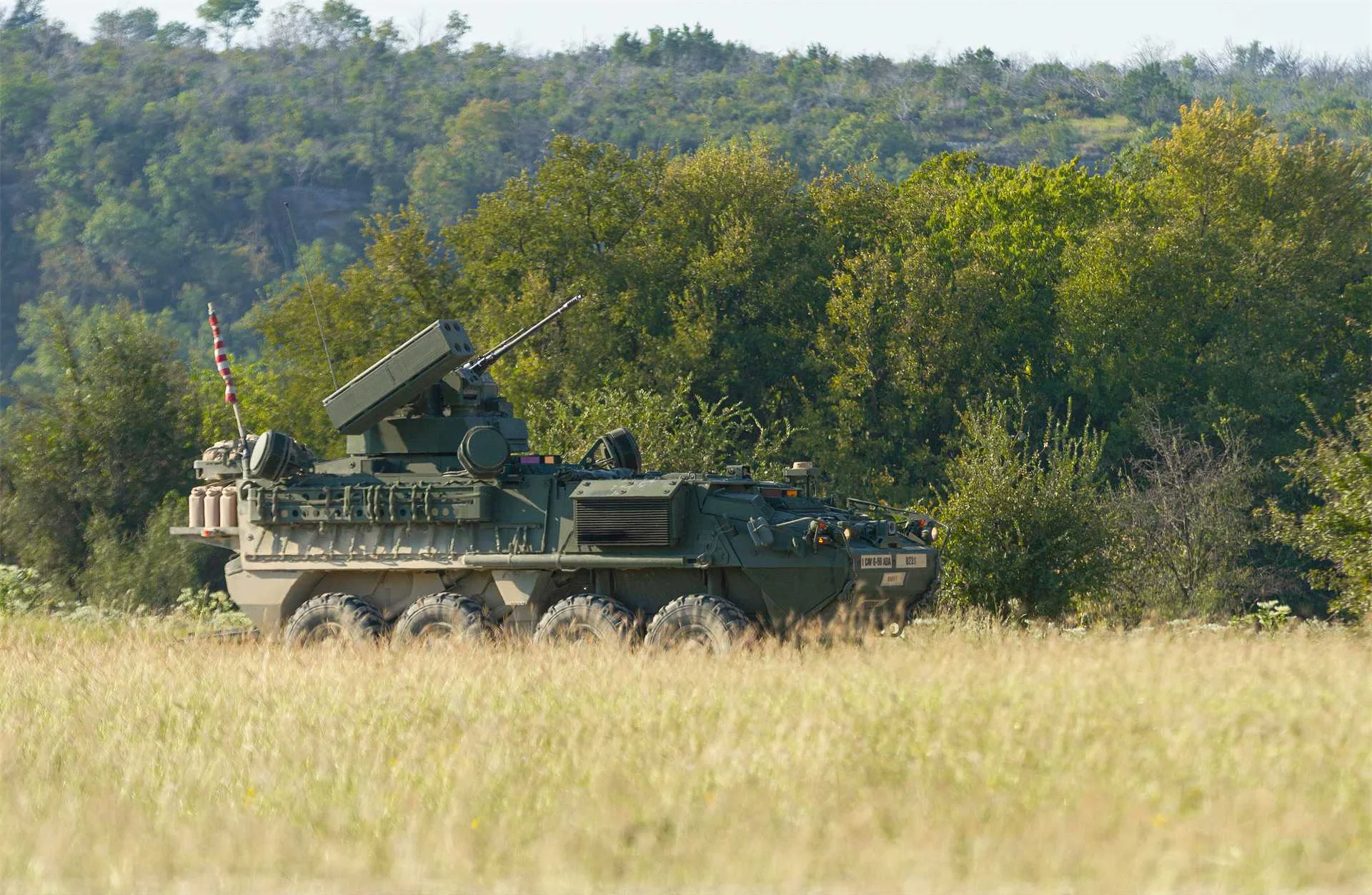
The U.S. Army has launched live-fire training exercises at Fort Hood featuring its latest SGT Stout short-range air defense vehicle, marking a major step in integrating next-generation counter-drone and low-altitude defense systems into operational units.
Troops from the 6th Battalion, 56th Air Defense Artillery Regiment are evaluating the system’s real-world performance as part of a broader modernization effort to strengthen the Army’s maneuver air defense capability. Developed under the Mobile Short-Range Air Defense (M-SHORAD) Increment 3 program, the SGT Stout is based on the Stryker A1 platform and began limited fielding in early 2025.
The vehicle features a fully modernized weapons and sensor suite tailored for mobile warfare. Its main armament—the XM914 30mm chain gun—fires programmable airburst ammunition against aerial or ground targets, while twin Stinger missile launchers provide layered engagement capability. Advanced electro-optical and infrared sensors, an L3Harris fire-control radar, and a Leonardo DRS mission command network enable automated target tracking and fast engagement decisions across connected Army platforms.
The ongoing drills test the Stout’s performance in dynamic battlefield simulations, including multi-threat engagements, drone swarm scenarios, and rapid maneuvers under simulated enemy fire. Soldiers are also being trained in emerging doctrines that emphasize integrating the system directly with infantry and armored formations.
Reviving short-range air defense capacity—long neglected since the end of the Cold War—has become a strategic imperative. Lessons from recent conflicts in Ukraine and the Middle East have shown how exposed ground forces can be to drones and low-altitude munitions. The SGT Stout addresses this vulnerability by offering mobile, autonomous protection that can deploy alongside combat brigades with minimal external support.
Full-rate production is set to begin in fiscal year 2026, equipping Stryker Brigade Combat Teams and National Guard air defense units. Several U.S. allies in Europe and the Indo-Pacific have already expressed interest in the platform.
Designed with a modular digital architecture, the SGT Stout can accommodate future upgrades, including directed-energy weapons and electronic warfare modules. The system is expected to serve as the backbone of the Army’s short-range air defense network for the next two decades, combining mobility, firepower, and adaptability for modern, high-threat environments.
