

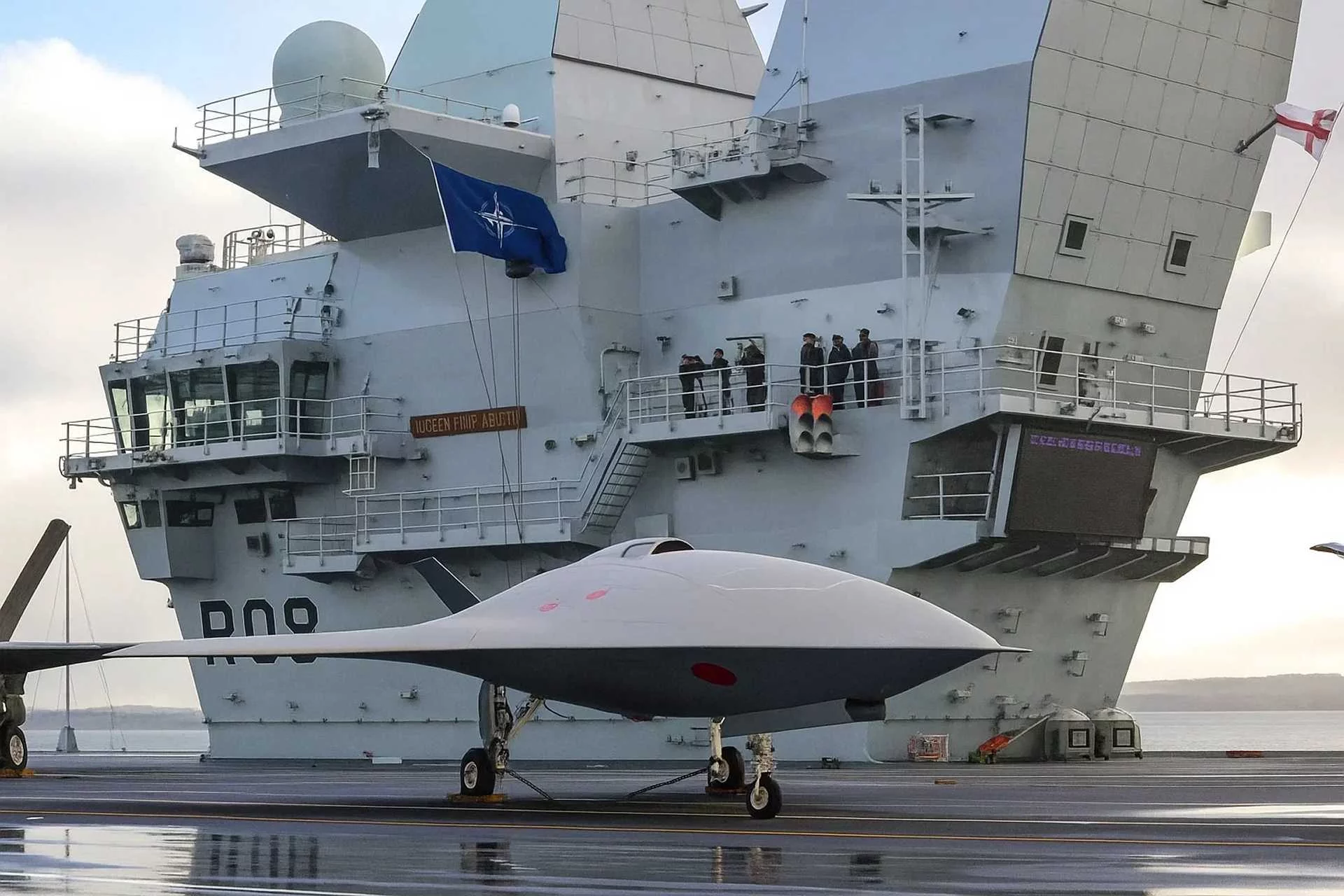
The UK Ministry of Defence has officially launched Project VANQUISH, a new initiative aimed at designing an autonomous, jet-powered aircraft capable of operating from Queen Elizabeth-class aircraft carriers without catapults or arrestor gear. The program represents a major milestone in the UK’s expansion into AI-driven naval aviation.
A Request for Information (RFI) issued on October 3, 2025, seeks industry proposals for a Fixed-Wing Short Take-Off and Landing (STOL) Autonomous Collaborative Platform (ACP). The goal is to demonstrate the first sea-based flight by late 2026, marking a key step toward integrating unmanned systems into the Royal Navy’s future carrier strike capability.
Described as a “Tier 2 attritable” platform, VANQUISH aircraft will be designed to perform missions such as intelligence, surveillance, reconnaissance, strike, and aerial refueling, while maintaining cost-efficiency suitable for high-risk operations. These expendable platforms will enhance the reach and combat flexibility of F-35B Lightning II squadrons without putting pilots at risk.
The project is closely aligned with the Maritime Aviation Transformation (MATX) initiative, which aims to merge crewed and autonomous airpower into a unified networked force. While the Royal Air Force’s Loyal Wingman focuses on airbase operations, Project VANQUISH adapts similar collaborative principles to the challenging maritime domain.
According to the RFI, the aircraft must feature fully autonomous launch and recovery, jet propulsion with sustained high-subsonic performance, and advanced navigation and mission management systems. These will enable seamless coordination with crewed aircraft and carrier strike assets in real time.
The open-ended RFI allows for diverse design proposals, including tilt-wing, blended wing-body, or folding-wing concepts. The emphasis is on innovation—finding the optimal balance between payload, range, endurance, and deck compatibility.
VANQUISH builds on lessons from General Atomics’ Mojave UAS trial aboard HMS Prince of Wales in 2023, which proved that STOL unmanned aircraft could safely operate from non-catapult-equipped carriers. The new system will advance beyond propeller-driven designs toward jet-powered, high-endurance platforms capable of fully autonomous deck operations.
From an industrial perspective, the program offers a strategic opportunity for UK aerospace firms specializing in autonomy software, composite materials, flight control systems, and maritime integration. The Ministry of Defence aims to identify national partners capable of leading the development effort.
Looking ahead, Project VANQUISH could become operational by the early 2030s, contributing to a joint autonomy architecture shared by both the RAF and Royal Navy. Strategically, it will strengthen the UK’s ability to project air power, reduce risk, and maintain technological parity with leading global naval powers.
Ultimately, Project VANQUISH marks a bold step toward a hybrid carrier air wing—one that merges human decision-making with machine precision, ensuring that the UK’s carrier strike group remains at the forefront of naval innovation for decades to come.
