

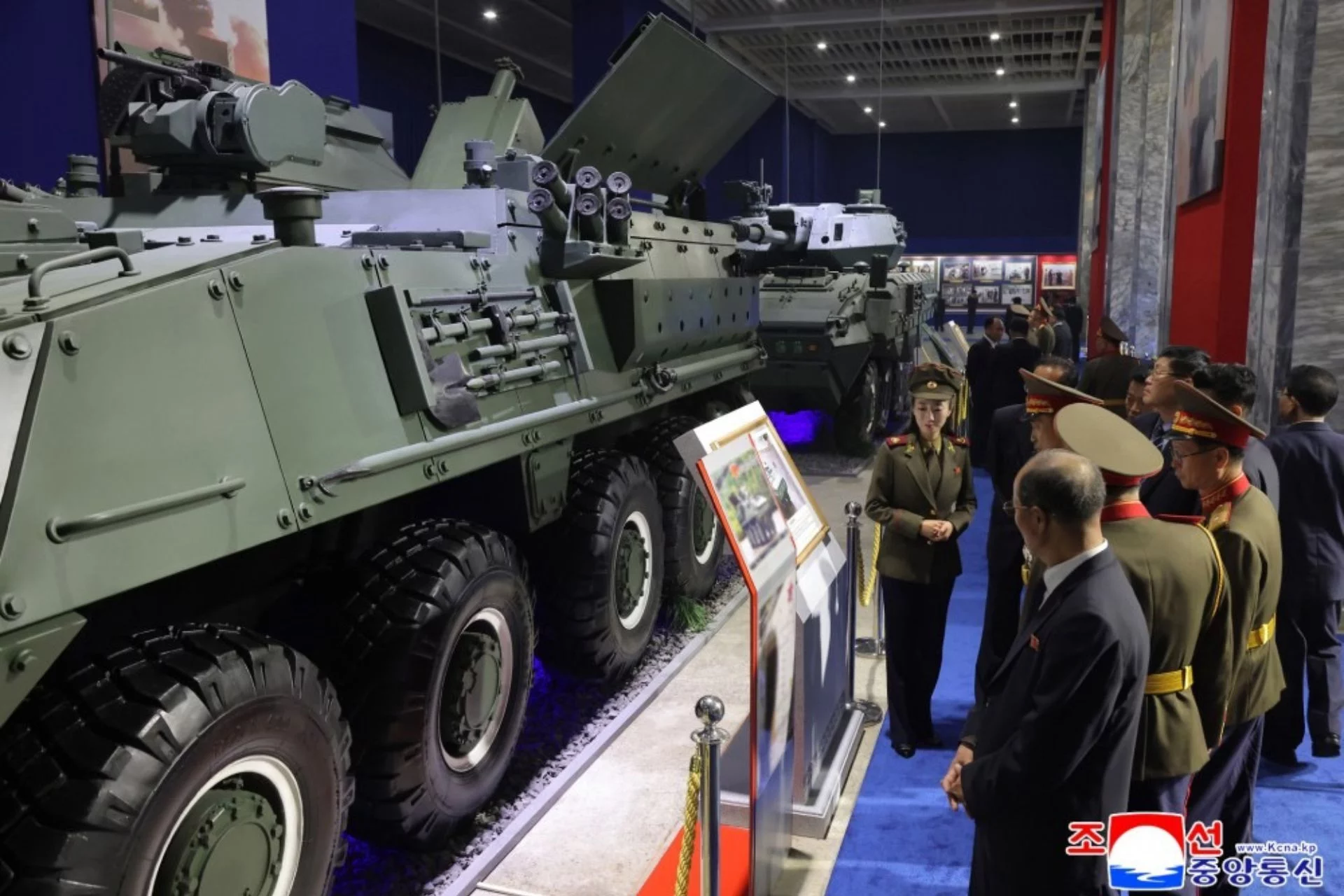
North Korea displayed a new self-propelled mortar mounted on an M2020-series 8×8 chassis at the Defence Development-2025 exhibition in Pyongyang. State media photos show a reconfigured rear fighting compartment compatible with an armored, vehicle-mounted ~120 mm mortar with assisted loading — a layout that mirrors the under-armor firing concept used by Western examples like the U.S. Stryker M1129 and France’s Griffon MEPAC. If fielded effectively, the design would enable wheeled formations to conduct rapid shoot-and-scoot indirect fires.
Common Base and Modular Design
The vehicle’s silhouette and layout suggest it derives from a common 8×8 family previously adapted for direct-fire guns and anti-tank roles. A modular chassis approach simplifies logistics, maintenance and training while allowing multiple mission modules — a force-multiplying logic increasingly visible in recent North Korean displays.
Why a 120 mm Under-Armor Mortar Matters
Armored 120 mm mortar carriers provide rapid, dense indirect fires with improved survivability versus towed systems. Western parallels (notably the M1129) emphasize short halt-fire-move cycles that reduce exposure to counter-battery fire. Given North Korea’s large existing mortar inventory and doctrine of massed fires, a mobile 8×8 mortar would enhance the tempo and flexibility of its indirect-fire options.
Technical Caveats
Imagery implies an internal mortar well and assisted loading rather than a full rotating turret — a simpler, easier-to-produce choice. Absent official specs, reasonable assumptions for an 8×8 of this class might include ~20 tonnes curb weight, highway speeds near 90–100 km/h, and baseline protection against small arms and splinters. However, critical parameters — automation level, fire-control integration, first-round accuracy and drivetrain robustness — remain undisclosed.
Operational Assessment
- Upside: Standardized chassis and mobile, reactive indirect fire increase tactical flexibility for wheeled units.
- Unknowns: Without firing demonstrations or detailed data, operational reliability and accuracy are unconfirmed.
- Bottom line: The concept borrows operational grammar from Stryker and MEPAC designs and could be militarily useful, but its battlefield value depends on execution, production scale and integration with command-and-control systems.
