

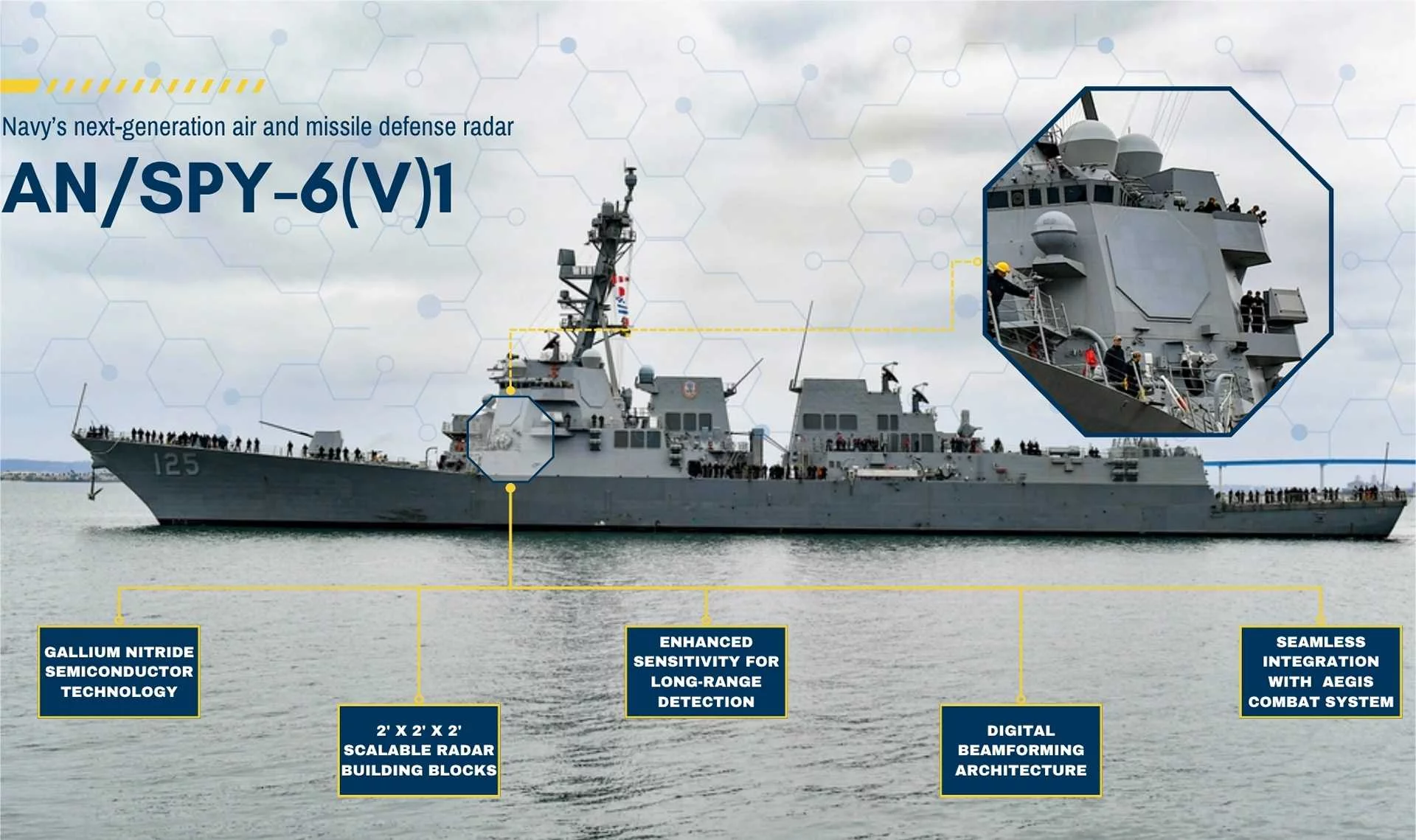
Germany has officially chosen Raytheon’s AN/SPY-6(V)1 radar system for its future F127-class frigates, marking the first international sale of the U.S. Navy’s most advanced maritime radar. The deal represents a major milestone in NATO’s collective maritime defense and deepens U.S.–European defense cooperation.
Raytheon confirmed the selection under a proposed U.S. Foreign Military Sales (FMS) agreement, making Germany the first global customer of the SPY-6 system—a central sensor in America’s next-generation Aegis fleet. Beyond technological significance, the deal enhances allied interoperability and shared situational awareness across NATO’s northern and Atlantic theaters.
Multi-Mission AESA Powerhouse
The AN/SPY-6(V)1 is a modular, active electronically scanned array (AESA) radar comprising four fixed faces, each built from 37 Radar Modular Assemblies (RMAs) based on Gallium Nitride (GaN) technology. It delivers 360-degree coverage with simultaneous air and ballistic missile defense, surface tracking, and electronic warfare resilience. This scalable design gives naval commanders faster decision-making and broader threat response capability across multiple domains.
The deal with Berlin includes integration and adaptation support to ensure seamless compatibility with Germany’s upcoming F127-class—a frigate family set to replace the F123 Brandenburg class. The new ships will feature low-observable hull shaping, extended operational range, modular weapon systems, and improved endurance. Raytheon’s technical role will be vital to synchronizing SPY-6 performance with Germany’s indigenous combat management systems.
“A vote of global confidence”
Raytheon’s President of Naval Power, Barbara Borgonovi, said:
“Germany’s selection of SPY-6 reaffirms global confidence in the radar’s advanced capabilities and its critical role in enhancing naval defense. Integration on the F127 frigates will provide the German Navy with faster, more informed decision-making at sea.”
F127: Germany’s Future Maritime Flagship
With an expected displacement exceeding 10,000 tons, the F127 represents a generational leap in German surface combatants—optimized for network-centric warfare, integrated air and missile defense, and survivability in contested seas. Equipped with SPY-6, the frigates will detect and track stealth aircraft, cruise missiles, and hypersonic threats while engaging in ballistic missile defense and cooperative targeting with allied forces. The radar’s automation and modularity also help reduce crew workload, enhancing endurance and combat readiness.
Strategic and Industrial Dimensions
Raytheon’s Andover, Massachusetts facility—home of SPY-6 production—remains a cornerstone of the U.S. defense industrial base, capable of large-scale GaN radar output. With the U.S. Navy set to field SPY-6 across seven ship classes, the system is becoming the benchmark of 21st-century naval sensing. Germany’s move aligns with a growing NATO trend toward sensor standardization and data interoperability across allied fleets.
Though financial details remain undisclosed, German defense sources indicate the first SPY-6-equipped F127 could enter service in the early 2030s, with radar testing expected by 2028. The decision underscores Berlin’s commitment to accelerated modernization under NATO’s Strategic Concept 2030, strengthening both deterrence and alliance integration.
For Germany, SPY-6 brings a qualitative leap in detection, early warning, and engagement flexibility; for Raytheon, it opens the door to broader European naval markets—where nations like the Netherlands and Norway are already watching Germany’s path closely.
