

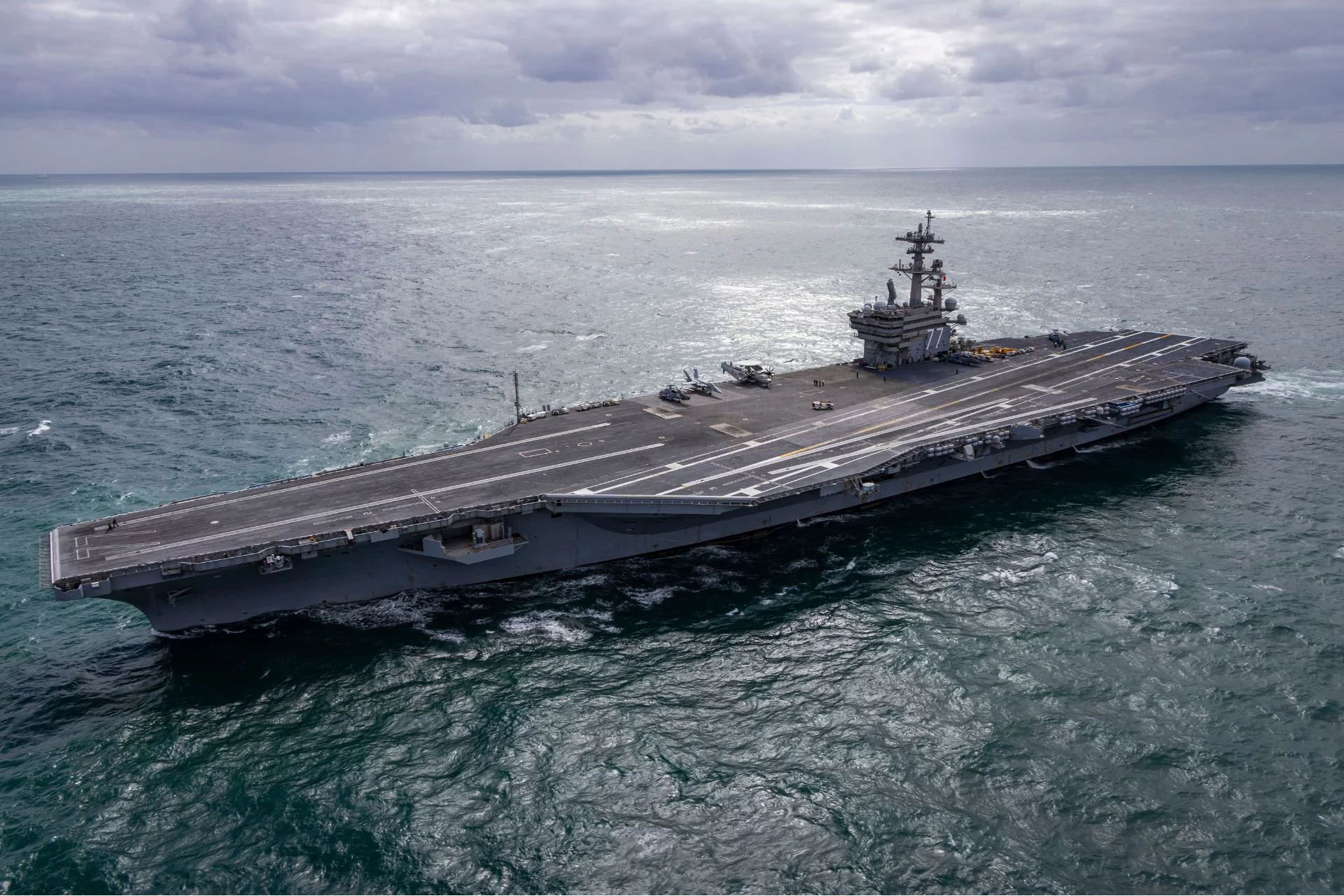
The U.S. Navy has released new images of the USS George H.W. Bush, a Nimitz-class aircraft carrier, conducting routine operations in the Atlantic Ocean. These activities underline the carrier’s readiness to support U.S. commitments to NATO and Atlantic security.
Captured on 14 August 2025, the photos highlight the cyclic missions of the carrier’s air wing and strike group. As the last vessel of the Nimitz class, USS George H.W. Bush maintains a continuous U.S. presence in the Atlantic, reinforcing NATO deterrence and operational readiness.
During Atlantic exercises, the carrier typically deploys F/A-18E and F/A-18F Super Hornets for strike, air defense, and maritime interdiction. EA-18G Growlers handle electronic attack and escort jamming, while E-2D Advanced Hawkeye extends radar coverage and manages the air picture. MH-60R/S helicopters support anti-submarine, search-and-rescue, and short-range logistics operations. The new CMV-22B provides flexible long-range carrier onboard delivery.
The ship relies on layered defenses for survivability. Evolved Sea Sparrow counters short- to medium-range threats, RAM addresses missiles breaching outer layers, and Phalanx serves as the last line of defense against close-range threats. Aegis-equipped destroyers with Tomahawk missiles provide additional protection.
Routine Atlantic operations cover extensive training, from carrier qualifications to integrated air wing drills and strike group exercises. Flight deck teams rehearse launch and recovery, aerial refueling, long-range strikes, and anti-submarine tactics. Integration with allied frigates and destroyers tests communications, helicopter cross-decking, and logistics coordination, enhancing interoperability.
Operationally, the carrier projects U.S. and NATO airpower over a moving area of approximately 1,000 kilometers without relying on shore bases. The air wing can target surface threats, maintain an air defense umbrella, and extend anti-submarine patrols. Its systems integrate with allied maritime patrols and national sensors, enabling measured and coordinated responses.
In recent years, NATO forces have increased North Atlantic and High North patrols while Russian submarines and surface combatants operate farther from home waters. Although a U.S. carrier in the Atlantic is common, its timing and course convey strategic signals. A route toward the Mediterranean reinforces the southern flank, while movements to colder waters highlight maritime lines of communication and undersea monitoring. Allied integration further demonstrates interoperability and steady cooperation.
