

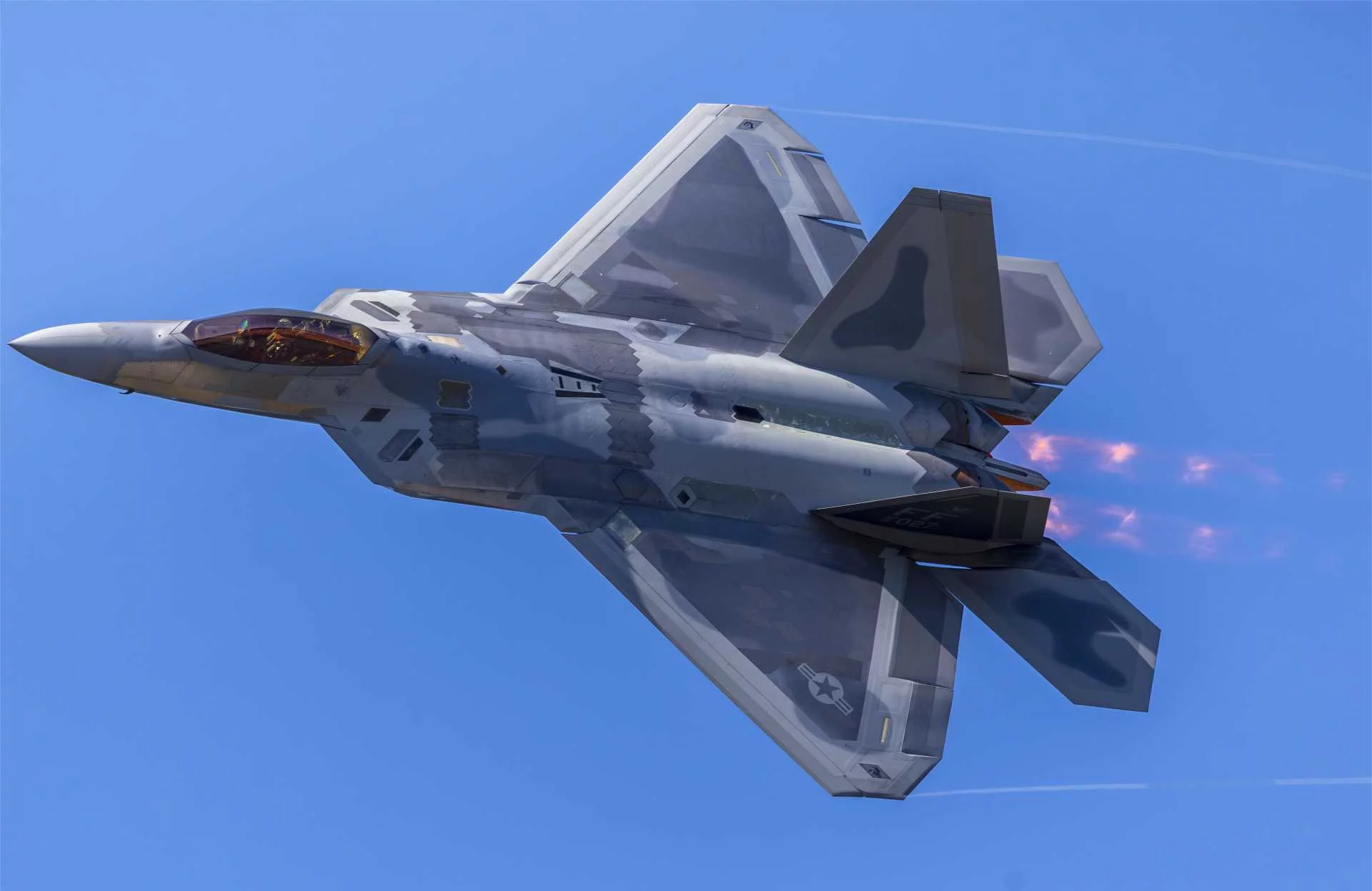
The U.S. Air Force’s fifth-generation F-22 Raptor once again proved its dominance in the skies during the 2025 NAS Oceana Air Show, performing precision maneuvers that showcased its agility, stealth, and unmatched control. Nearly two decades after entering service, the Raptor continues to represent the backbone of America’s air superiority strategy.
During its aerial demonstration, the aircraft executed high-G climbs, loops, tail slides, and high-alpha passes, exhibiting the extraordinary aerodynamic performance enabled by its thrust-vectoring engines. Powered by twin Pratt & Whitney F119-PW-100 engines, the Raptor can supercruise at Mach 1.5 without afterburners.
The F-22’s stealth design integrates radar-absorbing materials, internal weapon bays, and infrared signature suppression, giving it full-spectrum low observability. It can carry up to six AIM-120 AMRAAM and two AIM-9 Sidewinder missiles internally, maintaining lethal capability while remaining virtually invisible to enemy radars.
Although production ended in 2012, the Raptor continues to evolve under the Raptor Agile Capability Release (RACR) program. Upgrades include enhanced electronic warfare resilience, new data links for Joint All-Domain Command and Control (JADC2), and integration with next-generation AIM-260 JATM missiles.
As the Next Generation Air Dominance (NGAD) program remains in development, the F-22 stands as the U.S. Air Force’s primary “first-day-of-war” platform—capable of penetrating contested airspace and neutralizing advanced threats.
Its appearance at NAS Oceana was more than a demonstration of flying skill—it was a visible symbol of America’s enduring deterrence posture. Until NGAD enters service in the early 2030s, the F-22 Raptor will remain the cornerstone of U.S. air superiority across global theaters.
