

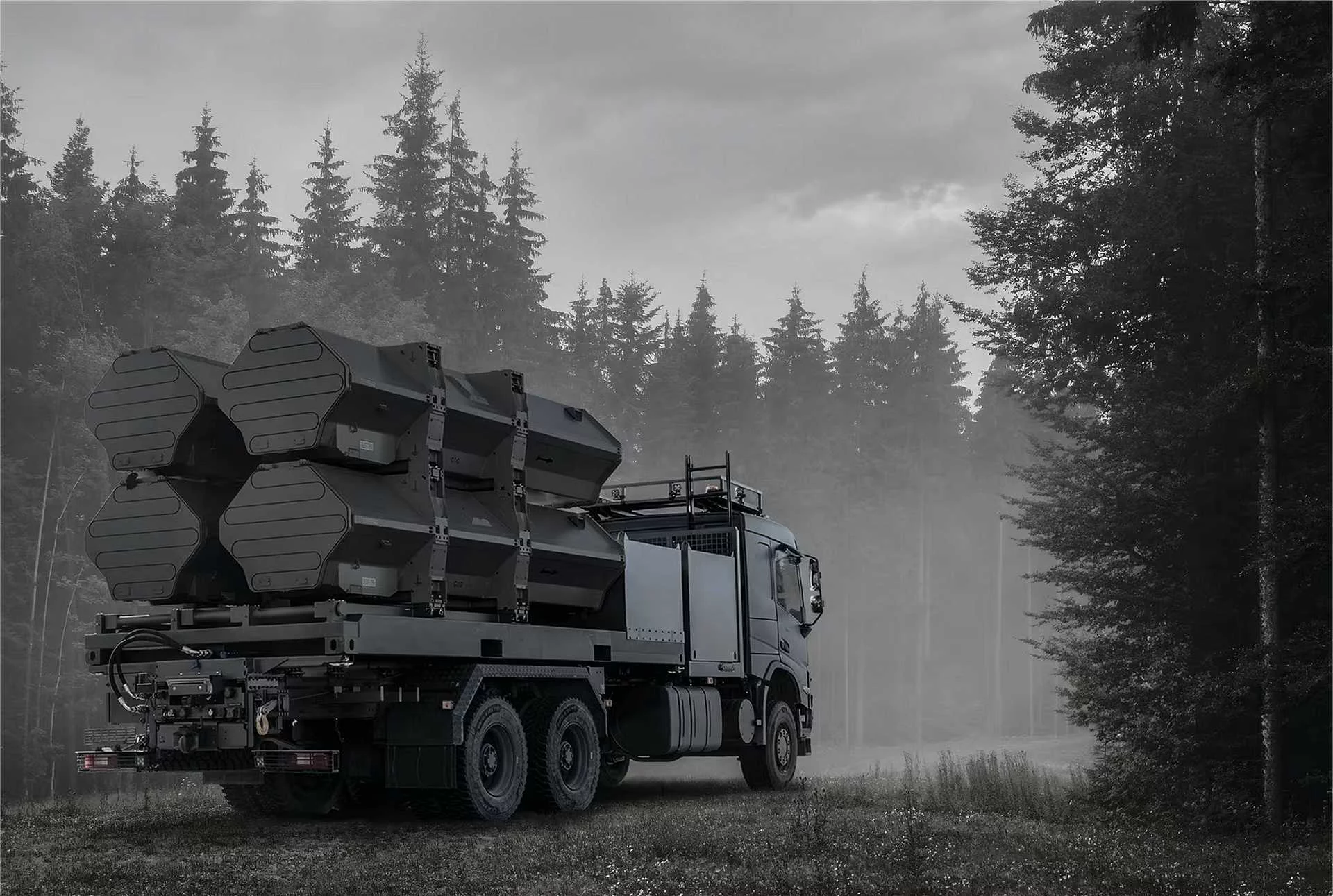
Swedish firm Saab has revealed a next‑generation Coastal Defence Missile System (CDMS) built around the battle‑proven RBS15 anti‑ship family. The shore‑based, mobile and modular solution is designed to provide scalable maritime protection as regional tensions rise and defence budgets tighten.
The CDMS adapts the RBS15 into a land‑based, containerised launcher compatible with the current Mk3 and the upcoming Mk4. Saab states the Mk3 already exceeds 200 km in range, while the Mk4, due later in the decade, pushes effective reach beyond 300 km. Both keep a sea‑skimming, high‑subsonic profile that complicates interception; the Mk4 adds software‑defined guidance, improved resistance to electronic countermeasures and a more potent high‑explosive warhead.
Each launcher vehicle carries four RBS15 missiles mounted within a unit matching a 20‑foot ISO container footprint — a standardised layout that eases deployment, concealment and rapid relocation. Saab highlights a two‑minute shoot‑and‑scoot cycle from launch to displacement to improve survivability against counter‑fire. Launchers are self‑powered with hydraulic generators and contain onboard control systems; crews can operate from inside the vehicle or remotely via tethered stations.
At battery level, multiple launcher vehicles connect to a mobile command post that fuses data from existing sensor networks — airborne surveillance, naval radars, UAVs and shore sensors — to generate precise targeting. Saab also proposes sensor vehicles for local radar tracking and battle‑damage assessment and logistics trucks with cranes able to reload spent missile canisters in roughly 15 minutes.
The system’s disruptive potential lies in operational agility and cost efficiency: Saab argues that a small number of CDMS batteries could secure hundreds of kilometres of coastline, offering credible strike power at a fraction of the cost of surface combatants. The launchers’ passive posture until firing also adds a stealth element that complicates enemy reconnaissance.
Saab is exploring a modular naval variant as well, using standard container interfaces to convert non‑equipped ships into missile platforms within hours — an option for multi‑purpose vessels and auxiliaries that aligns with the broader military shift toward modular, mission‑tailored packages.
With orders already placed by the Swedish Armed Forces, Saab is marketing the CDMS to additional European and Indo‑Pacific customers. The widespread fielding of RBS15 in Sweden, Finland, Germany, Poland, Bulgaria and Croatia strengthens interoperability and creates a networked anti‑ship deterrent across northern and eastern flanks.
In short, Saab’s CDMS represents a strategic move toward affordable maritime denial — giving smaller and medium powers a mobile, survivable and long‑reach capability to control the littoral without depending on costly fleets.
