

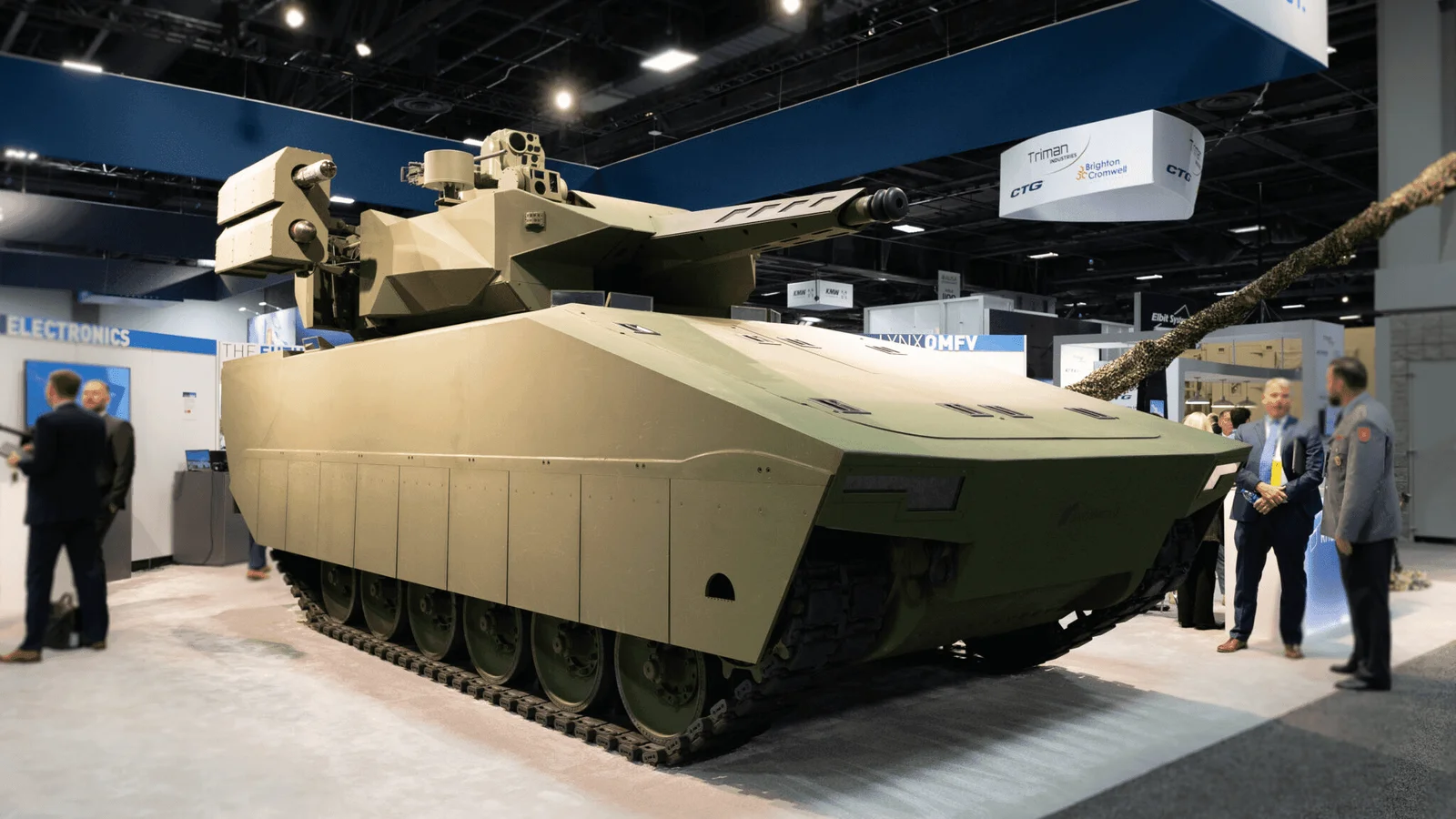
General Dynamics Land Systems has confirmed it will deliver XM30 Mechanized Infantry Combat Vehicle (MICV) prototypes to the U.S. Army in July 2026. The program, previously known as the Optionally Manned Fighting Vehicle, is part of a five-phase acquisition effort worth approximately $45 billion to replace the M2 Bradley, which has been in service since 1981. General Dynamics competes with American Rheinmetall Vehicles in this development.
The Army plans to select a single contractor in FY2027, with low-rate production starting in 2028 and full-rate production by 2030. Each company is building eight prototypes during the Engineering and Manufacturing Development phase. Prototype fabrication is expected to take 18–20 months, after which testing will determine the serial-production winner. Milestone B approval, initially planned for April 2025, was finalized in June 2025, authorizing full-scale development.
The XM30 is a tracked, optionally manned combat vehicle designed for Armored Brigade Combat Teams. With a two-person crew and six infantry seats, it incorporates Modular Open Systems Architecture (MOSA) for rapid upgrades and future modernization. A hybrid-electric propulsion system reduces noise and thermal signatures, increases fuel efficiency, and provides a silent-watch mode. The digital backbone integrates subsystems, mission electronics, sensors, and weapons for unified control, and allows modular future upgrades.
Its main armament is a Northrop Grumman XM913 50×228 mm automatic cannon on a remote turret, capable of firing armor-piercing discarding sabot rounds and programmable high-explosive airburst ammunition. The system is supported by twin ATGMs, a coaxial machine gun, AI-assisted digital fire control, and third-generation forward-looking infrared sensors for enhanced situational awareness. Signature management reduces detection across radar, infrared, and acoustic spectrums.
Protection includes modular composite armor, active protection systems (hard- and soft-kill), counter-UAS sensors, electronic warfare capabilities, and integrated NBC and cyber-defense measures. Duality AI is developing an AI-based drone detection system to enhance threat awareness.
Two industrial teams are currently building and testing competing XM30 designs. American Rheinmetall leads Team Lynx; General Dynamics collaborates with GM Defense, Applied Intuition, AeroVironment, and General Dynamics Mission Systems. The Army allocated $1.6 billion in June 2023 for prototype development, with roughly $2.4 billion appropriated across all phases. If approved, approximately 3,800 vehicles will equip active and National Guard armored brigades.
The XM30 program runs alongside ongoing Bradley upgrades, ensuring combat readiness until the new vehicle enters service. September 2025 contracts expanded M2A4 and M7A4 conversions, including upgraded weapons, powerpacks, suspensions, and digital fire-control. The XM30 represents the first fully model-based, digitally engineered U.S. ground combat vehicle, integrating hybrid-electric propulsion, 50 mm main armament, layered protection, and modular electronics to support future armored warfare and modernization through the 2030s and beyond.
