

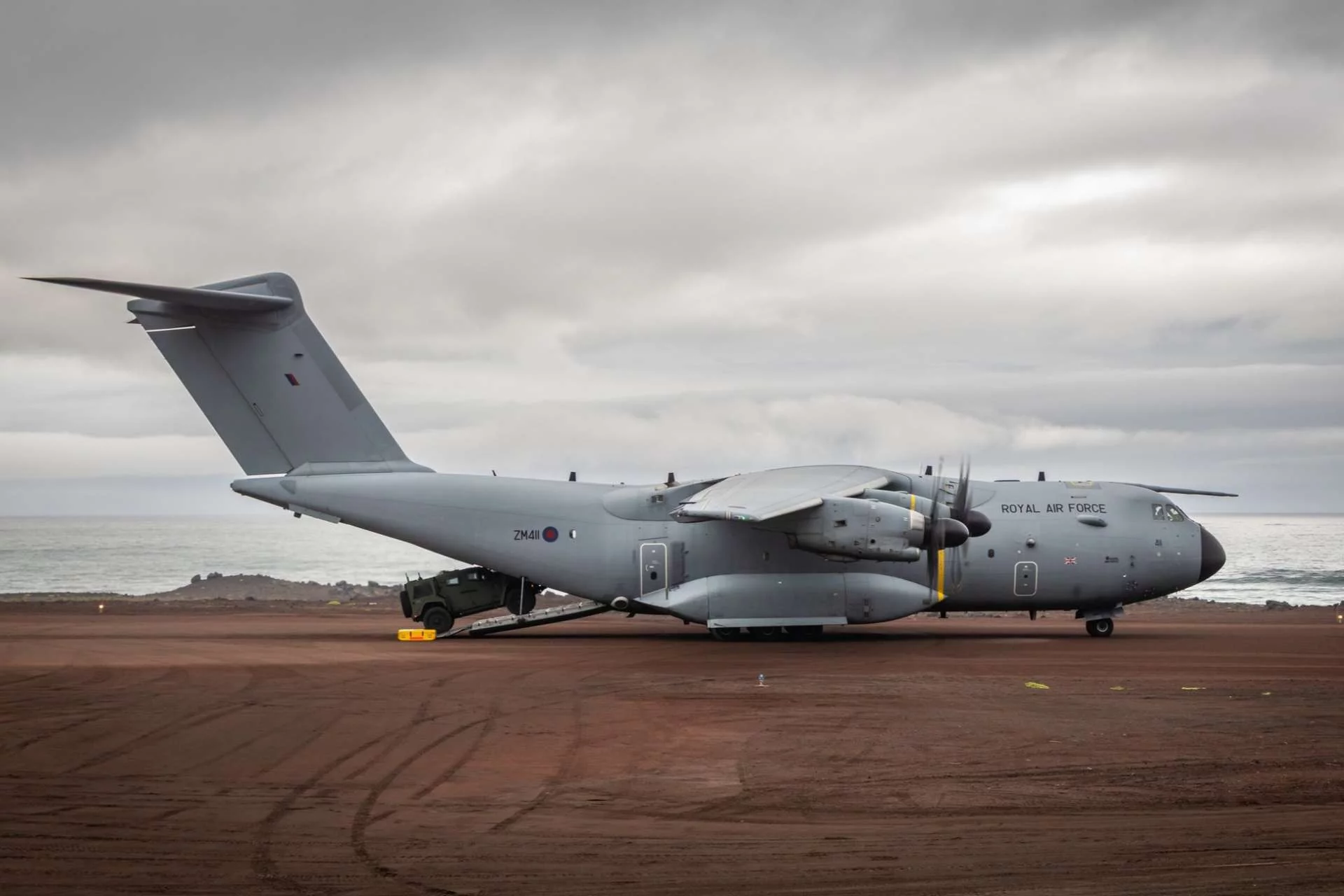
The UK Royal Air Force (RAF) has made history by landing an A400M Atlas transport aircraft on Norway’s remote Jan Mayen Island for the first time on October 9, 2025. The mission delivered a U.S. Marine Corps JLTV as part of a trilateral NATO Arctic deployment involving British and Norwegian forces, showcasing the alliance’s ability to sustain operations in one of the world’s most challenging environments.
The sortie validated NATO’s capacity for rapid mobility, logistics, and access in the High North — a region increasingly recognized as vital to transatlantic security. The JLTV served as a stand-in for the U.S. Navy and Marine Corps’ NMESIS coastal defense system, demonstrating how protected, wheeled launchers could be deployed to isolated Arctic terrain from a minimally prepared airstrip.
The participating units — the RAF, Norwegian Armed Forces, UK Royal Marines, and U.S. Marines — established two operational points on the volcanic island, proving the feasibility of deploying coastal strike assets under severe weather conditions. Despite heavy winds and limited infrastructure, the A400M’s successful landing and offload validated joint Arctic airlift procedures for rapid insertion of mobile firepower.
Designed by Airbus as a tactical airlifter with strategic range, the A400M bridges the gap between the C-130J and the C-17, carrying up to 37 tonnes while operating from short or unpaved runways. Its balance of payload, endurance, and rough-field performance makes it uniquely suited for Arctic logistics, where infrastructure and resupply opportunities are scarce.
The JLTV’s NMESIS configuration adds further operational depth. By integrating the Kongsberg Naval Strike Missile onto a mobile JLTV chassis, NMESIS enables fast-deploying, land-based anti-ship capability — a significant enhancement to NATO’s deterrence posture in littoral and archipelagic terrain. Deploying such systems on Jan Mayen complicates potential adversary naval operations in the Norwegian and Greenland Seas.
Jan Mayen’s geographic position — straddling transatlantic sea lanes and northern approaches to Europe — makes it strategically invaluable. For NATO, maintaining operational access to such a location demonstrates credible deterrence; for Russia, it introduces an additional layer of complexity to Northern Fleet movements emanating from the Kola Peninsula.
Vice Admiral Rune Andersen, Chief of the Norwegian Joint Headquarters, emphasized that Arctic readiness and allied cooperation are key pillars of collective defense, noting that “training in extreme environments is central to deterrence and security.” The Jan Mayen landing, he said, reflects that principle in practice.
Ultimately, the operation symbolizes more than a single landing — it represents proof that NATO can project and sustain combat-capable forces in the Arctic without permanent infrastructure. It sends a clear message: allied air mobility now extends into the planet’s harshest frontiers, reinforcing deterrence and ensuring that logistics and strike capabilities can follow the flag anywhere, even onto a frozen volcanic island in winter.
