

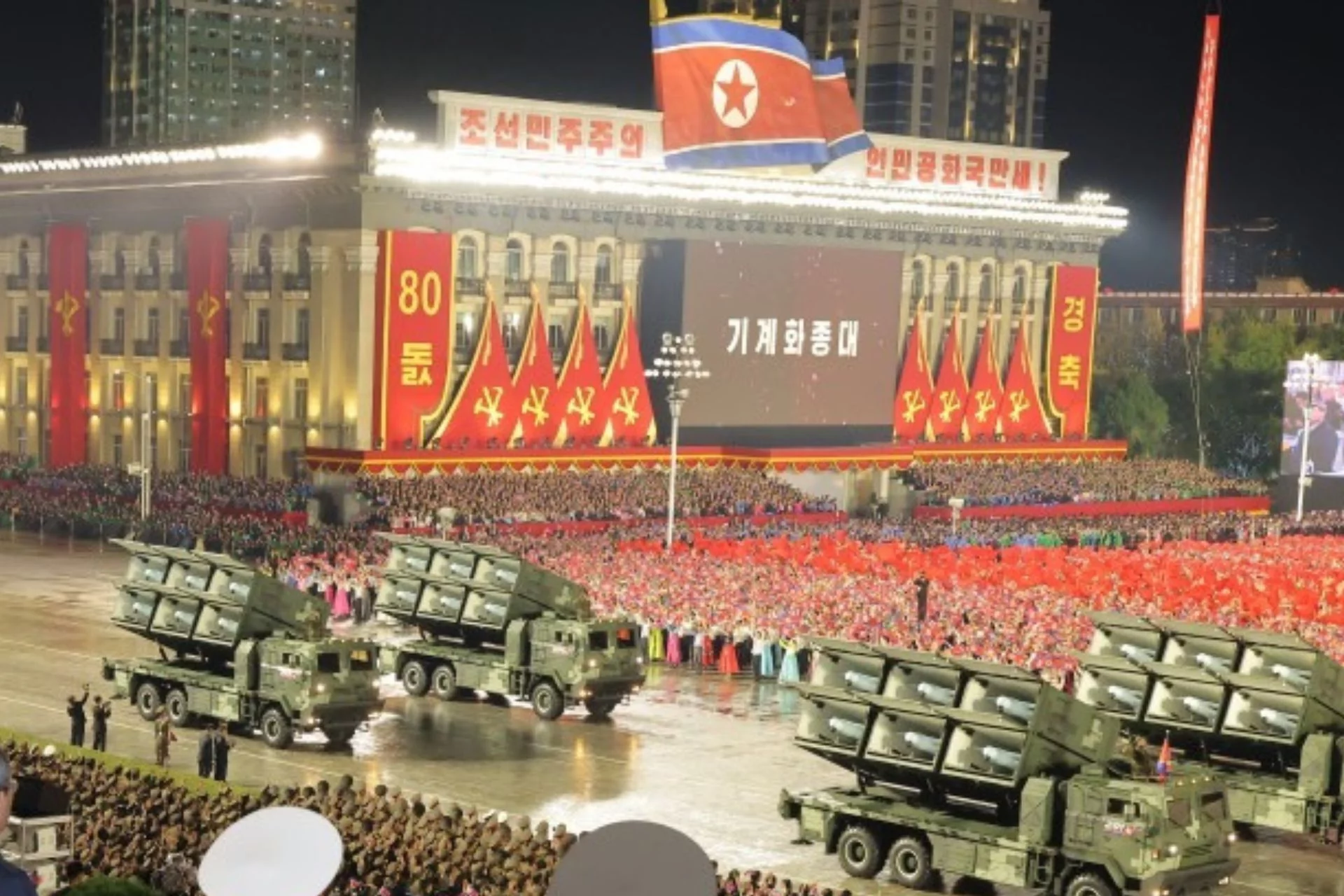
North Korea unveiled a launcher for Harop-style loitering munitions during the October 10 military parade marking the 80th anniversary of the Workers’ Party. Observers see the public display as a sign the program is progressing from workshop prototypes toward a fieldable capability aimed at South Korean defenses and outside viewers.
Footage shows a conventional 6×6 wheeled carrier with an armored cab, fitted with two stacked rows of three containerized launch cells — six ready-to-fire tubes per vehicle. Each container opens on hinges; a tilting launch frame increases departure angle and keeps the pusher propeller clear at ejection. The containerized approach reduces logistical burden, protects airframes from weather, and enables salvo launches from roads or improvised sites.
The drone’s silhouette — compact delta planform, small canards, and tip-mounted vertical fins — closely matches Harop-class designs. A pusher propeller frees the nose for an electro-optical (EO) turret, allowing a human-in-the-loop to conduct terminal corrections, aborts, and real-time observations. Official figures for endurance, warhead mass, and range were not published; cautious analogy with Harop suggests endurance measured in hours and a relatively light warhead, but that remains unconfirmed.
The six-cell layout supports near-simultaneous launches from multiple carriers, saturating local defenses and complicating counter-UAS responses. The nose turret permits a guidance alternative to classic radar-emission hunting, particularly useful under GNSS denial when operators take visual control for the terminal phase. The system architecture points to a straightforward concept: medium-range datalink, pre-programmed navigation, and sighted terminal takeover.
Tactically, loitering munitions like this serve three primary roles: suppression of air defenses and radar nodes during initial strikes; strike and interdiction of artillery, command nodes, or convoys in tactical depth; and harassment or sensor-targeting in littoral environments. The containerized 6×6 format eases dispersal and rapid displacement, increasing survivability against counter-battery actions.
Industrial trends since 2024 — prototype airframes followed by launcher hardware in 2025 — suggest North Korea is moving toward batch production with simple, repeatable assembly of airframe, propulsion, mission electronics, and sensors. Such systems could be distributed to brigade or artillery-group levels as part of doctrines tied to counter-battery radars, ISR drones, and long-range fires.
For Seoul, the launcher raises pressure on layered air defenses and continuous low-altitude surveillance, driving demand for passive sensors, enhanced counter-UAS measures, and stricter interception prioritization. Beyond the peninsula, the system’s export potential — even under sanctions — represents an additional proliferation concern given global demand for loitering munitions.
At present, the launcher is a sign of industrial intent rather than proven battlefield effect; its true operational value will depend on production scale, reliable targeting/datalink networks, and performance under combat conditions.
