


Kymeta Corporation has announced that its Osprey u8 satellite terminal has been selected as the multi-orbit communications solution for the U.S. Army’s Next Generation Command and Control (NGC2) Pilot, highlighting the Army’s growing focus on resilient, mobile connectivity in complex operational theaters.
The selection follows evaluations under the Armored Formation Network On The Move, Network Modernization Experiment (NETMODX), and Project Convergence Capstone programs, all of which underscored the need for uninterrupted, low-profile data links for dispersed and maneuvering forces.
According to Kymeta, the Osprey u8 provides full-duplex data transmission through a single aperture, enabling simultaneous communication across both geostationary (GEO) and low Earth orbit (LEO) satellite networks. Its modular, cartridge-based design allows rapid reconfiguration to adapt to evolving mission requirements.
The system’s multi-orbit architecture enables users to maintain connectivity through both commercial and government satellite networks, minimizing reliance on any single path and preserving operational continuity in contested or degraded environments.
Tom Jackson, Executive Vice President and Chief Revenue Officer at Kymeta — and a retired U.S. Marine Corps Lieutenant Colonel — emphasized the company’s edge over competing systems:
“Our metamaterials-based architecture allows us to build terminals that consume significantly less power than others on the market. Competitors may attempt to match our capabilities, but they cannot replicate the core technology that defines our product line.”
Jackson noted that this approach to innovation aligns with the Army’s drive to integrate commercially developed technologies into existing military capabilities.
Designed for Communications-On-The-Move (COTM) and beyond-line-of-sight operations, the Osprey u8 supports mobile teams in data-intensive missions where signature management and survivability are critical. Its low thermal signature, Low Probability of Detection/Intercept (LPD/LPI) features, narrow beamwidth, and low-profile form factor reduce the risk of enemy tracking.
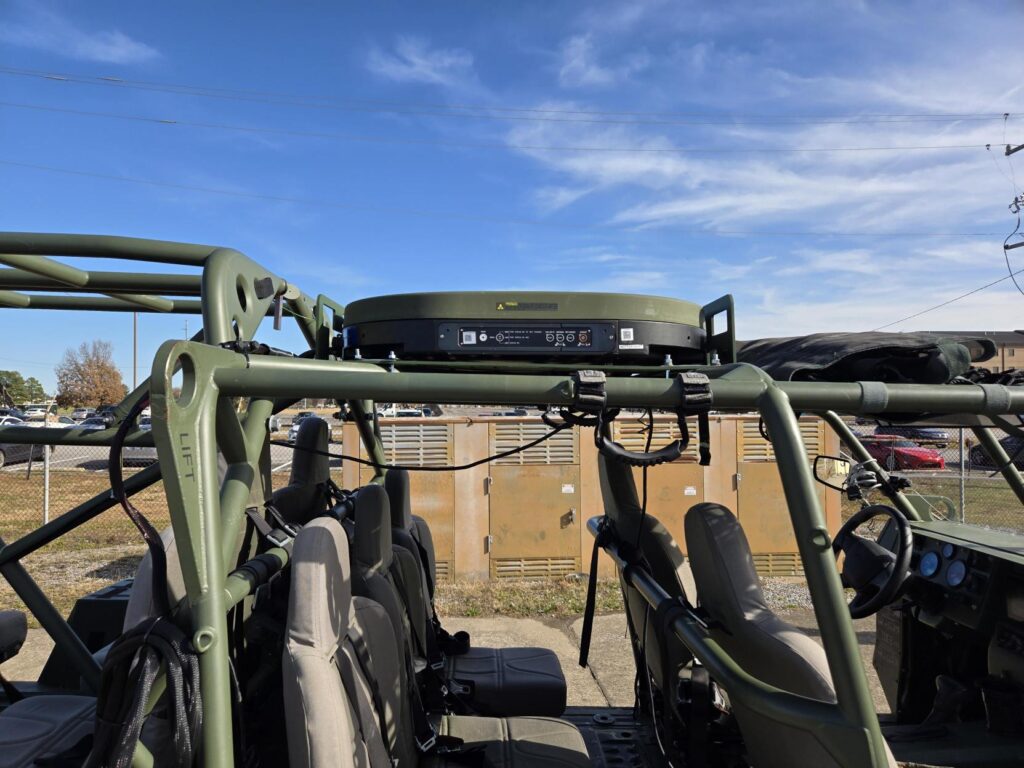
Kymeta added that the terminal’s energy efficiency gives it a significant advantage in mobile environments constrained by size, weight, and power (SWaP) limitations. Proprietary software-defined tracking algorithms allow for rapid signal acquisition even while on the move.
Concluding his remarks, Jackson stated:
“My military experience taught me how crucial resilient, secure communications are to mission success. In unpredictable and high-risk environments, downtime or exposure is not an option. The Army’s adoption of Osprey u8 makes it clear — network resiliency is no longer a luxury, it’s an operational necessity.”
