

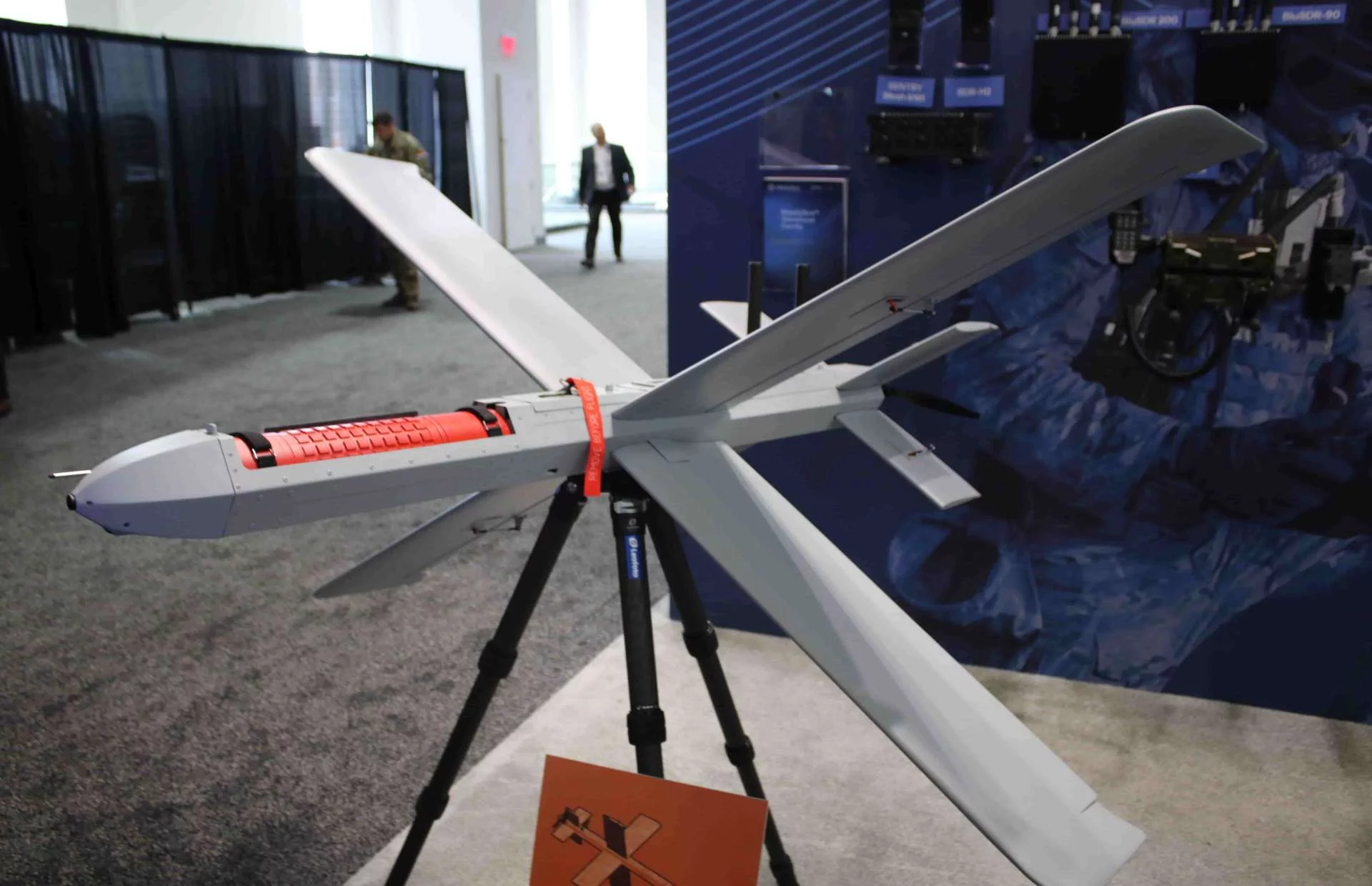
At AUSA 2025, Venator Technologies unveiled Flycat, a GPS-independent, X-wing loitering munition designed to combine loitering-weapon effects with automated, jam-resistant navigation. The electric, lightweight airframe—about a 12 kg takeoff weight—is aimed at light tactical teams that need affordable, precision attritable strike options when satellite navigation is unavailable.
Army Recognition documented the full-scale display in Washington, D.C., where the missile-shaped fuselage and distinctive X-wings showcased a modular warhead capability and a design intended to operate even under heavy GNSS denial. The demonstration highlighted a shift from battlefield improvisation toward export-ready product lines for attritable precision strike.
Manufacturer specs: Flycat’s X-wing airframe is GPS-independent, with a stated 40 km range and 40 minutes endurance; modular warheads of 2.5–3.6 kg; pneumatic catapult launch; and autonomous, EW-resilient target tracking. The fuselage dimensions are roughly 1,350 × 1,340 × 800 mm. Operational altitude ranges from 200 to 700 meters with a 1,000-meter ceiling. Minimum speed is 70 km/h, cruise around 85 km/h, and terminal dives reach up to 120 km/h. The pneumatic launcher and a 20-minute readiness posture make it suitable for dispersed units that must shoot-and-scoot.
Removing a conventional tail and shifting lift/control authority to the X-wing gives Flycat greater agility across axes compared with small fixed-wing drones—an advantage in terminal attacks on moving vehicles. Venator envisions Flycat operating solo or paired with a scout/recon vehicle that can act as a designator and communications relay. Crucially, Flycat uses intelligent navigation and communications modules instead of GPS, enabling route maintenance, autonomous target tracking, and terminal engagement even in intense jamming environments. Warhead options—high explosive, shaped charge (HEAT), and thermobaric in the 2.5–3.6 kg class—allow commanders to tailor effects for soft-skinned logistics, structural collapse, or personnel in defilade.
Flycat positions itself between disposable FPV quadcopters and larger, more expensive loitering munitions. A two-person team can set the catapult, program a route, and launch in minutes; the munition’s route-following and autonomous targeting let it hunt logistics vehicles, radar emitters, field artillery, or point defenses within a 40 km bubble. The electric motor reduces acoustic signature, while high-speed terminal dives complicate last-second countermeasures. Pairing with a scout extends line-of-sight communications across broken terrain, and GPS-independent navigation directly answers the dense jamming increasingly encountered at the front.
The debut coincides with the U.S. Army’s intensified push for massed, affordable unmanned strike options. AUSA 2025’s buffet of drone and counter-drone systems from primes and startups alike underscores accelerating procurement pressure for cheaper, attritable solutions. Conflict-driven innovation—especially from firms working with battlefield lessons out of Ukraine—has sped product development; Venator, after earlier European showings, is now courting Western partners in Washington. The throughline is plain: autonomous, jam-resistant loitering munitions are moving from a niche capability to a baseline requirement for land forces preparing for high-electronic-warfare environments.
