

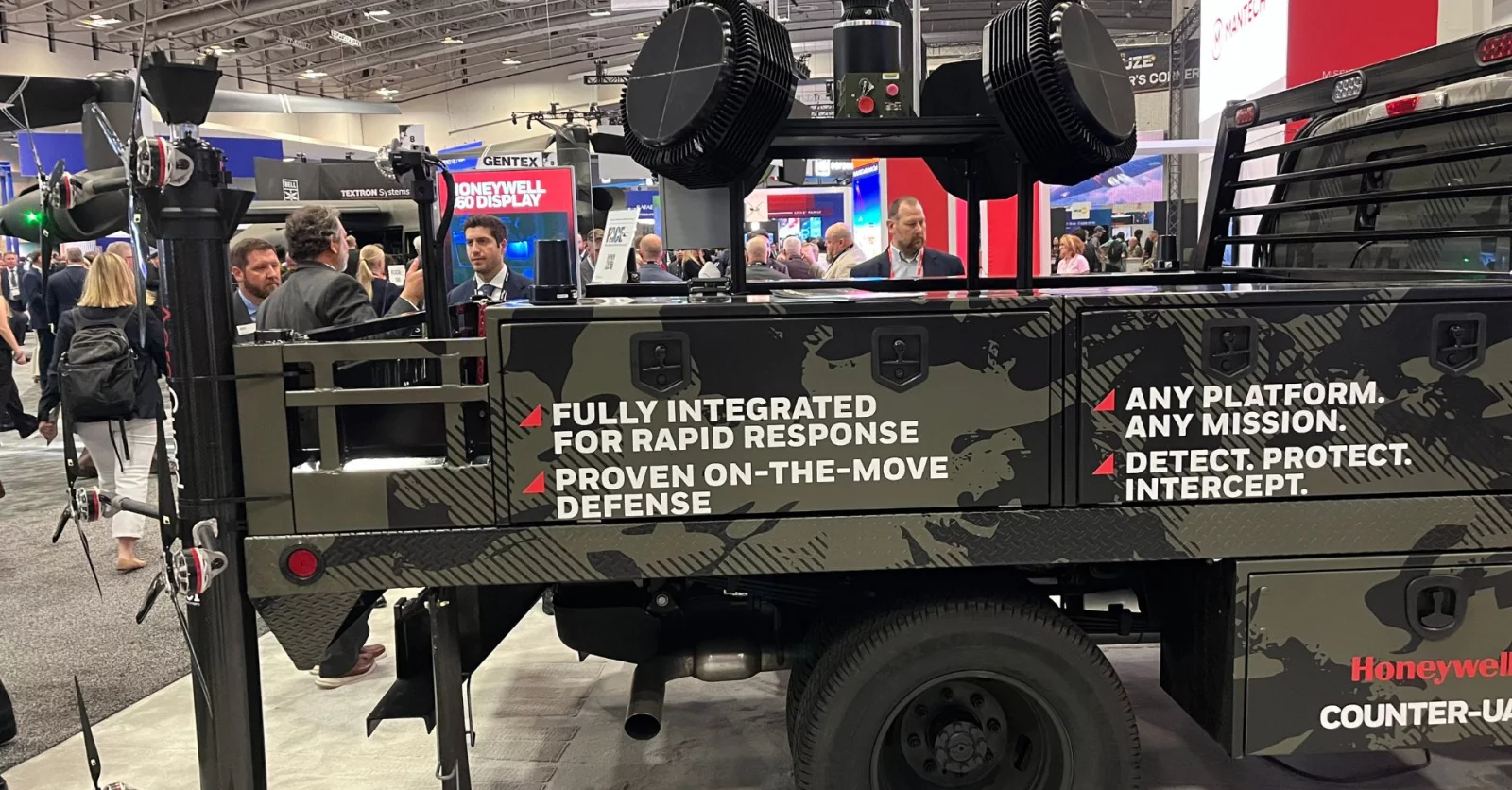
Honeywell unveiled its Stationary And Mobile UAS Reveal And Intercept system, SAMURAI, at AUSA 2025. Weeks earlier the company ran demonstrations for U.S. military operators, operating core elements from a ground vehicle and deploying sensors on an aerostat flown above 1,000 feet to showcase elevated sensing over cluttered terrain.
Open Architecture And Integration
Designed as a sensor- and effector-agnostic battle management layer, SAMURAI was developed using Model-Based Systems Engineering and aligns with MOSA principles. That open approach allows customers to integrate third-party detectors and effectors without disrupting command-and-control chains. The September trials combined components from multiple vendors under a single supervisory point to maintain coherent operations as threats evolve.
Technical Advantages
Three technical benefits stand out: using an aerostat at altitude changes detection geometry and buys critical seconds in multi-vector approaches; MOSA compliance shortens integration cycles for rapidly evolving commercial sensors and countermeasures; and fusing RF detection with electro-optical sensors improves target classification in dense urban and look-down scenarios.
Employment Scenarios
SAMURAI is positioned as a link in a layered air defense. Vehicle-mounted nodes can ride with convoys to provide early warning and cue jamming, RF takeover, or interceptors as rules of engagement require. On fixed sites, aerostat elevation extends horizon and hands tracks to existing effectors, enabling continuous coverage without wholesale system replacements.
Operational And Logistical Benefits
Because SAMURAI can reuse prior investments in sensors and jammers, it reduces logistical burden and avoids training disruptions. Its modular design supports gradual capability growth, letting forces densify defense layers without reconfiguring entire bases.
Strategic Implications
With low-cost UAS proliferating and swarm attacks becoming a regular threat, a deployable, modular battle manager that works with existing assets fills an urgent capability gap. Honeywell’s AUSA presentation positions SAMURAI as an interoperable, near-term solution for forces seeking rapid, exportable counter-UAS capacity.
