

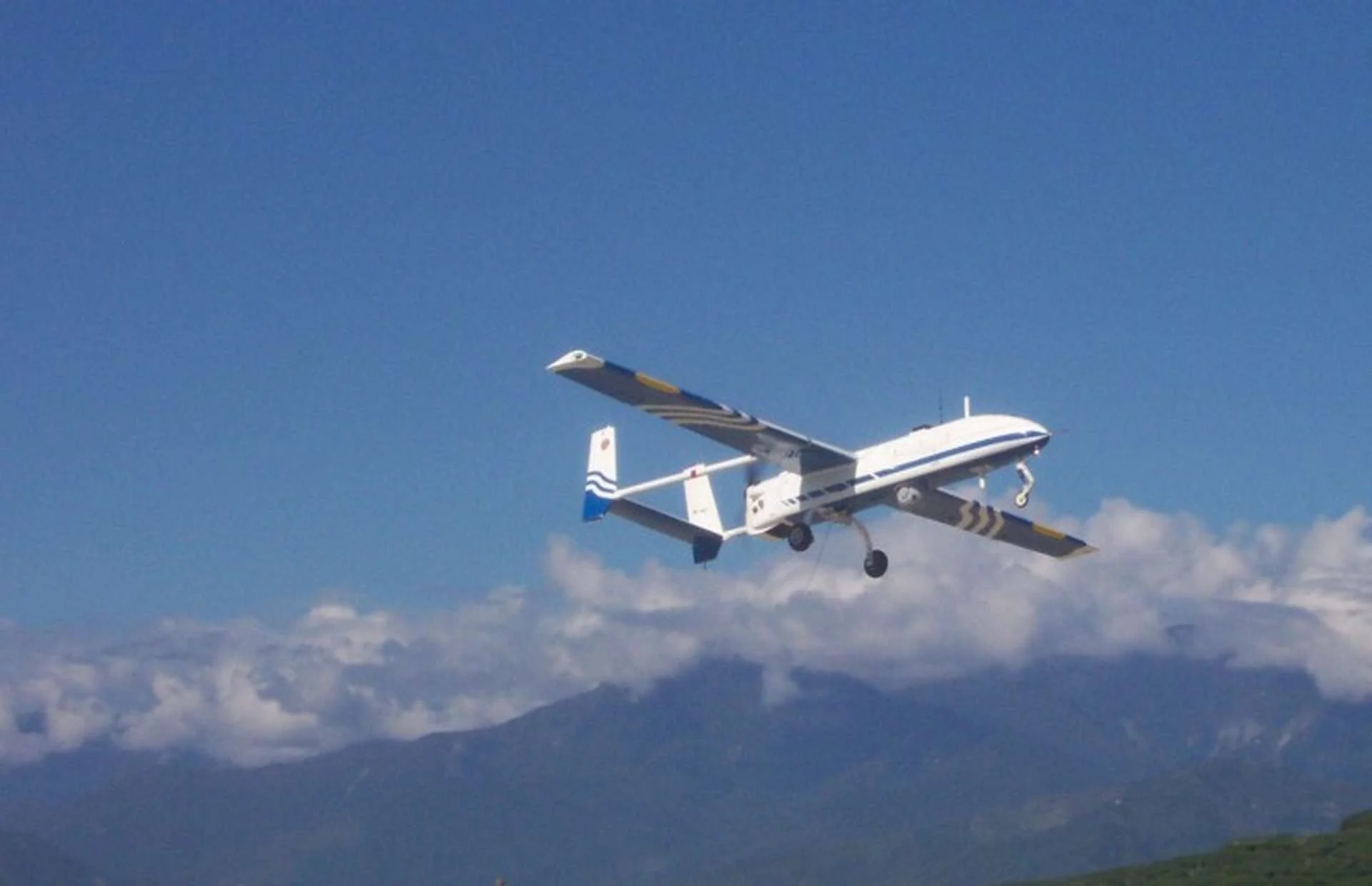
Taiwan’s Executive Yuan has approved a NT$44.2 billion (US$1.4 billion) initiative running through 2030 to boost domestic drone manufacturing, strengthen its defense industry, and position the island as a democratic hub for unmanned systems in Asia.
The plan combines new funding with existing budgets to expand industrial capacity, localize supply chains, and transition several drone platforms from prototype to serial production — underscoring Taipei’s growing reliance on UAVs as a cornerstone of its defense strategy.
Key systems under the program include the Teng Yun 2, Chien Hsiang, and Albatross II drones, which will enhance Taiwan’s surveillance, strike, and defense capabilities while reducing dependency on Chinese components amid intensifying pressure from the People’s Liberation Army.
The Teng Yun 2, a MALE-class UAV similar to the MQ-9 Reaper, features autonomous takeoff and landing, networked control, and real-time imaging. It offers around 24 hours of endurance, an operational ceiling near 25,000 feet, and a range exceeding 1,000 kilometers, giving Taiwan long-endurance ISR and precision-strike capacity from indigenous sources.
At the tactical level, the truck-launched Chien Hsiang loitering munition is designed to neutralize PLA air defenses. Its delta-wing, pusher-prop configuration allows it to home in on hostile emitters and execute coordinated swarm attacks on coastal and inland radar sites, reaching up to 1,000 kilometers.
For maritime domain awareness, the Albatross II expands the endurance and payload capabilities of its predecessor, integrating a synthetic aperture radar for wide-area sea surveillance — a crucial complement to Taiwan’s coastal missile batteries and naval patrols.
These systems are being integrated under the new T-Dome initiative, which seeks to connect air defense and counter-UAS networks, enhancing strike efficiency and protecting mobile assets from saturation attacks.
On the policy side, Taipei is pushing to eliminate Chinese-origin electronics from all military UAVs and mandate local assembly to reduce sabotage risks, maintain wartime sustainability, and open export opportunities with partners wary of PRC supply chains. With U.S. restrictions tightening on Chinese drones, Taiwan’s domestically produced, clean-origin UAVs could find new markets abroad.
Facing near-daily Chinese military incursions, encirclement drills, and naval patrols, Taiwan is investing heavily in asymmetric technologies that complicate PLA operations — and the new drone initiative stands as a key pillar of that defensive transformation.
