

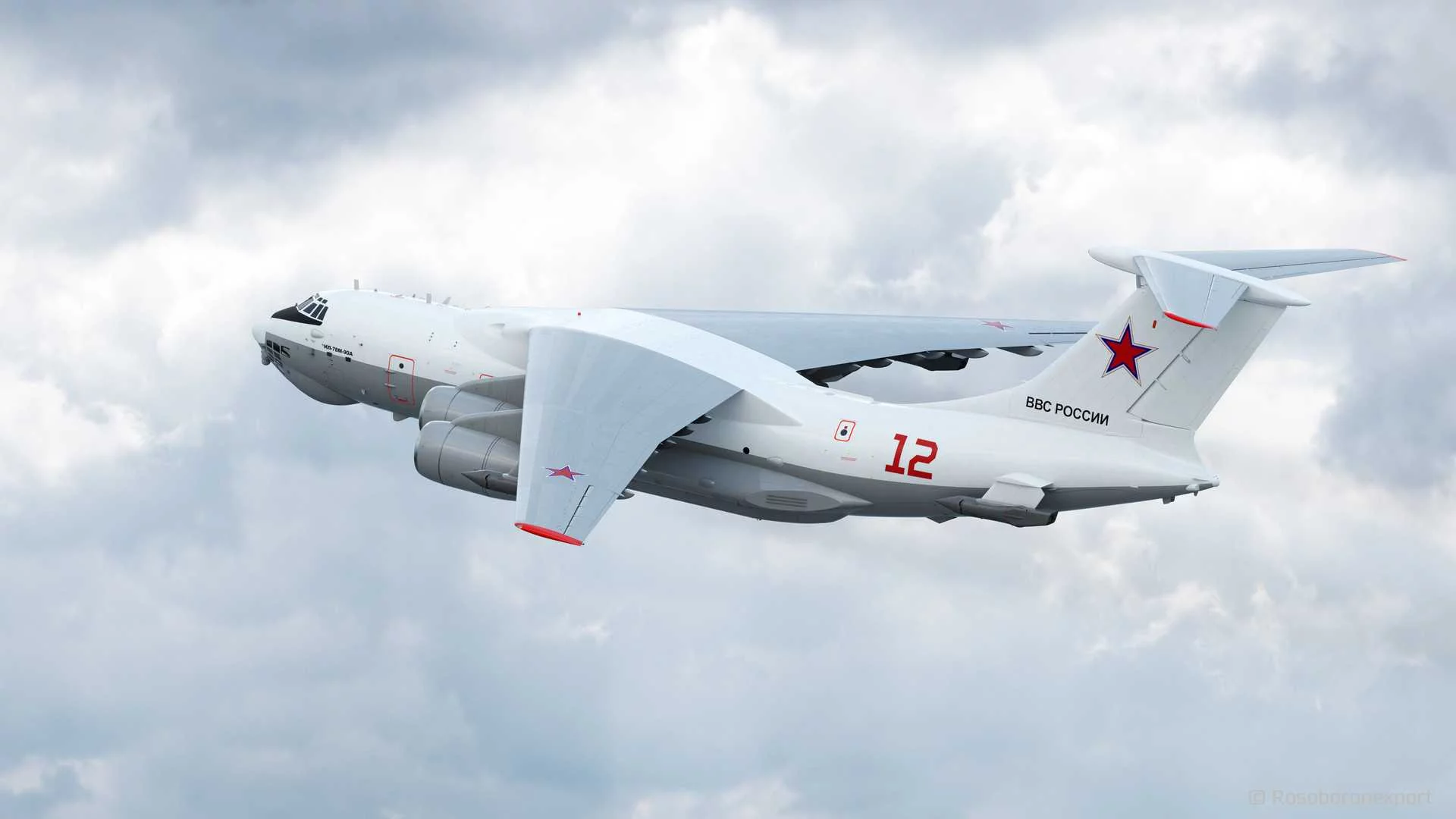
According to a leaked document from the Russian defense industry, China intends to acquire 20 Il-78MK-90A aerial refueling aircraft from Russia, with deliveries scheduled between 2027 and 2028. The deal would significantly strengthen the People’s Liberation Army Air Force’s (PLAAF) limited tanker fleet.
The Il-78MK-90A, built at the Aviastar-SP plant in Ulyanovsk and derived from the Il-76MD-90A transport aircraft, is powered by four PS-90A-76 turbofan engines. The aircraft can reach 800 km/h, conduct refueling operations between 450–600 km/h, and transfer up to 78 tons of fuel at a distance of 1,000 kilometers. It is capable of refueling either one heavy aircraft or two tactical aircraft simultaneously in flight, and up to four aircraft on the ground. Within hours, it can be reconfigured for cargo, vehicle, or troop transport missions.
Identified as “Customer 156” in the leaked document, China’s order would substantially expand its long-range operational reach and support aircraft such as the J-16, J-20, J-35, and H-6K. The acquisition would also bridge the gap until domestic YY-20 (Y-20U) production reaches sufficient numbers.
Currently, the PLAAF operates only a handful of Il-78s obtained from Ukraine between 2014 and 2016, along with a small number of converted Y-20-based tankers. As production of the YY-20 accelerates, additional heavy refuelers like the Il-78MK-90A are needed to support extended missions across the Taiwan Strait, South China Sea, and Western Pacific.
The Il-78MK-90A uses three UPAZ-1M refueling pods, two mounted under the wings and one on the tail, each capable of transferring up to 3,000 liters per minute. A digital BAI control unit allows automated software-based adjustments for safer and more precise refueling operations. The cockpit features a modern “glass” layout with eight multifunction LCD displays and the Kupol-III-76M flight management system, enabling day-and-night, all-weather missions.
The aircraft’s maximum takeoff weight is 210,000 kilograms, and its range extends up to 7,300 kilometers. In its transport role, it can carry 52–60 tons of cargo and up to 225 personnel, depending on configuration. With its modular layout, it can transition rapidly between tanker and transport configurations without specialized facilities.
If finalized, this procurement will serve as a major interim capability boost for the PLAAF, enhancing China’s ability to sustain long-range air operations until a sufficient fleet of indigenous YY-20 tankers is in full service.
