

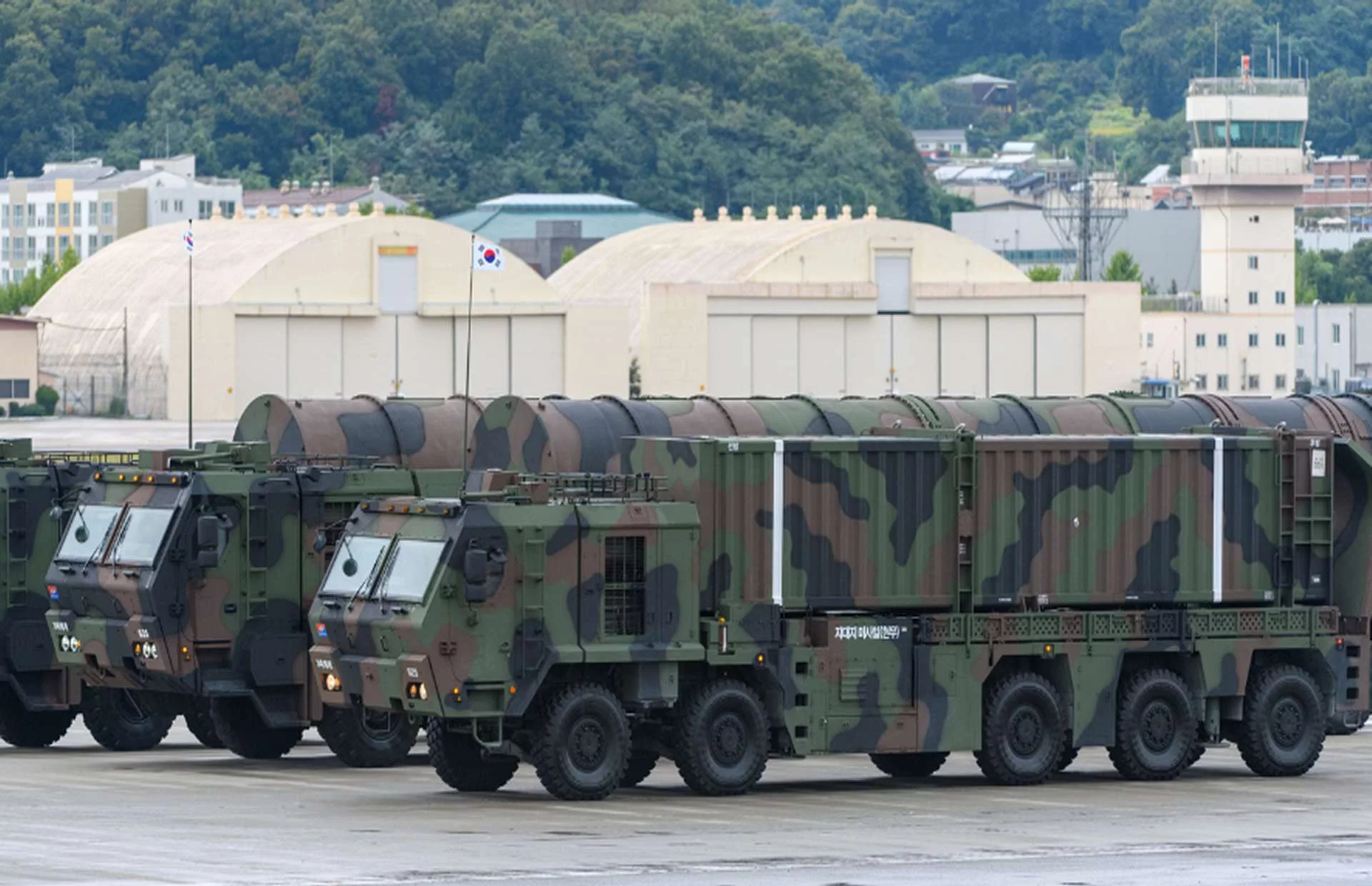
South Korea will begin fielding its Hyunmoo 5 heavy conventional ballistic missile at the end of 2025, with mass production already in progress, Defense Minister Ahn Gyu‑back told Yonhap. The road‑mobile, two‑stage solid‑propellant missile carries an approximately eight‑ton penetrator and is intended to provide Seoul with a non‑nuclear means of deterring deeply buried targets.
Public parade footage and official descriptions revealed a large, nine‑axle transporter‑erector‑launcher (TEL) configuration for the weapon. Open estimates put the missile’s all‑up weight near 36 tonnes with dimensions around 16 meters in length and about 1.6 meters in diameter. That size—paired with a two‑stage solid motor and heavy warhead—reflects a design optimized for brute‑force penetration of reinforced, rock‑buried facilities.
Analysts believe the Hyunmoo 5’s earth‑penetrating warhead can crater and destroy command bunkers buried more than 100 meters underground. A lofted trajectory and high terminal velocity convert mass and speed into shock, shear and spall effects to defeat deep hardening. While Seoul has not published a circular error probable, the weapon’s role implies a guidance package tuned for precision strikes against fixed coordinates.
Lawmakers note that with a lighter, roughly one‑ton payload the airframe’s potential range extends beyond 5,000 km, whereas the full eight‑ton penetrator reduces practical range into the hundreds to low thousands of kilometers. For operations on the peninsula, the primary requirement is not intercontinental reach but the assured defeat of hardened nodes inside North Korea. The TEL’s off‑road mobility and shoot‑and‑scoot profile improve survivability and complicate enemy targeting. Solid propellant and sealed canisters support rapid launch timelines and resilience in cold conditions.
Hyunmoo 5 is assigned to the third pillar of Seoul’s Korea Massive Punishment and Retaliation (KMPR) architecture, intended to neutralize leadership and command systems after any major attack. Complementing pre‑emptive concepts and missile defense, the missile gives commanders a conventional bunker‑busting option to respond to nuclear coercion without resorting to nuclear weapons. Its combination of mobility and deep‑penetration physics makes it a robust tool against attempts to hide key capabilities underground.
The deployment schedule follows recent North Korean displays—most notably the Hwasong‑20 ICBM—and grows amid concern about potential foreign assistance to Pyongyang. Seoul is simultaneously restructuring strike, defense and special operations under a Strategic Command and debating wartime operational control conditionality. With defense spending rising toward a 3.5 percent of GDP target, a mass‑produced, survivable, conventional penalty option is viewed as essential rather than redundant.
